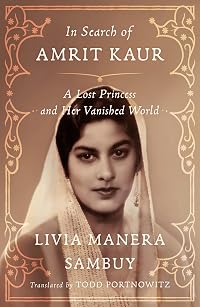
In Search of Amrit Kaur: A Lost Princess and Her Vanished World
by Livia Manera Sambuy
On This Page
Description
As she builds her own life anew, an Italian writer embarks on an all-consuming search for the true story of the mysterious princess H. H. Amrit Kaur of Mandi.On a sweltering day in 2007, having just lost her brother to illness, Livia Manera Sambuy finds herself at a museum in Mumbai, enthralled by a 1924 photograph of a stunningly elegant Indian princess. What she reads in the picture's caption will change her life forever. This alluring Punjabi royal had supposedly sold her jewels in show more occupied Paris to save Jewish lives, only to be arrested by the Gestapo and sent to a concentration camp, where she died within a year.
Could it be true? And if so, how could such a sensational story have gone unreported? Almost against her will, Manera becomes drawn into the mystery. Delving into the history of the British Raj, its durbars and society balls and jubilees, she shows us the precipitous decline of India's royal caste. The lives of extraordinary figures such as the Maharaja Jagatjit Singh of Kapurthala, the Jewish banker Albert Kahn, and the Russian explorer Nicholas Roerich?all in a decades-long pursuit of the elusive Amrit Kaur.
When she rendezvouses with the princess's eighty-year-old daughter, Sambuy's search takes on a new dimension, as she strives to reconnect an orphan with the mother who abandoned her in 1933, leaving behind her two children, her raja husband, and a legacy of activism in India's women's civil rights movement.
In Search of Amrit Kaur is an engrossing detective story, a kaleidoscopic history lesson, and a moving portrait of women, across the century, seeking personal freedom.
. show less
Tags
Recommendations































Member Reviews
Amrit Kaur was the wife of the ruler of the princely state of Mandi during the early 20th century. Beautiful and wealthy, she moved in elite circles in India and Europe before leaving her family in the 1930s and moving to Paris. During the war, she spent time in a Nazi internment camp at Besançon, accused of complicity in helping Jews escape persecution. Although her family was able to secure her release, her health was broken by her experiences and she died in London in the late 1940s.
This is basically what Livia Manera Sambuy knows about Amrit Kaur at the beginning of her book, and it's largely what she knows about her at the end. Hence, I suppose, the title: the fact that this is called In Search of Amrit Kaur should perhaps clue us show more in from the beginning that Sambuy was working with a fragmentary source base long after most people who personally knew Amrit had died, and that much of what she was going to find were dead ends. I sympathise with that predicament of the historian!
Yet this was a deeply frustrating read in that, at least based on what Sambuy tells us about her research process/methods here, she was unfocused and unsystematic in her work. I'm not at all satisfied, based on what we're presented with here, that there aren't more sources out there about Amrit that went unplumbed. The book as a whole is unfocused and badly structured, full of endless digressions about things which sometimes provide context for Amrit's life and times and sometimes don't—I'm sorry, but I don't really care about the history of the trade in precious gems, or the cricketing career of her grandson, or the details of the '70s burlesque career or education history of a Californian woman who by chance came into possession of some of Amrit's belongings. (Or at least, I might, but not when they're getting in the way of what I picked this book up for. Well, no, I'd never be interested in the cricket.)
I would have ploughed on through this and called it an uninspired but okay read, though, if not for what happened about 75% of the way through the book, when Sambuy revealsthat a cache of materials she finds in a suitcase which had once belonged to Amrit shows that the reason why she left her family was because she entered into a long-term relationship with a wealthy American widow—and then proceeds to do absolutely nothing with this revelation. If I was writing about this topic, I'd start with the suitcase and use it to build out Amrit's world and contextualise her as a queer Indian woman in this period—not spend pages and pages writing about her jewels (the least interesting part of her history) and then gloss over her sexuality with a sentence or two about how aristocrats at the time just accepted lesbian relationships, unlike the petty bourgeoisie! What?
Maybe one day Amrit Kaur will get a biography which doe her justice—but this book isn't it. show less
This is basically what Livia Manera Sambuy knows about Amrit Kaur at the beginning of her book, and it's largely what she knows about her at the end. Hence, I suppose, the title: the fact that this is called In Search of Amrit Kaur should perhaps clue us show more in from the beginning that Sambuy was working with a fragmentary source base long after most people who personally knew Amrit had died, and that much of what she was going to find were dead ends. I sympathise with that predicament of the historian!
Yet this was a deeply frustrating read in that, at least based on what Sambuy tells us about her research process/methods here, she was unfocused and unsystematic in her work. I'm not at all satisfied, based on what we're presented with here, that there aren't more sources out there about Amrit that went unplumbed. The book as a whole is unfocused and badly structured, full of endless digressions about things which sometimes provide context for Amrit's life and times and sometimes don't—I'm sorry, but I don't really care about the history of the trade in precious gems, or the cricketing career of her grandson, or the details of the '70s burlesque career or education history of a Californian woman who by chance came into possession of some of Amrit's belongings. (Or at least, I might, but not when they're getting in the way of what I picked this book up for. Well, no, I'd never be interested in the cricket.)
I would have ploughed on through this and called it an uninspired but okay read, though, if not for what happened about 75% of the way through the book, when Sambuy reveals
Maybe one day Amrit Kaur will get a biography which doe her justice—but this book isn't it. show less
The premise of the story is fascinating: an Indian princess, a WWII Gestapo arrest, lost jewels. Amrit Kaur was the daughter of the last Maharajah of Kapurthala. She was married off to a man she didn't love, and eventually fled that life and existence. It was alleged that she used her jewels to help Jews during WWII.
The author first came face to face with Amrit Kaur during a photograph exhibition, which featured a picture of the Indian princess. The picture launched an obsession and the author was determined to find out everything she could about the woman. However, this woman turned out to be elusive. There were frustrating gaps in documentation about her.
What we have here is everything the author found out about Amrit Kaur. show more Admittedly, that isn't very much. There are still so many questions that need answering. To make the book fuller, the author set Amrit Kaur's life against the background of things that were happening during the time.
A good read, but I was left feeling that it was incomplete. show less
The author first came face to face with Amrit Kaur during a photograph exhibition, which featured a picture of the Indian princess. The picture launched an obsession and the author was determined to find out everything she could about the woman. However, this woman turned out to be elusive. There were frustrating gaps in documentation about her.
What we have here is everything the author found out about Amrit Kaur. show more Admittedly, that isn't very much. There are still so many questions that need answering. To make the book fuller, the author set Amrit Kaur's life against the background of things that were happening during the time.
A good read, but I was left feeling that it was incomplete. show less
Excerpt from a longer article:
Timely Take-aways for life-long Learners: Strong Women Around the World
From a planetary scientist to a pirate’s wife, several new autobiographies and biographies explore the lives of lesser-known women through history. Whether using her position as first lady to support educational projects or solving crimes on the high seas, these nontraditional women left powerful legacies.
...In Search of Amrit Kaur: A Lost Princess and Her Vanished World
Livia Manera Sambuy, Mar 2023, Farrar, Straus and Giroux, Macmillan
Themes: Biography, World History, Women
Livia Manera Sambuy traces the forgotten story of H. H. Amrit Kaur of Mandi, a woman who left her family for personal freedom and spoke out for women’s show more rights.
Take-aways: Teachers are always looking for less-known stories and perspectives.
...
Whether helping educators keep up-to-date in their subject-areas, promoting student reading in the content-areas, or simply encouraging nonfiction leisure reading, teacher librarians need to be aware of the best new titles across the curriculum and how to activate life-long learning. - Annette Lamb show less
Timely Take-aways for life-long Learners: Strong Women Around the World
From a planetary scientist to a pirate’s wife, several new autobiographies and biographies explore the lives of lesser-known women through history. Whether using her position as first lady to support educational projects or solving crimes on the high seas, these nontraditional women left powerful legacies.
...In Search of Amrit Kaur: A Lost Princess and Her Vanished World
Livia Manera Sambuy, Mar 2023, Farrar, Straus and Giroux, Macmillan
Themes: Biography, World History, Women
Livia Manera Sambuy traces the forgotten story of H. H. Amrit Kaur of Mandi, a woman who left her family for personal freedom and spoke out for women’s show more rights.
Take-aways: Teachers are always looking for less-known stories and perspectives.
...
Whether helping educators keep up-to-date in their subject-areas, promoting student reading in the content-areas, or simply encouraging nonfiction leisure reading, teacher librarians need to be aware of the best new titles across the curriculum and how to activate life-long learning. - Annette Lamb show less
Members
- Recently Added By
Lists

History: Asia
103 works; 1 member
Author Information
2 Works 35 Members
Common Knowledge
- People/Characters
- Amrit Kaur
- Important places
- India; Mandi, Himachal Pradesh, India
Classifications
- Genres
- Nonfiction, Biography & Memoir, History, Sexuality and Gender Studies, General Nonfiction
- DDC/MDS
- 954.03 — History & geography History of Asia India 1785–1947 British rule
- LCC
- G2023 — Geography, Anthropology and Recreation Atlases By region or country Eastern Hemisphere. Eurasia, Africa, etc. Europe
- BISAC
Statistics
- Members
- 33
- Popularity
- 838,338
- Reviews
- 3
- Rating
- (2.88)
- Languages
- English
- Media
- Paper, Audiobook, Ebook
- ISBNs
- 5
- ASINs
- 1