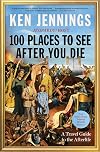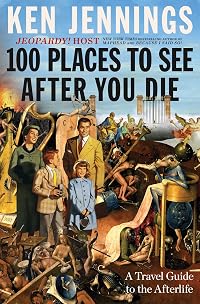
100 Places to See After You Die: A Travel Guide to the Afterlife
by Ken Jennings
On This Page
Description
"100 Places to See After You Die is written in the style of iconic bestselling travel guides. But instead of recommending must-see destinations in Mexico, Thailand, or Rome, this book outlines journeys through the afterlife, as dreamed up over the past 5,000 years of human history by our greatest prophets, poets, mystics, artists, and TV showrunners. Where's the best place to grab a bite to eat in the ancient Egyptian underworld? Which circles of Dante's Inferno have the nicest show more accommodations? How does one dress like a local in the heavenly palace of Hinduism's Lord Vishnu, or avoid the flesh-eating river serpents in the Klingon afterlife? What are the hidden treasures to be found off the beaten path in Hades, Valhalla, or NBC's The Good Place? This book answers all those questions and more about the world(s) to come. The destiny of the human soul in the great beyond is one of life's deepest mysteries. But you won't have to wonder anymore! 100 Places to See After You Die comprehensively indexes one hundred different afterlife destinations, exhaustively researched from sources ranging from the Epic of Gilgamesh to modern-day pop songs, video games, and Simpsons episodes. Be ready for whatever post-mortal destiny awaits, whether you're hoping for the astral plane, a Hieronymus Bosch hellscape, or the baseball diamond from Field of Dreams. This is one trip no one should leave to chance. Most vacation sojourns are brief, but this destination could be your eternal resting place!"-- show lessTags
Recommendations




Member Reviews
That was the one thing the world’s oldest civilization had figured out about death: that it was extremely permanent.
from 100 Places to See After You Die by Ken Jennings
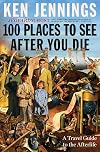
Okay, just seeing this book cover made me laugh and I had to get inside it. And, it’s by Jeopardy champ and host Ken Jennings.
It is a book best taken in bites, because, after all, how much time do you really want to spend in places where people are subjected to endless pain and suffering? Like the Inuit’s Adlivun where you meet Sedna’s old man who will pull you under a bearskin rug and torment you for a year. Or the Chinese Diyu, a purgatory where you might be sawed in half. Or worst of all, observe your home town that has happily forgotten you.
Sure, there is the show more opportunity to get to some really nice places, where you are assured a good hunt at the other end of the Milky Way path to the heavens. Your dog even has his own route there. If you are one of the lucky 144,000, the Jehovah’s Witnesses believe you will govern heaven next to Jesus. Swedenborg had visions of communities for the good and the bad; nice parks and gardens for some, shantytowns and thieves for others.
Jennings has scoured sources of all kind–of course mythology and religion but also literature and art and comic books and video games and D&D and movies and television like The Good Place, which my husband and I absolutely loved.
Humanity has imagined a multitude of possible afterlives, but most seem to involve the same dichotomy: we will be punished for our sins or rewarded for good behavior–or after we atone for our sins.
So, as Pascal posited in his wager, it’s better to err on the safe side, and you’d better be good.
I received a free egalley from the publisher through NetGalley. My review is fair and unbiased. show less
from 100 Places to See After You Die by Ken Jennings
Okay, just seeing this book cover made me laugh and I had to get inside it. And, it’s by Jeopardy champ and host Ken Jennings.
It is a book best taken in bites, because, after all, how much time do you really want to spend in places where people are subjected to endless pain and suffering? Like the Inuit’s Adlivun where you meet Sedna’s old man who will pull you under a bearskin rug and torment you for a year. Or the Chinese Diyu, a purgatory where you might be sawed in half. Or worst of all, observe your home town that has happily forgotten you.
Sure, there is the show more opportunity to get to some really nice places, where you are assured a good hunt at the other end of the Milky Way path to the heavens. Your dog even has his own route there. If you are one of the lucky 144,000, the Jehovah’s Witnesses believe you will govern heaven next to Jesus. Swedenborg had visions of communities for the good and the bad; nice parks and gardens for some, shantytowns and thieves for others.
Jennings has scoured sources of all kind–of course mythology and religion but also literature and art and comic books and video games and D&D and movies and television like The Good Place, which my husband and I absolutely loved.
Humanity has imagined a multitude of possible afterlives, but most seem to involve the same dichotomy: we will be punished for our sins or rewarded for good behavior–or after we atone for our sins.
So, as Pascal posited in his wager, it’s better to err on the safe side, and you’d better be good.
I received a free egalley from the publisher through NetGalley. My review is fair and unbiased. show less
This originally appeared at The Irresponsible Reader.
---
WHAT'S 100 PLACES TO SEE AFTER YOU DIE ABOUT?
Ken Jennings provides a handy tour guide through one hundred visions of the afterlife for the modern reader. Complete with tips on places to see, areas to avoid, local lingo, bits of trivia, dining tips, and so on, it's just the kind of thing you're going to want to peruse before you shuffle off this mortal coil, so you know where to go.
The book is broken down into: Mythology, Religion, Books, Movies, Music and Theater, and Miscellaneous. Then (alphabetically) Jennings looks at a variety of afterlife locales in each category.
For example, the Books section covers:
Aslan’s Country • The Bridge • The Cemetery • The Empyrean • The show more Five Lessons • Half-Life • The Inbetween • Inferno • The Kingdom • King’s Cross • Mansoul • The Null • Pandemonium • Paradiso • The Parish • Purgatorio • Riverworld • The Third Sphere • The Time Bubble • The Undying Lands • The Valley of the Shadow of Life*
* From Lewis' The Chronicles of Narnia and The Great Divorce; O'Connor's story "Revelation"; Saunders' Lincoln in the Bardo; Milton's Paradise Lost; Albom's The Five People You Meet in Heaven; Dick's Ubik; Sebold's The Lovely Bones; Dante's The Divine Comedy; Twain's "Captain Stormfield's Visit to Heaven"; Rowling's Harry Potter; Moore's Jerusalem; King's Revival; O'Brien/O'Nolan's The Third Policeman; Farmer's Riverworld; Matheson's What Dreams May Come; Oliver's The Time Bubble; and Tolkien's The Lord of the Rings.
Jennings describes each place with wit, humor, Dad Jokes, puns, irreverence, and plenty of facts.
DANCING THROUGH A MINEFIELD
It's one thing to talk about places like Valhalla, Hades, The Bad Place, Bill & Ted's Bogus destination, or Futurama's Robot Hell in a light-hearted or flippant fashion. It's an entirely different can of worms to discuss the LDS Three Kingdoms of Glory, Jannah, Jahannam, Ariel Toll Houses/Telonia, and so on—in the same tone.
I will not say that Jennings was able to fully succeed in discussing the afterlives described in some major religions in an unoffensive manner. Primarily because I'm not an adherent of any of the religions he discussed, so my tolerance for that is really high. Had he tackled something I believe in, I very well could've been at risk of insult.
That said, I think he did okay. Yes, he walks close to irreverent. But he maintains a decent degree of respect. The humor largely comes from the way he describes the beliefs not at the expense of an article of faith.
Still, some people might want to skip over a chapter or two if they're worried about getting their toes stepped on. (but those people probably aren't going to be reading this book in the first place)
A FEW HIGHLIGHTS
Ohhh, there are just so many.
The Books section was my favorite—followed closely by Movies and Television—this is the kind of thing I blog about, think about, and so on, so it makes sense that those sections resonated with me most. The Books section, in particular, discussed portions of those works in ways I could really sink my teeth into.
But there were multiple highlights in each section—I learned a lot about D&D, I couldn't help singing "Ghost Riders in the Sky" during that chapter, I think he pointed out a good plot hole in It's a Wonderful Life (I don't know, maybe he's not the first), I loved the discussion of Bosch's paintings, and so on.
The chapter on The Good Life was fantastic—a great systemization of the series' take on the afterlife (and several characters). The chapter on Nirvana was sublime.
Books, movies, mythologies, songs, etc. that I've never heard of, much less, read/watched/listened to/studied were described in enough detail that I could appreciate those chapters and maybe even develop an interest in following up on.
PROBLEMS/QUIBBLES/THINGS THAT DIDN'T WORK FOR ME
Um. Hold on, I'll think of something.
...
...
oh! Here's a problem: the eARC came with the typical "don't quote from this version until verified by the published edition" warning—but it was more pronounced than usual. I really want to use samples throughout this post, but I can't. (and I wouldn't have even without this warning, because I know things get tweaked in the final stages).
Actually, I do have a legitimate gripe. There are no footnotes—or even endnotes*—for anything that Jennings says. Most of what the book contains could fall into the category of "General Knowledge" (at least for people who know anything about The Good Place, Dante, or the religion of the Maori). But I wouldn't have minded a point in the right direction to learn some more details, context, or background on many, many, many things Jennings wrote about.
* It's been decades since I haven't asked why a book uses endnotes when footnotes exist, and yet I'd have liked to have them in this book more than the nothing we got. That's how much this bothers me.
I CAN'T HELP PONDERING...
Given the argument of Planet Funny: How Comedy Took Over Our Culture by Ken Jennings, I wonder about his approach to the subject of the afterlife. Sure, even Planet Funny was frequently funny as it critiqued the overuse of humor in our culture, but for his next book to take this tone, seems to undercut the work.
Or maybe it just shows that even as he can look with clear eyes at some of the weaknesses of our culture, he's part of it and is subject to the influences. It's almost like he's human.
SO, WHAT DID I THINK ABOUT 100 PLACES TO SEE AFTER YOU DIE?
This section is going to be shorter than usual because I think I've pretty much answered the question already.
From the "throwaway lines" to the big ideas, this was a delight from start to finish. I thoroughly enjoyed this approach to the subjects—quick hits that tell you the essentials and make you smile while telling them.
Jennings' style is one I aspire to, and can't say enough good things about.
I can't think of a reason not to give this 5 Stars, but my gut tells me not to. So I'll knock it down to 4 1/2 (which isn't a big deal since Goodreads, NetGalley, etc. won't let me use 1/2 stars, I'll round up). It's educational, it's entertaining, and it's thought-provoking. You can't go wrong with this. show less
---
WHAT'S 100 PLACES TO SEE AFTER YOU DIE ABOUT?
Ken Jennings provides a handy tour guide through one hundred visions of the afterlife for the modern reader. Complete with tips on places to see, areas to avoid, local lingo, bits of trivia, dining tips, and so on, it's just the kind of thing you're going to want to peruse before you shuffle off this mortal coil, so you know where to go.
The book is broken down into: Mythology, Religion, Books, Movies, Music and Theater, and Miscellaneous. Then (alphabetically) Jennings looks at a variety of afterlife locales in each category.
For example, the Books section covers:
Aslan’s Country • The Bridge • The Cemetery • The Empyrean • The show more Five Lessons • Half-Life • The Inbetween • Inferno • The Kingdom • King’s Cross • Mansoul • The Null • Pandemonium • Paradiso • The Parish • Purgatorio • Riverworld • The Third Sphere • The Time Bubble • The Undying Lands • The Valley of the Shadow of Life*
* From Lewis' The Chronicles of Narnia and The Great Divorce; O'Connor's story "Revelation"; Saunders' Lincoln in the Bardo; Milton's Paradise Lost; Albom's The Five People You Meet in Heaven; Dick's Ubik; Sebold's The Lovely Bones; Dante's The Divine Comedy; Twain's "Captain Stormfield's Visit to Heaven"; Rowling's Harry Potter; Moore's Jerusalem; King's Revival; O'Brien/O'Nolan's The Third Policeman; Farmer's Riverworld; Matheson's What Dreams May Come; Oliver's The Time Bubble; and Tolkien's The Lord of the Rings.
Jennings describes each place with wit, humor, Dad Jokes, puns, irreverence, and plenty of facts.
DANCING THROUGH A MINEFIELD
It's one thing to talk about places like Valhalla, Hades, The Bad Place, Bill & Ted's Bogus destination, or Futurama's Robot Hell in a light-hearted or flippant fashion. It's an entirely different can of worms to discuss the LDS Three Kingdoms of Glory, Jannah, Jahannam, Ariel Toll Houses/Telonia, and so on—in the same tone.
I will not say that Jennings was able to fully succeed in discussing the afterlives described in some major religions in an unoffensive manner. Primarily because I'm not an adherent of any of the religions he discussed, so my tolerance for that is really high. Had he tackled something I believe in, I very well could've been at risk of insult.
That said, I think he did okay. Yes, he walks close to irreverent. But he maintains a decent degree of respect. The humor largely comes from the way he describes the beliefs not at the expense of an article of faith.
Still, some people might want to skip over a chapter or two if they're worried about getting their toes stepped on. (but those people probably aren't going to be reading this book in the first place)
A FEW HIGHLIGHTS
Ohhh, there are just so many.
The Books section was my favorite—followed closely by Movies and Television—this is the kind of thing I blog about, think about, and so on, so it makes sense that those sections resonated with me most. The Books section, in particular, discussed portions of those works in ways I could really sink my teeth into.
But there were multiple highlights in each section—I learned a lot about D&D, I couldn't help singing "Ghost Riders in the Sky" during that chapter, I think he pointed out a good plot hole in It's a Wonderful Life (I don't know, maybe he's not the first), I loved the discussion of Bosch's paintings, and so on.
The chapter on The Good Life was fantastic—a great systemization of the series' take on the afterlife (and several characters). The chapter on Nirvana was sublime.
Books, movies, mythologies, songs, etc. that I've never heard of, much less, read/watched/listened to/studied were described in enough detail that I could appreciate those chapters and maybe even develop an interest in following up on.
PROBLEMS/QUIBBLES/THINGS THAT DIDN'T WORK FOR ME
Um. Hold on, I'll think of something.
...
...
oh! Here's a problem: the eARC came with the typical "don't quote from this version until verified by the published edition" warning—but it was more pronounced than usual. I really want to use samples throughout this post, but I can't. (and I wouldn't have even without this warning, because I know things get tweaked in the final stages).
Actually, I do have a legitimate gripe. There are no footnotes—or even endnotes*—for anything that Jennings says. Most of what the book contains could fall into the category of "General Knowledge" (at least for people who know anything about The Good Place, Dante, or the religion of the Maori). But I wouldn't have minded a point in the right direction to learn some more details, context, or background on many, many, many things Jennings wrote about.
* It's been decades since I haven't asked why a book uses endnotes when footnotes exist, and yet I'd have liked to have them in this book more than the nothing we got. That's how much this bothers me.
I CAN'T HELP PONDERING...
Given the argument of Planet Funny: How Comedy Took Over Our Culture by Ken Jennings, I wonder about his approach to the subject of the afterlife. Sure, even Planet Funny was frequently funny as it critiqued the overuse of humor in our culture, but for his next book to take this tone, seems to undercut the work.
Or maybe it just shows that even as he can look with clear eyes at some of the weaknesses of our culture, he's part of it and is subject to the influences. It's almost like he's human.
SO, WHAT DID I THINK ABOUT 100 PLACES TO SEE AFTER YOU DIE?
This section is going to be shorter than usual because I think I've pretty much answered the question already.
From the "throwaway lines" to the big ideas, this was a delight from start to finish. I thoroughly enjoyed this approach to the subjects—quick hits that tell you the essentials and make you smile while telling them.
Jennings' style is one I aspire to, and can't say enough good things about.
I can't think of a reason not to give this 5 Stars, but my gut tells me not to. So I'll knock it down to 4 1/2 (which isn't a big deal since Goodreads, NetGalley, etc. won't let me use 1/2 stars, I'll round up). It's educational, it's entertaining, and it's thought-provoking. You can't go wrong with this. show less
I received an advance copy via NetGalley.
Jennings’s new release is an inventive, diverse tour guide to the afterlife, ranging from world religions to The Good Place to the Marvel Universe. Each chapter is a quick, snappy read, many only three or so pages in length, with a few more prolonged and detailed. To use an irresistible pun, the book is enlightening. There were several faiths and media-based afterlives I knew nothing about, and I appreciated Jennings’s tone. His humor can be dry, but there is never a sense that he is picking on someone.
Jennings’s new release is an inventive, diverse tour guide to the afterlife, ranging from world religions to The Good Place to the Marvel Universe. Each chapter is a quick, snappy read, many only three or so pages in length, with a few more prolonged and detailed. To use an irresistible pun, the book is enlightening. There were several faiths and media-based afterlives I knew nothing about, and I appreciated Jennings’s tone. His humor can be dry, but there is never a sense that he is picking on someone.
Pulling from Norse mythology to the iconic film "Field of Dreams" and everything in between, Ken Jennings takes the reader through 100 different possible "afterlives" go visit in his newest book, which is as informative as it is funny. It is abundantly clear the sheer magnitude of research that went into creating this book, and Jennings lays it all out for the "still living" in ways that are easily understandable and make you want to keep reading.
This was an absolute joy to read (not someone one usually says about death!) and could easily be updated and expanded as time continues its never ending march forward. I would absolutely recommend this book to others - you'll be shocked by how much you learn without realizing it! (I've had show more many of Ken's books on my TBR for quite a while, but this was my first to cross off the list. I'm very excited to continue through his catalog of seemingly unending knowledge.) show less
This was an absolute joy to read (not someone one usually says about death!) and could easily be updated and expanded as time continues its never ending march forward. I would absolutely recommend this book to others - you'll be shocked by how much you learn without realizing it! (I've had show more many of Ken's books on my TBR for quite a while, but this was my first to cross off the list. I'm very excited to continue through his catalog of seemingly unending knowledge.) show less
I'm not quite sure how Mr. Jennings did all of his research, but this is a 'lite' travel guide, listed alphabetically, of 100 afterlife destinations. Quite amusing and great trivia too. It covers everything from mythological locations, literary, movies, TV shows and a very, very few from formal religions. He mostly stays away from discussing religious beliefs, but not entirely. In 1 to 4 pages, he summarizes what an afterlife might be like, from South Park (really) to Valhalla.
This was a blast to read! I really enjoyed learning about ancient culture's views on the afterlife, as well as learning about a variety of religions, books, movies, and tv's views on the afterlife.
the book starts off funny and interesting, but not long after beginning, it was like seeing the same jokes over and over with slightly-changed characters and scenarios... while the book seems well-researched, i ended up skipping a fair number of chapters rather than enduring the attempts at being the same "funny" over and over...
Members
- Recently Added By
Lists

Books With the Most Memorable Titles
478 works; 158 members
Author Information

15+ Works 3,644 Members
Ken Jennings is die author of Brainiac: Adventures in the Curious, Competitive, Compulsive World of Trivia Buffs, about his record-breaking 2004 appearance on the quiz show Jeopardy!, as well as Ken Jennings's Trivia Almanac: 8,883 Questions in 365 Days. He lives outside Seattle, Washington, with his wife, Mindy, their two kids, and a deeply show more unstable Labrador retriever named Banjo. show less
Common Knowledge
- Original publication date
- 2023
Classifications
Statistics
- Members
- 203
- Popularity
- 161,299
- Reviews
- 9
- Rating
- (3.50)
- Languages
- English, Italian, Spanish
- Media
- Paper, Audiobook, Ebook
- ISBNs
- 10
- ASINs
- 3