The Magic Gourd
by Baba Wagué Diakité
On This Page
Description
Brother Rabbit and Chameleon teach a greedy king the importance of generosity and friendship.Tags
Recommendations













Member Reviews
Gifted a magic gourd which produces whatever the possessor requests after rescuing Chameleon, Rabbit provides for his family and neighbors in this picture book retelling of a traditional folktale from Mali. When this good fortune comes to the attention of Mansa Jugu, the greedy king, and the gourd is taken from rabbit by that unworthy ruler, our leporine hero is once again given a gift by Chameleon: a rock which continuously strikes its possessor until addressed in a respectful way. With the aid of this second gift, Rabbit is able to retrieve what belongs to him, and teach Mansa Jugu a lesson...
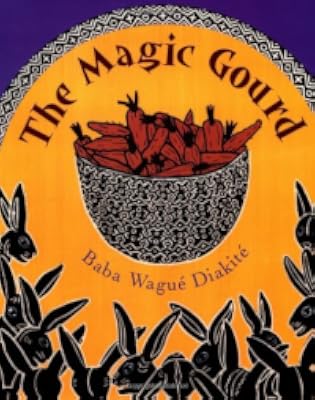
Although long aware of the work of Malian-American artist and author Baba Wagué Diakité, whose gorgeous ceramic pieces have been shown around show more the country, and who has also produced a number of picture books, and although I have read one book he illustrated—Adwoa Badoe's The Pot of Wisdom: Ananse Stories—The Magic Gourd is the first of his own titles that I have picked up. I am glad that I finally made time for his work, as I found the story here engaging and the illustrations beautiful! The artwork mostly consists of ceramic tiles, plates and bowls, which were then photographed, although the figure of Chameleon is a clay sculpture. This is a true visual feast, and I greatly appreciated the guide to mudcloth patterns provided at the rear, explaining the meaning behind the different decorative borders on Diakité's ceramic pieces. The rest of the back matter—a song of praise which would have accompanied the story in a traditional telling, an author's note, a glossary of Bambara terms, and a brief explanation of where this story fits in the wider world of global folklore—was also excellent. As someone interested in comparative folklore, the latter was particularly welcome! Everything about this book was excellent, leaving me eager to track down more of his work. Recommended to young folklore enthusiasts, to anyone looking for picture books with a Malian cultural background, and to those who appreciate beautiful illustrations. show less
Although long aware of the work of Malian-American artist and author Baba Wagué Diakité, whose gorgeous ceramic pieces have been shown around show more the country, and who has also produced a number of picture books, and although I have read one book he illustrated—Adwoa Badoe's The Pot of Wisdom: Ananse Stories—The Magic Gourd is the first of his own titles that I have picked up. I am glad that I finally made time for his work, as I found the story here engaging and the illustrations beautiful! The artwork mostly consists of ceramic tiles, plates and bowls, which were then photographed, although the figure of Chameleon is a clay sculpture. This is a true visual feast, and I greatly appreciated the guide to mudcloth patterns provided at the rear, explaining the meaning behind the different decorative borders on Diakité's ceramic pieces. The rest of the back matter—a song of praise which would have accompanied the story in a traditional telling, an author's note, a glossary of Bambara terms, and a brief explanation of where this story fits in the wider world of global folklore—was also excellent. As someone interested in comparative folklore, the latter was particularly welcome! Everything about this book was excellent, leaving me eager to track down more of his work. Recommended to young folklore enthusiasts, to anyone looking for picture books with a Malian cultural background, and to those who appreciate beautiful illustrations. show less
This book offers children a peak of African culture through it's authentic illustrations and through songs from Mali that can be sung during different parts of the story with translations of the lyrics displayed as well. The main character, Rabbit, exemplifies what a good neighbor is when crossing paths with a chameleon who needs help. The chameleon sets an example by sharing and caring for someone in need (Rabbit), even when it's a stranger. This is a great book for children to learn the importance of keeping a good attitude when times are tough, as Rabbit gracefully did, and also displays the importance of sharing, as Chameleon so kindly did.
The Magic Gourd tells us a tale of a vegetable with impressive powers. This gourd can fill itself with whatever the owner desires. This book expresses the typical tale of the good-hearted vs. the greedy, with the good prevailing in the end. I enjoyed that the story line was presented in Mali’s aspect of culture, giving a new spin to the popular battle of good vs. evil. The illustrations reveal realistic animals, until a few appear in the story wearing clothing. The images have a distorted, tribal feel which add to the distinctiveness of this story. This is a great read in comparing traditional American fantasies to other country’s fantasy picture books.
The Magic Gourd is a traditional rabbit story that are very popular among children in Mali, West Africa. Rabbit's family is experiencing a drought and famine. Because of Rabbit's hard work, kindness, and loyalty, a chameleon gives him a magic gourd that can fill itself with anything you ask. Rabbit's family is now no longer hungry and thirsty. However, when the greedy king steals it back Rabbit out smarts him and overcomes do to his kind and loyal nature.
The story is written in a conversative dialect between the characters along with a narrator. Some words are written in Bambara, the national language of Mali. Also, in the back of the book is a song in Bambara, facts about traditional ali things, and a glossary with the words in show more Bombara and translated to English. show less
The story is written in a conversative dialect between the characters along with a narrator. Some words are written in Bambara, the national language of Mali. Also, in the back of the book is a song in Bambara, facts about traditional ali things, and a glossary with the words in show more Bombara and translated to English. show less
This is a folktale that deals with the concepts of kindness and generosity. The illustrations and inclusion of Bambaran words create an authentic view into the culture of Mali. This is a great story of how kindness is rewarded and how friendships and generosity are more important than gold. This is a great book for teaching the concept of generosity and kindness even when times are tough.
This is a story again about what kindness can come from suffering. When the sun refuses to hide behind clouds, Brother Rabbit and his community find themselves starving in the drought. After doing a good deed for Chameleon, Brother Rabbit is gifted with a most valuable gift, a magic gourd that will fill itself with whatever the owner wishes for. Brother Rabbit uses it for good, and feeds his whole community with its bounty, until the greedy king hears about it. He seizes it from the Rabbit, and uses it to make himself gold. Luckily, Chameleon has another gift for Rabbit, which helps him to return the magic gourd, where he continues to use it for good.
This West African folk tale tells teaches lessons of kindness and generosity. When Brother Rabbit frees Chameleon from a thorny bush, he is rewarded with a magic gourd that will fill itself with anything Brother Rabbit asks for. Due to his generous nature, he uses it to help feed his friends and neighbors as well as his family, knowing that it really should be kept secret. The greedy king learns of the magic gourd and has it stolen. He uses it to make gold until Brother Rabbit uses a magic rock given to him by Chameleon that continuously hits the king in the head. Finally the king tells Brother Rabbit he can have the gold, food, and the magic gourd if he makes the rock stop. Bother Rabbit makes the rock stop, but only takes the gourd he show more came for. This final act of kindness teaches the king the importance of generosity and friendship.
I enjoyed reading this story. The traditional West African illustrations taken fro the mud cloth patterns native to Mali were beautiful. The story gave a touching lesson about kindness, generosity, and friendship that would be easy for young listeners to understand. Appropriate for a read aloud for ages four and above. show less
I enjoyed reading this story. The traditional West African illustrations taken fro the mud cloth patterns native to Mali were beautiful. The story gave a touching lesson about kindness, generosity, and friendship that would be easy for young listeners to understand. Appropriate for a read aloud for ages four and above. show less
Members
- Recently Added By
Lists

A Child's Book Tour of West Africa ::: Côte d'Ivoire, Mali, Ghana, Nigeria
59 works; 5 members
Author Information

6+ Works 1,106 Members
Awards and Honors
Common Knowledge
- Canonical title
- The Magic Gourd
- People/Characters
- Brother Rabbit; Chameleon
- Dedication
- For those who have little, yet live a life of utmost grace-- This book is dedicated to the people of Mali.
- First words
- It all began when the sin refused to allow the clouds to gather, and there was no rain.
- Last words
- (Click to show. Warning: May contain spoilers.)And for their many good deeds, all sang a song of praise to Rabbit and Chameleon.
Classifications
Statistics
- Members
- 216
- Popularity
- 151,044
- Reviews
- 24
- Rating
- (4.02)
- Languages
- Arabic, English
- Media
- Paper
- ISBNs
- 4