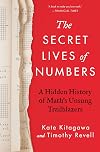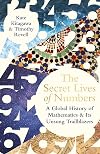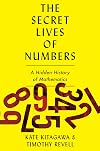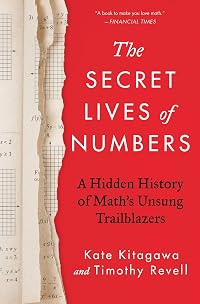
The Secret Lives of Numbers: A Hidden History of Math's Unsung Trailblazers
by Kate Kitagawa, Timothy Revell
On This Page
Description
A new history of mathematics focusing on the marginalized voices who propelled the discipline, spanning six continents and thousands of years of untold stories. Mathematics shapes almost everything we do. But despite its reputation as the study of fundamental truths, the stories we have been told about it are wrong-warped like the sixteenth-century map that enlarged Europe at the expense of Africa, Asia and the Americas. In The Secret Lives of Numbers, renowned math historian Kate Kitagawa show more and journalist Timothy Revell make the case that the history of math is infinitely deeper, broader, and richer than the narrative we think we know. Our story takes us from Hypatia, the first great female mathematician, whose ideas revolutionized geometry and who was killed for them-to Karen Uhlenbeck, the first woman to win the Abel Prize, "math's Nobel." Along the way we travel the globe to meet the brilliant Arabic scholars of the "House of Wisdom," a math temple whose destruction in the Siege of Baghdad in the thirteenth century was a loss arguably on par with that of the Library of Alexandria; Madhava of Sangamagrama, the fourteenth-century Indian genius who uncovered the central tenets of calculus 300 years before Isaac Newton was born; and the Black mathematicians of the Civil Rights era, who played a significant role in dismantling early data-based methods of racial discrimination. Covering thousands of years, six continents, and just about every mathematical discipline, The Secret Lives of Numbers is an immensely compelling narrative history. show lessTags
Recommendations



















Member Reviews
This book is devoted to the development of significant and important mathematical concepts, the full history of which has been long neglected or forgotten in the interest of promulgating a Eurocentric perspective. Perhaps not surprisingly, many of the persons involved were women, who, in spite of their accomplishments, were underpaid, under-recognized, or outright ignored, with their achievements being claimed by others.
The authors have a breezy style that stays engaging without getting into the nitty-gritty of the pure math involved. To me, the most interesting chapters involved the development of calculus, to which they credit neither Newton nor Leibniz. Rather, they report, calculus was advanced in India in the 14th century by a show more mathematician named Madhava. Similarly, they explain that binary notation has roots in the traditional hexagrams of the Chinese Book of Changes.
All in all, the book is an eye-opening account from which the reader will learn a little (but not a great deal of) math and a lot of engrossing history. On a meta level, the book shows how the achievements of non-Western cultures are consistently denigrated or ignored - a useful reminder that any one history is only partial, likely reflecting the cultural influences and biases of the author, and should be supplemented by books with other perspectives for a full understanding of the past.
(JAB) show less
The authors have a breezy style that stays engaging without getting into the nitty-gritty of the pure math involved. To me, the most interesting chapters involved the development of calculus, to which they credit neither Newton nor Leibniz. Rather, they report, calculus was advanced in India in the 14th century by a show more mathematician named Madhava. Similarly, they explain that binary notation has roots in the traditional hexagrams of the Chinese Book of Changes.
All in all, the book is an eye-opening account from which the reader will learn a little (but not a great deal of) math and a lot of engrossing history. On a meta level, the book shows how the achievements of non-Western cultures are consistently denigrated or ignored - a useful reminder that any one history is only partial, likely reflecting the cultural influences and biases of the author, and should be supplemented by books with other perspectives for a full understanding of the past.
(JAB) show less
This is a more inclusive look at all the people who have contributed to mathematics throughout history. While there are many gaps in the history without the white men this tries to stay away from, it highlights how people from all demographics are capable of mathematical genius with the right environment and resources, something usually only available to white men historically.
"The Secret Lives of Numbers: A Hidden History of Mathematics," by Kitagawa and Revell, explores the background of various advancements in mathematics and those who were involved in developing them. Overall, I found the book interesting (perhaps that's the math nerd in me), but there were points at which the progression seemed to slow more than I would have lliked.
Ratings
Members
- Recently Added By
Author Information
5 Works 135 Members
2+ Works 150 Members
Awards and Honors
Common Knowledge
- Original publication date
- 2023
Classifications
Statistics
- Members
- 130
- Popularity
- 251,207
- Reviews
- 3
- Rating
- (3.88)
- Languages
- English, German
- Media
- Paper, Audiobook, Ebook
- ISBNs
- 9
- ASINs
- 1