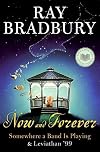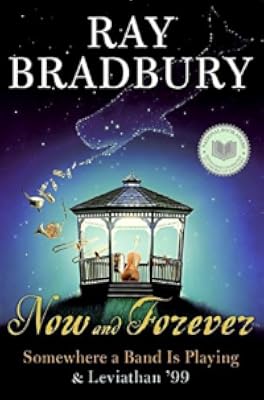
Now and Forever: Somewhere a Band Is Playing & Leviathan '99
by Ray Bradbury
On This Page
Description
Presents two novellas, including "Somewhere a Band Is Playing," in which a young writer discovers that all is not as it seems in a nostalgic community, and "Leviathan '99," in which Ishmael Hunnicut Jones prepares for a first interstellar hunt.Tags
Recommendations






















Member Reviews
Writers are often at their best when they begin facing their own mortality. Drawing closer to the end of things than they are to the beginning helps tap into a new level of depth and focus. The characters and stories have an urgency that cannot be ignored. “Listen to me, please. I can help unlock the mystery,” they seem to say.
[Now and Forever] was published in 2007 – Ray Bradbury died just five years later. Both of the novellas that make up the book are ones that Bradbury confesses he had been picking at for decades. But he could never quite unlock these stories, not until twilight was setting for him.
“Somewhere a Band Is Playing” is the first story. Bradbury’s introduction provides some insight into the long process that show more gave birth to this particular story. Years visiting a desert town, encounters with a movie star, and an orphan poem were all kicking around in his head for years before he completed the story about a magical town where no one ages. It’s not just any old magical town, though. This town is populated exclusively with writers. And the town is in danger of being discovered and razed to make room for a new interstate highway. The town is saved by a writer, of course, who warns the inhabitants rather than writing the newspaper story that he meant to write. He finds love in the town, and he is allowed to join the community. Interesting, don’t you think, that a writer saves an ageless town of writers by choosing life over a story. What must Bradbury have been thinking about?
“Leviathan 99” is the second story. It is an homage to Melville’s [Moby Dick]. But Bradbury transitions the story to deep space, with the mad captain of a spaceship hunting a destructive comet. Bradbury wrote the screenplay for John Huston’s film adaptation of [Moby Dick] in 1959. After that, he tried several times to move the story into space for the radio or television, settling for stage play that was never well received. Bradbury spent decades working on this story of a lone-survivor who tells a story. And it is one of the last stories he published.
Bottom Line: An author in his twilight years focused on his own mortality.
4 ½ bones!!!!! show less
[Now and Forever] was published in 2007 – Ray Bradbury died just five years later. Both of the novellas that make up the book are ones that Bradbury confesses he had been picking at for decades. But he could never quite unlock these stories, not until twilight was setting for him.
“Somewhere a Band Is Playing” is the first story. Bradbury’s introduction provides some insight into the long process that show more gave birth to this particular story. Years visiting a desert town, encounters with a movie star, and an orphan poem were all kicking around in his head for years before he completed the story about a magical town where no one ages. It’s not just any old magical town, though. This town is populated exclusively with writers. And the town is in danger of being discovered and razed to make room for a new interstate highway. The town is saved by a writer, of course, who warns the inhabitants rather than writing the newspaper story that he meant to write. He finds love in the town, and he is allowed to join the community. Interesting, don’t you think, that a writer saves an ageless town of writers by choosing life over a story. What must Bradbury have been thinking about?
“Leviathan 99” is the second story. It is an homage to Melville’s [Moby Dick]. But Bradbury transitions the story to deep space, with the mad captain of a spaceship hunting a destructive comet. Bradbury wrote the screenplay for John Huston’s film adaptation of [Moby Dick] in 1959. After that, he tried several times to move the story into space for the radio or television, settling for stage play that was never well received. Bradbury spent decades working on this story of a lone-survivor who tells a story. And it is one of the last stories he published.
Bottom Line: An author in his twilight years focused on his own mortality.
4 ½ bones!!!!! show less
This volume showcases two beautiful novellas that have apparently been in the works for years and are now finally making an appearance in their full and perhaps final form. Right off the bat, I will say that the time spent on this has been well worth it. Along with the stories are very short introductions gleaming a little light on to their genesis and making them all the more savory.
The first, "Somewhere a Band is Playing", is another of Bradbury's poetic odes to small western towns and the joys they contain, but that is only a thin veneer on the surface of a deeper and more moving work. Its quality may have been increased by the fact that I read it sitting in the sun in front of the general store in my own little village, and was show more touched by the feelings of love and belonging felt by Summerton's inhabitants. It is, however, the secret they all share that brings the story home.
'Leviathan '99' is based around one of the many apparent focuses of Bradbury's career. Born out of his famous screenplay adaptation for 'Moby Dick', 'Leviathan' is a re-imagining of Melville if the Pequot was a space ship, Quequeg an alien, and the great white whale something far more massive and powerful. Amazingly, Bradbury manages to tell the entire story of 'Moby Dick' in fewer than a hundred well-spaced pages, and yet took longer to finish it than Herman's oft hefted, but rarely finished novel. Most fascinating is the way Bradbury finds a place for God in the deep vastness of outer space, just as he has done in 'The Martian Chronicles' and numerous other stories. There are a few times when a plot point or object feels a little contrived, but the spirit of the original is preserved and enhanced.
Though both very different, these two short works revolve around themes Bradbury returns to time and time again: the shortness of youth, the love of writing, and the vast expanses of Space to name just a few. It is a sad truth that there is not that much of Ray these days, but even in these advanced years he still shines with wonder, virtuosity, and that simple joy that draws me so to his writings. Stay strong, sir, and peace. show less
The first, "Somewhere a Band is Playing", is another of Bradbury's poetic odes to small western towns and the joys they contain, but that is only a thin veneer on the surface of a deeper and more moving work. Its quality may have been increased by the fact that I read it sitting in the sun in front of the general store in my own little village, and was show more touched by the feelings of love and belonging felt by Summerton's inhabitants. It is, however, the secret they all share that brings the story home.
'Leviathan '99' is based around one of the many apparent focuses of Bradbury's career. Born out of his famous screenplay adaptation for 'Moby Dick', 'Leviathan' is a re-imagining of Melville if the Pequot was a space ship, Quequeg an alien, and the great white whale something far more massive and powerful. Amazingly, Bradbury manages to tell the entire story of 'Moby Dick' in fewer than a hundred well-spaced pages, and yet took longer to finish it than Herman's oft hefted, but rarely finished novel. Most fascinating is the way Bradbury finds a place for God in the deep vastness of outer space, just as he has done in 'The Martian Chronicles' and numerous other stories. There are a few times when a plot point or object feels a little contrived, but the spirit of the original is preserved and enhanced.
Though both very different, these two short works revolve around themes Bradbury returns to time and time again: the shortness of youth, the love of writing, and the vast expanses of Space to name just a few. It is a sad truth that there is not that much of Ray these days, but even in these advanced years he still shines with wonder, virtuosity, and that simple joy that draws me so to his writings. Stay strong, sir, and peace. show less
Two novellas in one volume: a format that has, recently, driven me to cynical mutterings about publishers letting under-par or under-length pieces do the financial legwork of a decent novel. I’m pleased to say that not only are both these offerings perfect for the novella format, they are easily of the expected standard of the author, and both have short introductions which make interesting additional reading.
I have read perhaps only a third of Bradbury's stories, but I have read enough to know to expect intriguing and quirky sci-fi. What I wasn’t expecting was the almost indescribably sweet sadness of Somewhere a Band is Playing. Told in brief, visually strong chapters, it describes the discovery by a young journalist of a town show more where nobody ages or dies, and the affinity he feels for the place and the people. In the introduction, Bradbury tells us all the elements that came together to form, if not the plot, then the atmosphere of Somewhere a Band…; elements that combine to provoke just the right sense of yearning and jeopardy. In comparison Leviathan ‘99 is almost predictable Bradbury; that’s not to say it isn’t clever, moving, interesting or well-written sci-fi – just that those things could have been predicted before I began reading it. I say ‘almost’… a science-fiction retelling of Moby Dick isn’t precisely something I would have foretold (but it does answer the expectation of ‘quirk’). Bradbury’s introduction, wherein he tells us that he’d tried the story – repeatedly – as a radio-play script, speaks to his delight with the idea of relocating and revisiting the epic, obsessive battle. Oddly enough, while Moby Dick is a hefty tome even in its abridged-all-to-hell state, Leviathan ‘99 carries off the same feel in a comparative nutshell. It’s my favourite of the two, and one of my favourite Bradbury tales, although I felt the climax could have been stronger.
So, a couple of must-read stories for Bradbury fans, pieces that work well together for their equally emotive poetry. Would I prefer to see them in a longer collection? Of course – but I’m going to make the rare condescension and say that this volume is a worthy addition in itself… I’m not even biased by the nice rough-guillotined edges, one of those nice tactile touches that nearly always push me over the edge of any prevaricating when it comes to book purchases. While I might buy on a whim, I only recommend what I love… and I loved these two tales. show less
I have read perhaps only a third of Bradbury's stories, but I have read enough to know to expect intriguing and quirky sci-fi. What I wasn’t expecting was the almost indescribably sweet sadness of Somewhere a Band is Playing. Told in brief, visually strong chapters, it describes the discovery by a young journalist of a town show more where nobody ages or dies, and the affinity he feels for the place and the people. In the introduction, Bradbury tells us all the elements that came together to form, if not the plot, then the atmosphere of Somewhere a Band…; elements that combine to provoke just the right sense of yearning and jeopardy. In comparison Leviathan ‘99 is almost predictable Bradbury; that’s not to say it isn’t clever, moving, interesting or well-written sci-fi – just that those things could have been predicted before I began reading it. I say ‘almost’… a science-fiction retelling of Moby Dick isn’t precisely something I would have foretold (but it does answer the expectation of ‘quirk’). Bradbury’s introduction, wherein he tells us that he’d tried the story – repeatedly – as a radio-play script, speaks to his delight with the idea of relocating and revisiting the epic, obsessive battle. Oddly enough, while Moby Dick is a hefty tome even in its abridged-all-to-hell state, Leviathan ‘99 carries off the same feel in a comparative nutshell. It’s my favourite of the two, and one of my favourite Bradbury tales, although I felt the climax could have been stronger.
So, a couple of must-read stories for Bradbury fans, pieces that work well together for their equally emotive poetry. Would I prefer to see them in a longer collection? Of course – but I’m going to make the rare condescension and say that this volume is a worthy addition in itself… I’m not even biased by the nice rough-guillotined edges, one of those nice tactile touches that nearly always push me over the edge of any prevaricating when it comes to book purchases. While I might buy on a whim, I only recommend what I love… and I loved these two tales. show less
Now and forever is comprised of two novellas, ‘Somewhere a band is playing’ and ‘Leviathan ‘99’.
‘Somewhere a band is playing’ begins with a stranger flinging himself from a moving train onto the platform of a station in a town where no train has stopped in living memory. There’s something about a story opening with a ‘but the train hasn’t stopped here in years’ scenario that generates expectation like little else. Is the station a ghost? Is it a ghost town? Is it a ghost train? Is the stranger a ghost?
Bradbury is, of course, an acknowledged master of fantasy and this story does not disappoint. Summertown is a charming, charming place and the cynics among the readers will instantly be on their guard because they show more know that perfection in a small town is normally obtained at A Terrible Price. That’s the case here too, but the Terrible Price is not shocking, just sad.
For the less cynical who really quite like the idea of a place like Summertown, a perfect place populated by perfect people, it’s okay, because Bradbury provides a cynic in the form of a competitor newsman to our hero, who tumbles from the next train to pass through in the wake of our hero.
There’s a straightforward story here of the suspicions we have of perfection, how ready we are to consider that something might be too good to be true, and sadly how often we think it. Layered onto this is a favourite Bradbury theme of immortality, the price it exacts and the responsibility that comes with it – not to mention the answer to the question: just what does one do with all that time?
Leviathan ’99 is a compelling study in obsession and a romantic glimpse into how the future of space travel might be. There is enough straightforward science fiction here to keep the pulpiest pulp fan happy, rocket ships, dead moons, spacemen, aliens, comets and comet-chasers. At the heart of the story is an obsessive desire by the captain of the Cetus 7 to find, and destroy, the great white comet that took his sight many years ago. What appealed most to me was the approach Bradbury took to the crew and how men together in space might behave in the future.
There are rocket ships and, although never described in detail, one builds an image of a huge silver cigar on fins, blasting off on a ribbon of fire into the unknown, an image straight from the front page of a faded and battered copy of pulp sci-fi tales from many years ago. The alien in the story is also straight from pulp fiction, it’s a large green spider like creature that originally terrifies and then becomes the best friend and ultimately saviour of the main character.
The captain of the ship is, to say the least, enigmatic. Ruling the crew with an iron will he is happy to take them all to their doom on a madman’s quest, and they are compelled to follow.
This story was originally conceived as a radio play and, in one of the best sequences of the book the Cygnus 7, far from Earth, actually catches up with radio transmission from over a century ago. They listen, enraptured, to news and sports broadcasts of people and events long dead but forever preserved.
Probably the most fascinating aspect of the story is Bradbury treating the spacefarers of 2099 like the seafarers of 1899. Back then it was wooden ships and iron men, in Bradbury’s tale the men are still iron, but the ships are steel and fire. The reality of space travel at present is based more around aviation than sailing, but as the number of crews on space ships increase, it seems appropriate that the mentality adopted would be a nautical one. What other culture could so easily adapt to long journeys in a hostile environment while they search the skies not for any altruistic reason but for profit. These are prospectors, willing to endanger themselves in a hostile environment for great reward, and Bradbury does well to capture the mentality of men who take the greatest risks for the greatest rewards. show less
‘Somewhere a band is playing’ begins with a stranger flinging himself from a moving train onto the platform of a station in a town where no train has stopped in living memory. There’s something about a story opening with a ‘but the train hasn’t stopped here in years’ scenario that generates expectation like little else. Is the station a ghost? Is it a ghost town? Is it a ghost train? Is the stranger a ghost?
Bradbury is, of course, an acknowledged master of fantasy and this story does not disappoint. Summertown is a charming, charming place and the cynics among the readers will instantly be on their guard because they show more know that perfection in a small town is normally obtained at A Terrible Price. That’s the case here too, but the Terrible Price is not shocking, just sad.
For the less cynical who really quite like the idea of a place like Summertown, a perfect place populated by perfect people, it’s okay, because Bradbury provides a cynic in the form of a competitor newsman to our hero, who tumbles from the next train to pass through in the wake of our hero.
There’s a straightforward story here of the suspicions we have of perfection, how ready we are to consider that something might be too good to be true, and sadly how often we think it. Layered onto this is a favourite Bradbury theme of immortality, the price it exacts and the responsibility that comes with it – not to mention the answer to the question: just what does one do with all that time?
Leviathan ’99 is a compelling study in obsession and a romantic glimpse into how the future of space travel might be. There is enough straightforward science fiction here to keep the pulpiest pulp fan happy, rocket ships, dead moons, spacemen, aliens, comets and comet-chasers. At the heart of the story is an obsessive desire by the captain of the Cetus 7 to find, and destroy, the great white comet that took his sight many years ago. What appealed most to me was the approach Bradbury took to the crew and how men together in space might behave in the future.
There are rocket ships and, although never described in detail, one builds an image of a huge silver cigar on fins, blasting off on a ribbon of fire into the unknown, an image straight from the front page of a faded and battered copy of pulp sci-fi tales from many years ago. The alien in the story is also straight from pulp fiction, it’s a large green spider like creature that originally terrifies and then becomes the best friend and ultimately saviour of the main character.
The captain of the ship is, to say the least, enigmatic. Ruling the crew with an iron will he is happy to take them all to their doom on a madman’s quest, and they are compelled to follow.
This story was originally conceived as a radio play and, in one of the best sequences of the book the Cygnus 7, far from Earth, actually catches up with radio transmission from over a century ago. They listen, enraptured, to news and sports broadcasts of people and events long dead but forever preserved.
Probably the most fascinating aspect of the story is Bradbury treating the spacefarers of 2099 like the seafarers of 1899. Back then it was wooden ships and iron men, in Bradbury’s tale the men are still iron, but the ships are steel and fire. The reality of space travel at present is based more around aviation than sailing, but as the number of crews on space ships increase, it seems appropriate that the mentality adopted would be a nautical one. What other culture could so easily adapt to long journeys in a hostile environment while they search the skies not for any altruistic reason but for profit. These are prospectors, willing to endanger themselves in a hostile environment for great reward, and Bradbury does well to capture the mentality of men who take the greatest risks for the greatest rewards. show less
“Take two Bradbury and call me in the morning.” Face it; that is a prescription that can be used in any situation. And, accordingly, this book fills that prescription perfectly.
This is actually two novellas collected in a single book. The second is okay, the first is a joy. So we will start with the second first (and save the best – the first – for last. Following so far? Good.) “Leviathan ‘99” is a retelling of Moby Dick in outer space. As Bradbury notes in his introduction, it has come to us through a circuitous path including being written as a radio play, doubling its length to a two-hour radio play, whittling back the material that wasn’t really needed, and finally production of this novella. The result is not okay. show more Bradbury cannot write badly, and it is evidenced here because the final story is so-so. But it is still a fun (if not overly fulfilling) read.
But now, to the main course. The first novella is titled “Somewhere a Band is Playing” and it is vintage Bradbury. A man steps off a train into small-town America (this time in Arizona.) He finds there is magic there, a magic he wants to be a part of. The magic is threatened. With that, you can tell that Bradbury is telling a story he has told before. And the story itself leads to an incredibly logical conclusion that is seen long before that end arrives. But that is the skill and talent and wonder that is Bradbury. Every page and every line of this story draws us in with its warmth. Every piece comes together to make us feel glad to be on the voyage. This is Bradbury helping us relive why he thinks life is worth living, and we are all glad to join in his sharing.
One story that is good. One that is excellent. Take both and you won’t even have to wait until the morning to feel better about yourself. show less
This is actually two novellas collected in a single book. The second is okay, the first is a joy. So we will start with the second first (and save the best – the first – for last. Following so far? Good.) “Leviathan ‘99” is a retelling of Moby Dick in outer space. As Bradbury notes in his introduction, it has come to us through a circuitous path including being written as a radio play, doubling its length to a two-hour radio play, whittling back the material that wasn’t really needed, and finally production of this novella. The result is not okay. show more Bradbury cannot write badly, and it is evidenced here because the final story is so-so. But it is still a fun (if not overly fulfilling) read.
But now, to the main course. The first novella is titled “Somewhere a Band is Playing” and it is vintage Bradbury. A man steps off a train into small-town America (this time in Arizona.) He finds there is magic there, a magic he wants to be a part of. The magic is threatened. With that, you can tell that Bradbury is telling a story he has told before. And the story itself leads to an incredibly logical conclusion that is seen long before that end arrives. But that is the skill and talent and wonder that is Bradbury. Every page and every line of this story draws us in with its warmth. Every piece comes together to make us feel glad to be on the voyage. This is Bradbury helping us relive why he thinks life is worth living, and we are all glad to join in his sharing.
One story that is good. One that is excellent. Take both and you won’t even have to wait until the morning to feel better about yourself. show less
This is comprised of two novellas: “Somewhere a Band is Playing” and “Leviathan ‘99”. I immensely enjoyed “Somewhere a Band is Playing”, it harkens back to Bradbury’s strength’s: small town America, although it seems faded in comparison with his tours de force. “Leviathan ‘99” is finally published after being reworked for a number of years. This still felt incomplete to me, although if pushed I could not point at what is missing. Perhaps it was not written with the same fire that originally imagined it.
Two novellas, published late in Bradbury's life, having gestated over decades.
Somewhere a Band is Playing
Beautiful.
A journalist sniffs a story and jumps off a train into a small town in Arizona, forgotten by the world. A story only Bradbury could make work ensues.
As an aside, in the Introduction, we learn that the inspiritaion for Nef in this story (and obviously for the movie star in Death is a Lonely Business) was none other than Katherine Hepburn. Well, it was obvious that there was a real world inspiration for those characters but exactly which leading lady from the Hollywood Age of Elegance was not easily guessed.
Leviathan '99
Bradbury went to Ireland when he wrote the screenplay for the film Moby Dick. The experience stuck with show more him, as his many Irish stories testify, but apparently the White Whale and Ahab stuck with him, too, since he wrote a radio play SF adaptation of the book (broadcast by the BBC), too and eventually that evolved into this novella, which is - bonkers.
There's a long tradition of these literary adaptations, of course, even just within SF, perhaps most famously, The Forbidden Planet being a take on Shakespeare's The Tempest. But despite being widely considered an SF writer, Bradbury for the most part stood apart from the mainstream development of the genre, not being really all that interested in science. And so if you go into this expecting a competent space opera, you will be very disappointed. Instead, it is necessary to ignore everything technical, which may as well be magic, and focus on this brief (unlike the voluminous original) examination of self-destructive obsession with it's weird telepathic alien "Queequeg" and blind "Ahab." show less
Somewhere a Band is Playing
Beautiful.
A journalist sniffs a story and jumps off a train into a small town in Arizona, forgotten by the world. A story only Bradbury could make work ensues.
As an aside, in the Introduction, we learn that the inspiritaion for Nef in this story (and obviously for the movie star in Death is a Lonely Business) was none other than Katherine Hepburn. Well, it was obvious that there was a real world inspiration for those characters but exactly which leading lady from the Hollywood Age of Elegance was not easily guessed.
Leviathan '99
Bradbury went to Ireland when he wrote the screenplay for the film Moby Dick. The experience stuck with show more him, as his many Irish stories testify, but apparently the White Whale and Ahab stuck with him, too, since he wrote a radio play SF adaptation of the book (broadcast by the BBC), too and eventually that evolved into this novella, which is - bonkers.
There's a long tradition of these literary adaptations, of course, even just within SF, perhaps most famously, The Forbidden Planet being a take on Shakespeare's The Tempest. But despite being widely considered an SF writer, Bradbury for the most part stood apart from the mainstream development of the genre, not being really all that interested in science. And so if you go into this expecting a competent space opera, you will be very disappointed. Instead, it is necessary to ignore everything technical, which may as well be magic, and focus on this brief (unlike the voluminous original) examination of self-destructive obsession with it's weird telepathic alien "Queequeg" and blind "Ahab." show less
Members
- Recently Added By
Author Information

940+ Works 168,488 Members
Ray Bradbury was born in Waukegan, Illinois on August 22, 1920. At the age of fifteen, he started submitting short stories to national magazines. During his lifetime, he wrote more than 600 stories, poems, essays, plays, films, television plays, radio, music, and comic books. His books include The Martian Chronicles, Fahrenheit 451, The show more Illustrated Man, Dandelion Wine, Something Wicked This Way Comes, and Bradbury Speaks. He won numerous awards for his works including a World Fantasy Award for Life Achievement in 1977, the 2000 National Book Foundation Medal for Distinguished Contribution to American Letters, the 2004 National Medal of Arts, and the 2007 Pulitzer Prize Special Citation. He wrote the screen play for John Huston's classic film adaptation of Moby Dick, and was nominated for an Academy Award. He adapted 65 of his stories for television's The Ray Bradbury Theater, and won an Emmy for his teleplay of The Halloween Tree. The film The Wonderful Ice Cream Suit was written by Ray Bradbury and was based on his story The Magic White Suit. He was the idea consultant and wrote the basic scenario for the United States pavilion at the 1964 World's Fair, as well as being an imagineer for Walt Disney Enterprises, where he designed the Spaceship Earth exhibition at Walt Disney World's Epcot Center. He died after a long illness on June 5, 2012 at the age of 91. (Bowker Author Biography) show less
Some Editions
Work Relationships
Is contained in
Common Knowledge
- Canonical title
- Now and Forever: Somewhere a Band Is Playing & Leviathan '99
- Original publication date
- 2007-09 (William Morrow, hardcover printing) (William Morrow, hardcover printing)
- Original language
- English
Classifications
Statistics
- Members
- 648
- Popularity
- 44,639
- Reviews
- 29
- Rating
- (3.66)
- Languages
- 7 — Czech, English, French, Italian, Japanese, Spanish, Turkish
- Media
- Paper, Audiobook, Ebook
- ISBNs
- 25
- ASINs
- 7