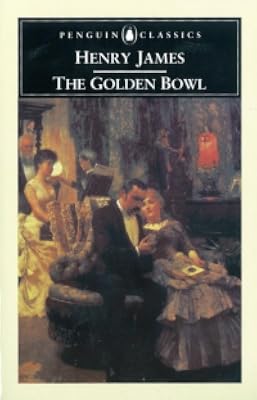
The Golden Bowl
by Henry James
On This Page
Description
The Golden Bowl is an intense, involved study of marriage, adultery and family ties. The central characters are a man and his daughter and James delves into their consciousness to explore the complexity of their relationship to each other and their respective spouses. The novel is often considered the completion of the "major phase" of James' career..
Tags
Recommendations














Member Reviews
Only Henry James can take a beguiling idea like quasi-incestuous adultery, add an Italian prince, a billionaire art collector, and exotic foreign travel, and make a story so tedious that it is a true chore to read.
James writes in wisps of ideas, continually layering these wisps until there is a shimmery, translucent image that gives an idea of what he is trying to get at. These literary holograms are sometimes pretty, often interesting up to a point, but there is no substance to them. By the time the image emerges from the wisps, all I can think is, “So what?”
I can appreciate the talent it took to write an entire novel without saying anything directly. James definitely had a skill that he developed to the utmost. But while I admire show more the talent, I have no desire to make it a part of my life. I appreciate James’s talent the way I appreciate that of the artists who can paint the face of Jesus on a grain of rice. Impressive, but I’m not going to collect a gallery of rice portraits. show less
James writes in wisps of ideas, continually layering these wisps until there is a shimmery, translucent image that gives an idea of what he is trying to get at. These literary holograms are sometimes pretty, often interesting up to a point, but there is no substance to them. By the time the image emerges from the wisps, all I can think is, “So what?”
I can appreciate the talent it took to write an entire novel without saying anything directly. James definitely had a skill that he developed to the utmost. But while I admire show more the talent, I have no desire to make it a part of my life. I appreciate James’s talent the way I appreciate that of the artists who can paint the face of Jesus on a grain of rice. Impressive, but I’m not going to collect a gallery of rice portraits. show less
I love Henry James' work -- I can think of no other writer that glares so mercilessly and relentlessly into the human soul. The Golden Bowl of the title is a metaphor for every person and situation in the novel: a seemingly perfect and priceless object that contains a subtle, but debilitating flaw.
Anyone who has ever watched a friend in the midst of an affair will feel heartbreak at the desperation, connivance, and manipulation of Prince Amerigo and Charlotte Stant. Anyone who has for a moment felt the power of those with money will recognize the insouciant cruelty of Adam Verner. And anyone who has known a person who is young and careless and privileged will spot the innocent ruthlessness of Maggie Verner.
I've read "The Golden Bowl" show more several times and as I get older, it becomes more and more fascinating and nuanced. To everyone who is giving it a try for the first time, please don't give up on it. It's true it is not an easy book, but it is also a novel that rewards you a hundred fold for the effort you put into it. As only a truly great book can, it makes you see the world -- and yourself -- in a new, if not entirely flattering, light. show less
Anyone who has ever watched a friend in the midst of an affair will feel heartbreak at the desperation, connivance, and manipulation of Prince Amerigo and Charlotte Stant. Anyone who has for a moment felt the power of those with money will recognize the insouciant cruelty of Adam Verner. And anyone who has known a person who is young and careless and privileged will spot the innocent ruthlessness of Maggie Verner.
I've read "The Golden Bowl" show more several times and as I get older, it becomes more and more fascinating and nuanced. To everyone who is giving it a try for the first time, please don't give up on it. It's true it is not an easy book, but it is also a novel that rewards you a hundred fold for the effort you put into it. As only a truly great book can, it makes you see the world -- and yourself -- in a new, if not entirely flattering, light. show less
"The Golden Bowl" is the most intricately detailed novel I have ever read, and having completed Marcel Proust’s six volume rambling odyssey "In Search of Lost Time" - that is saying something! The entire story revolves around a simple plot of infidelity and betrayal. Written in 1904, The Golden Bowl takes place an era when even speaking of such behavior was considered gauche and unacceptable; secrecy, plotting, duplicity, and strategic manipulation, all so two cheating spouses could carry on a romantic relationship.
The writing style is absurdly verbose. Henry James uses page after page of analogies, metaphors, idioms, and similes - a muddled labyrinth of verbiage to express an emotion, create a mood, or express a character’s show more actions. Even the title of the book is a metaphor - an antique cracked crystal bowl hidden beneath a superficial unmarred gold-plated surface.
It must have been an enormous challenge for Henry James to write this novel. He used every possible word in the dictionary to avoid speaking of physical intimacy, or getting to the point of moving the plot along, while keeping the reader bewildered and in suspense.
Here is my own analogy: Imagine yourself lying in bed at night, half asleep. You are in a state of semi-consciousness, your thoughts are jumbled, images flash before you but are hazy and out of reach and as you try to focus on their meaning you toss and turn trying to get comfortable and doze off. That is what reading "The Golden Bowl" is like. In fact, you might welcome dozing off a bit while reading this book. There is very little action and minimal conversation in this 568 page tome, but nevertheless, an intense plot.
My similes regarding this novel: It is kind of like tackling an impossibly difficult crossword puzzle, or trying to decipher an encrypted message, or watching a movie in a foreign language…yes, similes come in handy sometimes when you are trying to describe something - but the entire content of "The Golden Bowl" should not have been written so intentionally perplexing. Ranked Number 32 on the Modern Library list of best 100 novels of all time, I can only believe it was the plot that captured the critics awards, in spite of the unpleasant writing style.
My advice: If you are patient, and persistent, like a challenge, get tired of the real-life moronic condensed texting jargon, have a dictionary nearby, and have plenty of free time, you might find this to be an interesting read. Otherwise, don’t bother.
Rated 3 Stars May 2026 show less
The writing style is absurdly verbose. Henry James uses page after page of analogies, metaphors, idioms, and similes - a muddled labyrinth of verbiage to express an emotion, create a mood, or express a character’s show more actions. Even the title of the book is a metaphor - an antique cracked crystal bowl hidden beneath a superficial unmarred gold-plated surface.
It must have been an enormous challenge for Henry James to write this novel. He used every possible word in the dictionary to avoid speaking of physical intimacy, or getting to the point of moving the plot along, while keeping the reader bewildered and in suspense.
Here is my own analogy: Imagine yourself lying in bed at night, half asleep. You are in a state of semi-consciousness, your thoughts are jumbled, images flash before you but are hazy and out of reach and as you try to focus on their meaning you toss and turn trying to get comfortable and doze off. That is what reading "The Golden Bowl" is like. In fact, you might welcome dozing off a bit while reading this book. There is very little action and minimal conversation in this 568 page tome, but nevertheless, an intense plot.
My similes regarding this novel: It is kind of like tackling an impossibly difficult crossword puzzle, or trying to decipher an encrypted message, or watching a movie in a foreign language…yes, similes come in handy sometimes when you are trying to describe something - but the entire content of "The Golden Bowl" should not have been written so intentionally perplexing. Ranked Number 32 on the Modern Library list of best 100 novels of all time, I can only believe it was the plot that captured the critics awards, in spite of the unpleasant writing style.
My advice: If you are patient, and persistent, like a challenge, get tired of the real-life moronic condensed texting jargon, have a dictionary nearby, and have plenty of free time, you might find this to be an interesting read. Otherwise, don’t bother.
Rated 3 Stars May 2026 show less
The Golden Bowl is another fascinating novel by Henry James. It must be said, though, that this novel is very difficult to read. Despite the fact that there are very few characters, basically only five, the long sentences, unusual turns of phrase, natural conversation and the use of pronouns call for very careful reading. The other thing is that there is not much of a plot, and very little action. Most chapters describe endless conversations, observations and contemplations
The symbolism of the golden bowl is difficult to understand. It seems the author has had an ideosyncratic idea of its symbolism, or the author's focus would be more on the binding through gilding while most readers focus on the (supposed) hidden flaw. This is borne show more out by the end of the story as the pairs choose to stay together, while the doubt remains till the very end.
This ending is also different from other novels by Henry James, where the conclusion is often a miserable state for the women. The Golden Bowl seems to be a novel that tests the expectations of the reader as much as of the characters, and perfection is found when least expected. show less
The symbolism of the golden bowl is difficult to understand. It seems the author has had an ideosyncratic idea of its symbolism, or the author's focus would be more on the binding through gilding while most readers focus on the (supposed) hidden flaw. This is borne show more out by the end of the story as the pairs choose to stay together, while the doubt remains till the very end.
This ending is also different from other novels by Henry James, where the conclusion is often a miserable state for the women. The Golden Bowl seems to be a novel that tests the expectations of the reader as much as of the characters, and perfection is found when least expected. show less
Incredibly internal and intimate novel. I struggled with sections that felt meandering but overall I found it a very impressive work.
I began reading the Modern Library List of the 100 Best Novels shortly after the list was published, and thought I had finished it some time around 2004 or 2005. Recently I discovered that instead of having read Henry James' The Golden Bowl, I read The Turn of the Screw. So I corrected my mistake and have, by reading this novel, truly finished the Modern Library list.*
The Golden Bowl is a love quadrangle, and an unconvincing one at that. Maggie Verver marries Prince Amerigo of Italy. Her father, Adam, marries Charlotte Stant several years later. Unbeknownst to either Maggie or her father, Amerigo and Charlotte knew each other prior to meeting their spouses, were very much in love, but were unfortunately too poor to marry. That fact is show more believable as far as the Prince's reason for marrying into wealth, as he was first to the trough. It fails to withstand scrutiny when considering Charlotte's subsequent marriage to Adam, particularly when coupled with the fact that Maggie and Charlotte have been friends since childhood. Having Charlotte conceal her former intimacy with the Prince casts her as a conniving gold-digger, far from the light James portrays her in throughout the novel. Further complicating the plot, Maggie and her father have an especially close (odd, unrealistic) bond and spend an inordinate amount of time together after their marriages, leaving Amerigo and Charlotte to entertain each other. And to begin the adulterous affair they were forced into by the neglect of their spouses (as James appears to contend).
My major argument with the novel is the way in which the affair is discovered. The eponymous bowl appears twice in the story. First, Charlotte offers to buy it as a gift for the Prince on the day before his wedding, when they are purportedly shopping for a gift from her to Maggie. The Prince refuses, noting a defective crack in the bowl. Four years later, Maggie purchases the bowl as a birthday gift for her father when she just happens - in all of London - to chance upon the same shop while wandering home from a visit to the museum. Maggie discovers the infidelity when the shopkeeper, out of guilt for having overcharged her, tracks her down to refund a portion of the purchase price. While at her house, he sees pictures of the Prince and Charlotte and magically remembers not only their having looked at the bowl four years earlier but also their conversation about Maggie. Even James realizes the ridiculousness of this plot device and enlists the Prince to tell Maggie that such coincidences only occur in novels and plays. This attempt at irony fails to absolve James for having included it in the novel.
James seems incapable of writing a direct sentence. While his writing is not overly difficult to comprehend, you quickly tire of the multiple diversions seemingly every sentence takes. You also tire of page after page of dense prose containing a minimum of paragraphs. One sentence can last most of a page. One paragraph can go on for three or four pages. Maybe at this point in his career James was considered too "great" for an editor to suggest revisions to his text, but just eliminating all the "for that matter" and "in any case" and similar pointless clauses which litter most of his prose would reduce the novel by dozens of pages without altering the reader's understanding. His characters speak - when they speak, for this novel suffers from a dearth of dialogue and action - in horrific dialogue both stilted and affected. The conversations between Maggie and her father are so lacking in specifics, which James maddeningly refuses to supply in his endless analysis of them, that they often end without any clear indication of what they were discussing.
I could go on for several hundred words criticizing The Golden Bowl for its contrived, pretentious nature. I haven't even mentioned Fanny Assingham, who introduces Maggie to the Prince despite knowing he was in love with Charlotte. The same Fanny who also knows of the affair, does not disclose it to Maggie and yet remains her friend and confidant, even after Maggie learns of Fanny's deception. I have not questioned what is so great about Adam Verver - James (through Maggie) portrays him as such but refuses to provide any details to justify the attribution. I haven't nitpicked how the titular bowl can be, as James describes it, "shattered" into three pieces when it is ultimately broken.
Obviously I found this book unbelievable and unworthy of inclusion on major reading lists (e.g. 1001 Books). My wish is that it was actually as good as the introduction in my copy made it sound. I doubt the majority of non-academic readers would list it among their favorites or recommend it to a friend.
* - with the exception of Finnegans Wake, which I refuse to finish reading on the grounds of good taste and its abject failure to make any sense at all. show less
The Golden Bowl is a love quadrangle, and an unconvincing one at that. Maggie Verver marries Prince Amerigo of Italy. Her father, Adam, marries Charlotte Stant several years later. Unbeknownst to either Maggie or her father, Amerigo and Charlotte knew each other prior to meeting their spouses, were very much in love, but were unfortunately too poor to marry. That fact is show more believable as far as the Prince's reason for marrying into wealth, as he was first to the trough. It fails to withstand scrutiny when considering Charlotte's subsequent marriage to Adam, particularly when coupled with the fact that Maggie and Charlotte have been friends since childhood. Having Charlotte conceal her former intimacy with the Prince casts her as a conniving gold-digger, far from the light James portrays her in throughout the novel. Further complicating the plot, Maggie and her father have an especially close (odd, unrealistic) bond and spend an inordinate amount of time together after their marriages, leaving Amerigo and Charlotte to entertain each other. And to begin the adulterous affair they were forced into by the neglect of their spouses (as James appears to contend).
My major argument with the novel is the way in which the affair is discovered. The eponymous bowl appears twice in the story. First, Charlotte offers to buy it as a gift for the Prince on the day before his wedding, when they are purportedly shopping for a gift from her to Maggie. The Prince refuses, noting a defective crack in the bowl. Four years later, Maggie purchases the bowl as a birthday gift for her father when she just happens - in all of London - to chance upon the same shop while wandering home from a visit to the museum. Maggie discovers the infidelity when the shopkeeper, out of guilt for having overcharged her, tracks her down to refund a portion of the purchase price. While at her house, he sees pictures of the Prince and Charlotte and magically remembers not only their having looked at the bowl four years earlier but also their conversation about Maggie. Even James realizes the ridiculousness of this plot device and enlists the Prince to tell Maggie that such coincidences only occur in novels and plays. This attempt at irony fails to absolve James for having included it in the novel.
James seems incapable of writing a direct sentence. While his writing is not overly difficult to comprehend, you quickly tire of the multiple diversions seemingly every sentence takes. You also tire of page after page of dense prose containing a minimum of paragraphs. One sentence can last most of a page. One paragraph can go on for three or four pages. Maybe at this point in his career James was considered too "great" for an editor to suggest revisions to his text, but just eliminating all the "for that matter" and "in any case" and similar pointless clauses which litter most of his prose would reduce the novel by dozens of pages without altering the reader's understanding. His characters speak - when they speak, for this novel suffers from a dearth of dialogue and action - in horrific dialogue both stilted and affected. The conversations between Maggie and her father are so lacking in specifics, which James maddeningly refuses to supply in his endless analysis of them, that they often end without any clear indication of what they were discussing.
I could go on for several hundred words criticizing The Golden Bowl for its contrived, pretentious nature. I haven't even mentioned Fanny Assingham, who introduces Maggie to the Prince despite knowing he was in love with Charlotte. The same Fanny who also knows of the affair, does not disclose it to Maggie and yet remains her friend and confidant, even after Maggie learns of Fanny's deception. I have not questioned what is so great about Adam Verver - James (through Maggie) portrays him as such but refuses to provide any details to justify the attribution. I haven't nitpicked how the titular bowl can be, as James describes it, "shattered" into three pieces when it is ultimately broken.
Obviously I found this book unbelievable and unworthy of inclusion on major reading lists (e.g. 1001 Books). My wish is that it was actually as good as the introduction in my copy made it sound. I doubt the majority of non-academic readers would list it among their favorites or recommend it to a friend.
* - with the exception of Finnegans Wake, which I refuse to finish reading on the grounds of good taste and its abject failure to make any sense at all. show less
I'm not able to review this novel without a few small spoilers and I apologise for that.
Henry James finds his plots in unlikely places, and the story that slowly unfolds in this novel demonstrates this wonderfully. There are two halves. The first half of the novel lulls the reader into thinking that two cultured Europeans are taking advantage of a slightly distracted American father and his gormless American daughter. We're introduced to the idea that the father, a collector of precious things, has naively 'collected' an exotic son-in-law (though no critical reader will be terribly impressed with that little trope — yet). We're also introduced to the golden bowl itself, an object that one of the Europeans cannot value, and that the show more other rejects out of hand on account of a defect. At the end of the first half, the advantage is with the Europeans.
The second half of the novel reveals the canniness and, more importantly, the goodness and good sense, of the 'gormless' daughter. She's the star. She recognises that her husband's defects are not fatal to his overall worth (i.e., he is nonetheless a thing of value, just as the golden bowl is a thing of value notwithstanding its defect). She is simply a better judge of quality than the two Europeans. Thus she sets out to put things right, and she succeeds without exciting their suspicion. 'They thought of everything but that I might think' says the daughter, near the end. I was tempted to find a 'revenge of the Americans' theme here, but it's really the triumph of the daughter alone.
The chapter divisions are clever; they don't mark off scenes from one another in the conventional manner. They often fall in the very middle of a bit of dialogue, and signal some advancement in one or another character's understanding. This serves James's preferred way of advancing the story: the interaction of human thoughts. A character sees somebody do something, or talks to somebody, or learns of something somebody has done, and this new intelligence provokes that character to some new action or statement or level of understanding. This, in turn, sends another character by similar means into something new. James sets up these interactions so well, that the reader sees what he is about to reveal an instant before he reveals it.
But James doesn't always pull this off. There are great long passages where one character is drawing out a second character in a contrived way, simply to allow that second character to give expression to some key thought that the reader would otherwise never get wind of. Fanny Assingham draws out Maggie in this way many times, and Fanny's husband, the Colonel, seems to exist as a character solely for this purpose.
Another problem, common to late Henry James, is that his sentences often misfire. I.e., they don't express what he means them to express, or they give the false impression that they're expressing more than they actually do. I'm not as critical as others are. I would judge his late style by what he was obviously capable of producing and did sometimes produce. show less
Henry James finds his plots in unlikely places, and the story that slowly unfolds in this novel demonstrates this wonderfully. There are two halves. The first half of the novel lulls the reader into thinking that two cultured Europeans are taking advantage of a slightly distracted American father and his gormless American daughter. We're introduced to the idea that the father, a collector of precious things, has naively 'collected' an exotic son-in-law (though no critical reader will be terribly impressed with that little trope — yet). We're also introduced to the golden bowl itself, an object that one of the Europeans cannot value, and that the show more other rejects out of hand on account of a defect. At the end of the first half, the advantage is with the Europeans.
The second half of the novel reveals the canniness and, more importantly, the goodness and good sense, of the 'gormless' daughter. She's the star. She recognises that her husband's defects are not fatal to his overall worth (i.e., he is nonetheless a thing of value, just as the golden bowl is a thing of value notwithstanding its defect). She is simply a better judge of quality than the two Europeans. Thus she sets out to put things right, and she succeeds without exciting their suspicion. 'They thought of everything but that I might think' says the daughter, near the end. I was tempted to find a 'revenge of the Americans' theme here, but it's really the triumph of the daughter alone.
The chapter divisions are clever; they don't mark off scenes from one another in the conventional manner. They often fall in the very middle of a bit of dialogue, and signal some advancement in one or another character's understanding. This serves James's preferred way of advancing the story: the interaction of human thoughts. A character sees somebody do something, or talks to somebody, or learns of something somebody has done, and this new intelligence provokes that character to some new action or statement or level of understanding. This, in turn, sends another character by similar means into something new. James sets up these interactions so well, that the reader sees what he is about to reveal an instant before he reveals it.
But James doesn't always pull this off. There are great long passages where one character is drawing out a second character in a contrived way, simply to allow that second character to give expression to some key thought that the reader would otherwise never get wind of. Fanny Assingham draws out Maggie in this way many times, and Fanny's husband, the Colonel, seems to exist as a character solely for this purpose.
Another problem, common to late Henry James, is that his sentences often misfire. I.e., they don't express what he means them to express, or they give the false impression that they're expressing more than they actually do. I'm not as critical as others are. I would judge his late style by what he was obviously capable of producing and did sometimes produce. show less
Members
- Recently Added By
Lists

1001 Books You Must Read Before You Die
1,448 works; 1,132 members

Classics you know you should have read but probably haven't
421 works; 407 members

The Top Ten: Writers Pick Their Favorite Books
240 works; 31 members

Unread books
1,063 works; 87 members

20th Century Literature
1,161 works; 55 members

Folio Society
831 works; 53 members

The Guardian's 100 Best Novels Written in English
105 works; 13 members
Blue Pyramid 1,276 Best Books of All Time
1,248 works; 32 members

Love Triangles in Literature
108 works; 15 members
The Modern Library's 100 Best Novels: The Board's List
85 works; 6 members

SHOULD Read Books!
354 works; 9 members

Books Read in 2022
5,166 works; 114 members

Harold Bloom - The Western Canon: C. The Democratic Age
336 works; 15 members

Art of Reading
188 works; 5 members

Watched the Movie, Probably Won't Read the Book
185 works; 34 members

Greatest Books, allegedly
484 works; 9 members

AP Lit
363 works; 6 members
Canon de la narrativa universal del s. XX (cicutadry)
499 works; 3 members

Modern Library's 100 Best Novels
100 works; 2 members
Author Information

1,061+ Works 87,953 Members
Some Editions
Awards and Honors
Awards
Notable Lists
Series
Belongs to Publisher Series
Work Relationships
Is contained in
Contains
Common Knowledge
- Canonical title
- The Golden Bowl
- Original title
- The Golden Bowl
- Original publication date
- 1904
- People/Characters
- Prince Amerigo; Maggie Verver; Adam Verver; Charlotte Stant
- Important places
- England, UK
- Related movies
- The Golden Bowl (1972 | IMDb); The Golden Bowl (2000 | IMDb)
- First words
- The Prince had always liked his London, when it had come to him; he was one of the modern Romans who find by the Thames a more convincing image of the truth of the ancient state than any they have left by the Tiber.
Among many matters thrown into relief by a refreshed acquaintance with 'The Golden Bowl' what perhaps most stands out for me is the still marked inveteracy of a certain indirect and oblique view of my presented action; unless... (show all) indeed I make up my mind to call this mode of treatment, on the contrary, any superficial appearance not withstanding, the very straightest and closest possible. (Preface) - Quotations
- Mr. Gutermann-Seuss proved, on the second day - our friend had waited till then - a remarkably genial, a positively lustrous young man occupying a small neat house in a quarter of the place remote from the front and living, a... (show all)s immediate and striking signs testified, in the bosom of his family. Our visitors found themselves introduced, by the operation of close contiguity, to a numerous group of ladies and gentlemen older and younger, and of children larger and smaller, who mostly affected them as scarce less anointed for hospitality and who produced at first the impression of a birthday party, or some anniversary gregariously and religiously kept, though they subsequently fell into their places as members of one quiet domestic circle, preponderantly and directly indebted for their being in fact to Mr. Gutermann-Seuss.
“His relation to the things he cares for is absolutely romantic.... it’s the most romantic thing I know.”
“You mean his idea for his native place?”
“Yes – the collection, the Museum with which he wishes to... (show all) endow it, and of which he thinks more, as you know, than of anything in the world. It’s the work of his life and the motive of everything he does.... You’re a part of his collection ... You’re a rarity, an object of beauty, an object of price.... You’re what they call a morceau de musée.”
Representative precious objects, great ancient pictures and other works of art, fine eminent “pieces” in gold, in silver, in enamel, majolica, ivory, bronze, had for a number of years so multiplied themselves round him an... (show all)d, as a general challenge to acquisition and appreciation, so engaged all the faculties of his mind, that the instinct, the particular sharpened appetite of the collector, had fairly served as a basis for his acceptance of the Prince’s suit. - Last words
- (Click to show. Warning: May contain spoilers.)"Isn't she too splendid?" she simply said, offering it to explain and to finish.
"Oh, splendid!" With which he came over to her.
"That's our help, you see" she added—to point further her moral.
It kept him before her therefore, taking in—or trying to—what she so wonderfully gave. He tried, too clearly, to please her—to meet her in her own way; but with the result only that, close to her, her face kept before him, his hands holding her shoulders, his whole act enclosing her, her presently echoed: " 'See'? I see nothing but you." And the truth of it had, with this force, after a moment, so strangely lighted his eyes that, as for pity and dread of them, she buried her own in his breast.
(Click to show. Warning: May contain spoilers.)But on all the ground to which the pretension of performance by a series of exquisite laws may apply there reigns one sovereign truth - whcih decrees that, as art is nothing if not exemplary, care nothing if not active, finsih nothing if not consistent, the proved error is the base apologetic deed, the helpless regret is the barren commentary, and the 'connexions' are employable for finer purposes than mere gaping contrition. (Preface) - Original language
- English
Classifications
Statistics
- Members
- 3,063
- Popularity
- 5,741
- Reviews
- 33
- Rating
- (3.67)
- Languages
- 10 — Catalan, English, French, German, Italian, Portuguese, Romanian, Spanish, Swedish, Turkish
- Media
- Paper, Audiobook, Ebook
- ISBNs
- 148
- UPCs
- 1
- ASINs
- 66