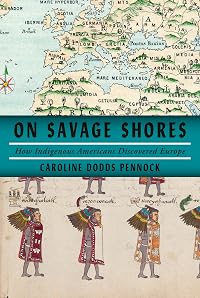
On Savage Shores: How Indigenous Americans Discovered Europe
by Caroline Dodds Pennock
On This Page
Description
We have long been taught to presume that modern global history began when the 'Old World' encountered the 'New', when Christopher Columbus 'discovered' America in 1492. But, as Caroline Dodds Pennock conclusively shows in this groundbreaking book, for tens of thousands of Aztecs, Maya, Totonacs, Inuit and others - enslaved people, diplomats, explorers, servants, traders - the reverse was true: they discovered Europe. For them, Europe comprised savage shores, a land of riches and marvels, yet show more perplexing for its brutal disparities of wealth and quality of life, and its baffling beliefs. The story of these Indigenous Americans abroad is a story of abduction, loss, cultural appropriation, and, as they saw it, of apocalypse - a story that has largely been absent from our collective imagination of the times. From the Brazilian king who met Henry VIII to the Aztecs who mocked up human sacrifice at the court of Charles V; from the Inuk baby who was put on show in a London pub to the mestizo children of Spaniards who returned 'home' with their fathers; from the Inuit who harpooned ducks on the Avon river to the many servants employed by Europeans of every rank: here are a people who were rendered exotic, demeaned, and marginalised, but whose worldviews and cultures had a profound impact on European civilisation. Drawing on their surviving literature and poetry and subtly layering European eyewitness accounts against the grain, Pennock gives us a sweeping account of the Indigenous American presence in, and impact on, early modern Europe. show lessTags
Recommendations




Member Reviews
Colonisation is often implicitly justified by the assumption that the colonised are stuck in a cultural prison that they cannot get out of. The rationalisation is an easy one. If the natives were incurious, and unable or unwilling to learn, then it was the “white man’s burden” to lift them out of the rut they were stuck in, forcibly if necessary. And somehow that justified taking their land and possessions away from them, even if it is not quite so obvious how that would help.
Caroline Dodds Pennock tells us the stories of Indigenous Americans who travelled to Europe to confront their colonisers, some of them willingly, many of them not. And if often enough they were victims, but they were not necessarily passive victims. Native show more Americans challenged their enslavers in the courts, recruited European supporters to their cause, presented their case at the royal courts, learned to navigate this new environment. A large number of these travellers perished, often because they had no resistance to Old World diseases, but others settled down and successfully developed new lives in an alien environment. Their experiences diverged, also because some of them were poor captives, but others were members of old or new aristocracy, on either side of the ocean.
The book starts slowly, with a long introduction and a waving finger, as Dodds Pennock lectures a bit, defending her project and her choices, setting out her ethical framework. Her struggle to find the right word, acceptable terminology, defensible formulations, is understandable but of limited value; languages and the meanings of words are subject to eternal change. But soon enough the book takes off to tell the stories of these eastward travellers to a strange new world.
These are unexpected stories. Many of them are deeply intriguing but short, as the archives show us a brief glimpse of a life through a letter, a court decision, a royal grant, a drawing, a local folklore. They tell of women who prepared a chocolate drink for a Spanish king, of sons of mixed ancestry who made complex choices about what to do with their lives, of Inka princesses who settled down in Spain, of slaves who won their freedom in court. In most cases, alas, we learn a limited amount about the thoughts and experiences of the people whose stories are told. Where their words are recorded, it is often in a formal context in which they conformed to the expectations of others. With few exceptions, they did not leave their comments on European civilisation for posterity. What we get is mostly the archival record prepared by European bureaucrats, and a few writers and artists.
A brief glimpse -- and then they disappear again from European memory, which did not find it convenient to remember them. It is a good thing that the author brought them back. Because these were quite remarkable lives, that show original inhabitants of the Americas who had the resilience and ingenuity to remain active participants, even when their world and culture underwent a shocking process of destruction. show less
Caroline Dodds Pennock tells us the stories of Indigenous Americans who travelled to Europe to confront their colonisers, some of them willingly, many of them not. And if often enough they were victims, but they were not necessarily passive victims. Native show more Americans challenged their enslavers in the courts, recruited European supporters to their cause, presented their case at the royal courts, learned to navigate this new environment. A large number of these travellers perished, often because they had no resistance to Old World diseases, but others settled down and successfully developed new lives in an alien environment. Their experiences diverged, also because some of them were poor captives, but others were members of old or new aristocracy, on either side of the ocean.
The book starts slowly, with a long introduction and a waving finger, as Dodds Pennock lectures a bit, defending her project and her choices, setting out her ethical framework. Her struggle to find the right word, acceptable terminology, defensible formulations, is understandable but of limited value; languages and the meanings of words are subject to eternal change. But soon enough the book takes off to tell the stories of these eastward travellers to a strange new world.
These are unexpected stories. Many of them are deeply intriguing but short, as the archives show us a brief glimpse of a life through a letter, a court decision, a royal grant, a drawing, a local folklore. They tell of women who prepared a chocolate drink for a Spanish king, of sons of mixed ancestry who made complex choices about what to do with their lives, of Inka princesses who settled down in Spain, of slaves who won their freedom in court. In most cases, alas, we learn a limited amount about the thoughts and experiences of the people whose stories are told. Where their words are recorded, it is often in a formal context in which they conformed to the expectations of others. With few exceptions, they did not leave their comments on European civilisation for posterity. What we get is mostly the archival record prepared by European bureaucrats, and a few writers and artists.
A brief glimpse -- and then they disappear again from European memory, which did not find it convenient to remember them. It is a good thing that the author brought them back. Because these were quite remarkable lives, that show original inhabitants of the Americas who had the resilience and ingenuity to remain active participants, even when their world and culture underwent a shocking process of destruction. show less
This is a solid look at how Indigeneous Americans encountered early modern Europe: from the enslaved women who brought knowledge of various foodways to Spain and Portugal, to the visitors to various royal courts in western Europe, to the Inuk infant who was displayed in a London tavern before his untimely death so far from home.
Caroline Dodds Pennock brings together a very fragmentary sourcebase, and does a great job at reading it closely and with sensitivity. I'm a bit bemused by the other reviews I've seen on here which complain either that Dodds Pennock isn't covering "new" ground, or that she engages in repetitive/pointless speculation about people and events. I don't think that's a fair reading of what she's trying to do here, show more which is to think carefully through the nature of the surviving sources, to think about what they can (and cannot) show us, and to walk the reader through how a historian thinks about these issues. On Savage Shores is a book that's clearly written in the tradition of works inspired by Stoler's Along the Archival Grain and Saidiya Hartman's "Venus in Two Acts", scholarship which demonstrates that the archives are never neutral.
A powerful reminder that encounter is always a mutual act. show less
Caroline Dodds Pennock brings together a very fragmentary sourcebase, and does a great job at reading it closely and with sensitivity. I'm a bit bemused by the other reviews I've seen on here which complain either that Dodds Pennock isn't covering "new" ground, or that she engages in repetitive/pointless speculation about people and events. I don't think that's a fair reading of what she's trying to do here, show more which is to think carefully through the nature of the surviving sources, to think about what they can (and cannot) show us, and to walk the reader through how a historian thinks about these issues. On Savage Shores is a book that's clearly written in the tradition of works inspired by Stoler's Along the Archival Grain and Saidiya Hartman's "Venus in Two Acts", scholarship which demonstrates that the archives are never neutral.
A powerful reminder that encounter is always a mutual act. show less
In school we learned about all the wonderful, brave, heroic explorers from western Europe who discovered the western hemisphere, and began the long, arduous process of civilizing and Christianizing it. But it turns out there was plenty of traffic in the other direction too. In On Savage Shores, Caroline Dodds Pennock has collected a book’s worth of evidence that thousands of natives, from Newfoundland to Brazil, made their way to Europe in the 1500s, discovering it as validly as Columbus did of the west. She says the reverse trips began right with the return of Columbus in the 1490s. By the mid 1520s, France alone was running ten ships a month out of Normandy to Brazil.
It will come as a shock to no one that Columbus captured a handful show more of his congenial hosts and brought them home as slaves. But Pennock found far more than that. She found indigenous people coming across the Atlantic as royalty, diplomats, performers, servants, family members, and translators. Lots of translators. Because the Europeans were interested in trade. And the aliens were even accepted in European society: “Native people were walking French streets and being baptized in French churches before even Cortés reached Mexico,” Pennock says.
Trade however, often meant taking as much as possible while giving little or nothing in return (aka theft), but she also has examples of genuine fair trade. Manufactured goods were beyond the means of Western societies, while gold, jewels and lumber could be found in abundance. So by dealing something even a little like fairly, everybody went home happy. Pennock cites Maori scholar Linda Tuiwai Smith saying “Our survival as peoples has come from our knowledge of our contexts, our environments, not from some active beneficence of our Earth Mother.”
There were all types of travelers beyond slaves. Some sent their children to be educated in the ways of the modern world. Diplomats crossed the ocean to negotiate trade and grievances. Officials came to pursue land grants, income grants, and titles promised, or merited by marriage. Natives were brought over as entertainment of the freak show kind, what with their tattoos, pierced lips and cheeks, and near total nakedness. Topped by outlandish Quetzal feather adornments. Some proved to be remarkable marksmen or canoeists, and many picked up their hosts’ languages and became go-betweens. Pennock has a documented story for every one of these kinds of travelers.
And while Europeans were busy being amazed at these aliens, the Indigenous visitors were busy being horrified by European society. They saw Europe “with its rulers and beggars, opulence and starvation, supposed civility and extreme violence against its citizens – as a savage shore,” she says. They came from a cashless, sharing economy where none of that made any sense.
There are plenty of legends and lies to dispel too. Pennock says more than 200 years before Condamine “discovered” rubber, it had already been written up by the Cortés crew. Five years before Jacques Cartier began “discovering” Québec, his wife became godmother to the baby of an Indigenous woman in France. One legend that turns out to be true concerns an Indigenous king who was presented to the King of Spain, and refused to bow before him, a slap that could easily lead Europeans to all-out war. He claimed that a king did not bow to another king, and that was good enough to avoid the dungeon and war and make for a totally successful tour.
Columbus and his huge (for the time) ship attracted a lot of attention, and people came to engage with him. Then in the middle of talking, he would grab them and drag them onboard and into slavery. In total, “Columbus himself seized and forcibly transported between 3000 and 6000 Caribbean men, women and children to Europe.” This made him one of the top traders of Native Americans in history. The pattern of kidnapping and promise breaking grew inexorably, not to mention shamefully.
And yet, the Spanish legal system was remarkably fair. With the right prominent lawyer, a western slave could obtain freedom. Queen Isabella set the stage by first of all being disgusted, and then by declaring that all indigenous people from the new lands were free subjects of the Spanish Crown, her vassals, and therefore could not be enslaved.
This of course, only lasted until her death, after which slavery flourished, along with branding, right on the face. Branding went well beyond symbols or initials. Pennock describes one woman who was illegally branded “Slave of Jurado Diego Lopez of Seville”. And yet, Spanish courts evaluated stories, paperwork and corroboration, and not only awarded freedom, but damages to several plaintiffs Pennock cites. For example, the courts fined Diego Lopez about a year’s wages. English, French and Portuguese slaves did not have an Isabella to shield them.
Slavery, caused numerous Natives to commit suicide rather than be taken by for example, English “cannibals”. Some killed themselves to avoid capture. Some threw themselves overboard. The trip itself caused many to die, and numerous others died after a short time in Europe, with its diseases and cold, damp weather. White supremacy also showed up in racism of all stripes. The most absurd story Pennock tells is of an “ugly and deformed” older woman who was not slave material, but she had to be checked out regardless: “So after they assured themselves she was not a devil or a witch – plucking off her boots to check for cloven feet, they let her go.”
There is also a Hollywood-esque story of an English hostage. Partners from Plymouth negotiated a deal to bring the native king to England while one of them remained as a hostage pending the king’s safe return. The English visit went splendidly, but the king died onboard the return trip. After a lot of explaining and negotiation, the natives allowed the hostage to go free anyway. These kinds of stories light up the book.
The detective work in On Savage Shores is nothing short of amazing. Tracking down clues and sources, Pennock has assembled as much as can be possibly gleaned from the European historical record. From court documents to paintings, from travelogues to eyewitness accounts, from graveyard visits to published memoirs, she has been able to separate fact from fiction, account for misspellings and language differences, and assess the fragments for what they really are - incomplete at best, but remarkably revealing nonetheless.
There are seemingly endless stories, and it is often difficult to remember who is who and how they are related. Remembering what tribe they came from not only can’t be done, it barely matters for the purposes here. The facts of European behavior hold across all nations and individuals – white supremacy and no respect.
David Wineberg show less
It will come as a shock to no one that Columbus captured a handful show more of his congenial hosts and brought them home as slaves. But Pennock found far more than that. She found indigenous people coming across the Atlantic as royalty, diplomats, performers, servants, family members, and translators. Lots of translators. Because the Europeans were interested in trade. And the aliens were even accepted in European society: “Native people were walking French streets and being baptized in French churches before even Cortés reached Mexico,” Pennock says.
Trade however, often meant taking as much as possible while giving little or nothing in return (aka theft), but she also has examples of genuine fair trade. Manufactured goods were beyond the means of Western societies, while gold, jewels and lumber could be found in abundance. So by dealing something even a little like fairly, everybody went home happy. Pennock cites Maori scholar Linda Tuiwai Smith saying “Our survival as peoples has come from our knowledge of our contexts, our environments, not from some active beneficence of our Earth Mother.”
There were all types of travelers beyond slaves. Some sent their children to be educated in the ways of the modern world. Diplomats crossed the ocean to negotiate trade and grievances. Officials came to pursue land grants, income grants, and titles promised, or merited by marriage. Natives were brought over as entertainment of the freak show kind, what with their tattoos, pierced lips and cheeks, and near total nakedness. Topped by outlandish Quetzal feather adornments. Some proved to be remarkable marksmen or canoeists, and many picked up their hosts’ languages and became go-betweens. Pennock has a documented story for every one of these kinds of travelers.
And while Europeans were busy being amazed at these aliens, the Indigenous visitors were busy being horrified by European society. They saw Europe “with its rulers and beggars, opulence and starvation, supposed civility and extreme violence against its citizens – as a savage shore,” she says. They came from a cashless, sharing economy where none of that made any sense.
There are plenty of legends and lies to dispel too. Pennock says more than 200 years before Condamine “discovered” rubber, it had already been written up by the Cortés crew. Five years before Jacques Cartier began “discovering” Québec, his wife became godmother to the baby of an Indigenous woman in France. One legend that turns out to be true concerns an Indigenous king who was presented to the King of Spain, and refused to bow before him, a slap that could easily lead Europeans to all-out war. He claimed that a king did not bow to another king, and that was good enough to avoid the dungeon and war and make for a totally successful tour.
Columbus and his huge (for the time) ship attracted a lot of attention, and people came to engage with him. Then in the middle of talking, he would grab them and drag them onboard and into slavery. In total, “Columbus himself seized and forcibly transported between 3000 and 6000 Caribbean men, women and children to Europe.” This made him one of the top traders of Native Americans in history. The pattern of kidnapping and promise breaking grew inexorably, not to mention shamefully.
And yet, the Spanish legal system was remarkably fair. With the right prominent lawyer, a western slave could obtain freedom. Queen Isabella set the stage by first of all being disgusted, and then by declaring that all indigenous people from the new lands were free subjects of the Spanish Crown, her vassals, and therefore could not be enslaved.
This of course, only lasted until her death, after which slavery flourished, along with branding, right on the face. Branding went well beyond symbols or initials. Pennock describes one woman who was illegally branded “Slave of Jurado Diego Lopez of Seville”. And yet, Spanish courts evaluated stories, paperwork and corroboration, and not only awarded freedom, but damages to several plaintiffs Pennock cites. For example, the courts fined Diego Lopez about a year’s wages. English, French and Portuguese slaves did not have an Isabella to shield them.
Slavery, caused numerous Natives to commit suicide rather than be taken by for example, English “cannibals”. Some killed themselves to avoid capture. Some threw themselves overboard. The trip itself caused many to die, and numerous others died after a short time in Europe, with its diseases and cold, damp weather. White supremacy also showed up in racism of all stripes. The most absurd story Pennock tells is of an “ugly and deformed” older woman who was not slave material, but she had to be checked out regardless: “So after they assured themselves she was not a devil or a witch – plucking off her boots to check for cloven feet, they let her go.”
There is also a Hollywood-esque story of an English hostage. Partners from Plymouth negotiated a deal to bring the native king to England while one of them remained as a hostage pending the king’s safe return. The English visit went splendidly, but the king died onboard the return trip. After a lot of explaining and negotiation, the natives allowed the hostage to go free anyway. These kinds of stories light up the book.
The detective work in On Savage Shores is nothing short of amazing. Tracking down clues and sources, Pennock has assembled as much as can be possibly gleaned from the European historical record. From court documents to paintings, from travelogues to eyewitness accounts, from graveyard visits to published memoirs, she has been able to separate fact from fiction, account for misspellings and language differences, and assess the fragments for what they really are - incomplete at best, but remarkably revealing nonetheless.
There are seemingly endless stories, and it is often difficult to remember who is who and how they are related. Remembering what tribe they came from not only can’t be done, it barely matters for the purposes here. The facts of European behavior hold across all nations and individuals – white supremacy and no respect.
David Wineberg show less
Caroline Dodds Pennock's On Savage Shores: How Indigenous Americans Discovered Europe is a remarkable piece of work. The task she's set for herself is to explore the flip side of Europeans' "discovery" of the Americas: indigenous Americans' "discovery" of Europe. Drawing on the available evidence—there's more of it than one might have expected, but still less than one might have hoped—she examines the identities of indigenous Americans who traveled or were taken to Europe; their status, raging from slavery to reception as "sibling" royalty by the king of Spain; and how they attempted to use contact with Europe as a way of defending existing indigenous hierarchies or to advocate for indigenous communities as a whole. In some ways, show more this is a frustrating read because there is so much that's not known, but Pennock makes good use of the information available, both to document events known to have happened and to consider what extrapolations can reasonably be made from those events.
If you're at all interested in the history of contact, On Savage Shores is a must-read for the perspective it provides that has been missing from this literature. I received a free electronic review copy of this title from the publisher via NetGalley; the opinions are my own. show less
If you're at all interested in the history of contact, On Savage Shores is a must-read for the perspective it provides that has been missing from this literature. I received a free electronic review copy of this title from the publisher via NetGalley; the opinions are my own. show less
In the decades after 1492, thousands of native Americans travelled from America to Europe. They came as slaves, as curiosities to be exhibited, as interpreters for use in future voyages, and sometimes as emissaries. Unfortunately, their stories are rarely mentioned in our histories of the age of exploration. Recreating their stories today is a challenge since only fragments remain of their presence.
Caroline Dodds Pennock has done a remarkable job of collecting those fragments into a coherent and compelling story. Out of the fragments presented, the reader gains a real impression of what their travels meant to those Americans as well as to the Europeans they met. Pennock is occasionally forced to speculate about how they felt about show more their visit. Her speculations force the reader to imagine their feelings having been (often) forced to leave their families to leave for a strange and brutal land.
The book focuses primarily on the 16th century and the Spanish colonies with some excursions to Portugal and France as well as a miniscule look at England. The reader is left curious about later years and other countries. show less
Caroline Dodds Pennock has done a remarkable job of collecting those fragments into a coherent and compelling story. Out of the fragments presented, the reader gains a real impression of what their travels meant to those Americans as well as to the Europeans they met. Pennock is occasionally forced to speculate about how they felt about show more their visit. Her speculations force the reader to imagine their feelings having been (often) forced to leave their families to leave for a strange and brutal land.
The book focuses primarily on the 16th century and the Spanish colonies with some excursions to Portugal and France as well as a miniscule look at England. The reader is left curious about later years and other countries. show less
When we realise that there were thousands of Indigenous people in Europe from as early as the 1490s, it becomes impossible to dismiss them as insignificant oddities. Across Spain and Portugal, France, Italy, England, and the Low Countries, Europeans were meeting Indigenous people, as diplomats, performers, translators, sailors, servants, family members, and enslaved people. A majority were involuntary migrants -- kidnapped or coerced from their homes -- but there were also a significant number of free people, travelling individually or in small groups. Most went to Spain and Portugal rather than England, the Tudors being busy with their domestic issues and giving little time to overseas exploration until Elizabeth I's disastrous Roanoke show more venture in the 1580s. But even England had several high-profile Native visitors, including Manteo and Wanchese, the Coastal Algonquin men who -- as we'll see -- became a critical part of early imperial enterprises, translating for Walter Ralegh and helping to compose an orthography for the Ossomocomuck Angonquian language in London. These men's explicit role as go-betweens, helping to translate the novelties of the 'New World' and inform European views of the Americas, is obvious, but a similar role was being played by Indigenous people at every level of European society, from the enslaved to the nobility.
Caroline Dodds Pennock, a British historian who specializes in Aztec history, took on an ambitious project: searching the historic record (and drawing on other historians' work) for people from the Americas who went to Europe (for both brief and extended periods) during the first century or two of globalization. The documents that have survived include very little actual narration (or extremely biased narration), so often she (and others who came before her) must rely on court documents (including appeals to the European courts to right the wrongs perpetrated by conquistadors and other Europeans), financial records (such as expenses approved to clothe, house, and otherwise support foreign royalty and others out of the crown's coffers), and other vague references to visitors from the Western Hemisphere. A certain amount of speculation is necessary to put the pieces together, but at times it feels like entire pages are constructed out of Ms. Pennock's conjectures about what people might have experienced and how they might have perceived European culture based on the differences from their own cultures.
Overall, a fairly interesting study, taking a different perspective on history, but less speculation could have made it a stronger (and shorter) read. show less
Caroline Dodds Pennock, a British historian who specializes in Aztec history, took on an ambitious project: searching the historic record (and drawing on other historians' work) for people from the Americas who went to Europe (for both brief and extended periods) during the first century or two of globalization. The documents that have survived include very little actual narration (or extremely biased narration), so often she (and others who came before her) must rely on court documents (including appeals to the European courts to right the wrongs perpetrated by conquistadors and other Europeans), financial records (such as expenses approved to clothe, house, and otherwise support foreign royalty and others out of the crown's coffers), and other vague references to visitors from the Western Hemisphere. A certain amount of speculation is necessary to put the pieces together, but at times it feels like entire pages are constructed out of Ms. Pennock's conjectures about what people might have experienced and how they might have perceived European culture based on the differences from their own cultures.
Overall, a fairly interesting study, taking a different perspective on history, but less speculation could have made it a stronger (and shorter) read. show less
Even keeping in mind that I'm probably not the target audience for this book, having done a fair amount of the study on the period and the issues, on the whole, I found it unsatisfactory. The basic issue is that Dr. Pennock is basically producing a critique of Western Civilization, using the experiences of the those natives of the Western Hemisphere that were dragged back by assorted voyagers, soldiers, and merchant adventurers as a mirror. However, she doesn't have enough testimony from the indigenous folk to hold up that end of the equation, whereas I think that the nature of the book requires her to offer an analysis of the mentality that rationalized conquest and exploitation; at least that is what I'd expect from a working show more academician. This being the case, I can only offer the tepid recommendation that if you really know nothing about the period besides Christopher Columbus hitting the beach in the "New World" in 1492, you'll probably get something out of this book. Otherwise, the best praise that I can give it is that I sense a strong opinion piece struggling to escaped a half-baked monograph. show less
Members
- Recently Added By
Published Reviews
ThingScore 100
On Savage Shores is a work of historical recovery. It paints [...] marginalised figures back on to history’s canvas, complicating familiar narratives of “exploration” and “discovery”. It introduces us to the Brazilians who met Henry VIII and the Inuit man who was brought to late 16th-century Bristol and hunted ducks on the River Avon. We learn of the thousands of others who arrived show more as intermediaries and translators, diplomats and servants.
Pennock uncovers their journeys and where possible their motivations, arguing forcefully that they should not only be written back into history but in some cases regarded as explorers in their own right; people who travelled to what were, after all, distant and unfamiliar lands, where they sought to understand new languages and make sense of foreign customs. show less
Pennock uncovers their journeys and where possible their motivations, arguing forcefully that they should not only be written back into history but in some cases regarded as explorers in their own right; people who travelled to what were, after all, distant and unfamiliar lands, where they sought to understand new languages and make sense of foreign customs. show less
added by Nevov
Lists

Wanted List
26 works; 1 member

Books in the Bibliography of Humans: A Monstrous History by Surekha Davies
346 works; 1 member

Books in the Bibliography of Contested Continent by Peter Mancall
495 works; 1 member
Author Information
4 Works 268 Members
Awards and Honors
Awards
Distinctions
The Guardian Book of the Day (2023-01-18)
Common Knowledge
- Original publication date
- 2023
Classifications
Statistics
- Members
- 246
- Popularity
- 132,354
- Reviews
- 8
- Rating
- (3.95)
- Languages
- English
- Media
- Paper, Audiobook, Ebook
- ISBNs
- 9
- ASINs
- 3