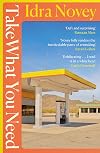
Take What You Need
by Idra Novey
On This Page
Description
A New York Times Editor's ChoiceNamed a Most Anticipated Book of 2023 by Oprah Daily, Vulture, Today.com, Elle, and Lit Hub.
â??A heart-rending book, but also a beautiful celebration of â??the glorious pleasure of erecting something new,â?? be it a work of art or a human connection.â?â??The Wall Street Journal
From â??one of the finest and bravest novelists at work today,â? (Vulture) award-winning writer Idra Novey has conjured a novel of â??astonishing and singularâ? show more honesty (Rumaan Alam) with two determined, unforgettable female voices.
Set in the Allegheny Mountains of Appalachia, Take What You Need traces the parallel lives of Jean and her beloved but estranged stepdaughter, Leah, whoâ??s sought a clean break from her rural childhood. In Leahâ??s urban life with her young family, sheâ??s revealed little about Jean, how much she misses her stepmotherâ??s hard-won insights and joyful lack of inhibition. But with Jeanâ??s death, Leah must return to sort through whatâ??s been left behind.
What Leah discovers is staggering: Jean has filled her ramshackle house with giant sculptures sheâ??s welded from scraps of the areaâ??s industrial history. Thereâ??s also a young man now living in the house who played an unknown role in Jeanâ??s last years and in her art.
With great verve and humor, Idra Novey zeros in on the joys and difficulty of family, the ease with which we let distance mute conflict, and the power we can draw from creative pursuits.
Take What You Need explores the continuing mystery of the people we love most with passionate and resonance, this novel illuminating can be built from what others have discardedâ??art, unexpected friendship, a n show less
Tags
Recommendations





































Member Reviews
“I thought I could be both. Mostly grandmother, and on occasion a bit wolf.” —
Idra Novey, “ Take What You Need”
Little Red Riding Hood is not the only fairy-tale allusion in Idra Novey's striking 2023 novel. The story may also remind readers of Cinderella or any fairy tale with a wicked stepmother. Is Jean, Leah's stepmother, wicked or not? Is she the grandmother or the wolf?
Leah loved her stepmother when she was a little girl, but Jean's marriage to her father didn't last, and the two were separated for many years. A reunion a few years before left Leah questioning her previous affection for Jean, and they parted under unpleasant circumstances. Now with a family of her own, Leah learns Jean has died and she is invited by a show more man named Elliott to come to Jean's house to, in effect, "take what you need."
In alternate chapters we read Leah's story in the present and Jean's story filling in the time between her marriage to Leah's father and her own death from falling off a sculpture in her own home.
Jean is a frustrated artist who uses her retirement years to create sculptures in her living room. She calls them Manglements. Her art is made from scrap metal, discarded mirrors and other junk found in her Appalachian town —"take what you need," in other words. Eventually it becomes so enormous, yet so impressive, that after her death nobody knows what to do with it.
Elliott is a young man with no apparent future, but with an unsuspected appreciation for art. He provides the muscle for her work and eventually moves in with her. In between he often breaks into her house at night (while she listens from her bed) and steals things — once again, "take what you need."
The novel's three major characters have complex relationships with one another, each of them mostly grandmother, and on occasion a bit wolf. show less
Idra Novey, “ Take What You Need”
Little Red Riding Hood is not the only fairy-tale allusion in Idra Novey's striking 2023 novel. The story may also remind readers of Cinderella or any fairy tale with a wicked stepmother. Is Jean, Leah's stepmother, wicked or not? Is she the grandmother or the wolf?
Leah loved her stepmother when she was a little girl, but Jean's marriage to her father didn't last, and the two were separated for many years. A reunion a few years before left Leah questioning her previous affection for Jean, and they parted under unpleasant circumstances. Now with a family of her own, Leah learns Jean has died and she is invited by a show more man named Elliott to come to Jean's house to, in effect, "take what you need."
In alternate chapters we read Leah's story in the present and Jean's story filling in the time between her marriage to Leah's father and her own death from falling off a sculpture in her own home.
Jean is a frustrated artist who uses her retirement years to create sculptures in her living room. She calls them Manglements. Her art is made from scrap metal, discarded mirrors and other junk found in her Appalachian town —"take what you need," in other words. Eventually it becomes so enormous, yet so impressive, that after her death nobody knows what to do with it.
Elliott is a young man with no apparent future, but with an unsuspected appreciation for art. He provides the muscle for her work and eventually moves in with her. In between he often breaks into her house at night (while she listens from her bed) and steals things — once again, "take what you need."
The novel's three major characters have complex relationships with one another, each of them mostly grandmother, and on occasion a bit wolf. show less
Told in alternating voices of Jean, the stepmother, and Leah, the stepdaughter, who have been estranged for many years. Though devoted to Leah, Jean divorced Leah's father when she was ten because of the father's emotionally abusive behavior toward Jean. Always an outsider in the rural Appalachian community both because she was Jewish and longed to be an artist, Jean is both unwilling and unable to leave the community. She inherits her father's home in a distressed neighborhood and begins to weld sculptures in the living room using scrap metal from a family junk yard.
Leah has grown up, become multilingual, married a man from Chile, and has a young son. She is contacted by Elliot, a man living with Jean, to tell her that Jean has died show more and left all of her art to Leah. While Jean's chapters precede her death, Leah's chapters take place in the aftermath of Jean's death, chronicling her return, with her blended family, to the depressed Appalachian community rife with excessive nationalism and bigotry.
In a relatively short book, the author explores the inner drive to create. And the contrast between lives that have access to education and opportunity and those who do not. It's a thought provoking novel and I look forward to more of this author's writing. show less
Leah has grown up, become multilingual, married a man from Chile, and has a young son. She is contacted by Elliot, a man living with Jean, to tell her that Jean has died show more and left all of her art to Leah. While Jean's chapters precede her death, Leah's chapters take place in the aftermath of Jean's death, chronicling her return, with her blended family, to the depressed Appalachian community rife with excessive nationalism and bigotry.
In a relatively short book, the author explores the inner drive to create. And the contrast between lives that have access to education and opportunity and those who do not. It's a thought provoking novel and I look forward to more of this author's writing. show less
This is about a woman and her stepmother, and their difficult relationship. At different times in their lives, they have been very close and very distant, and this novel gives us each of their points of view about what brought them close and pushed them apart. Looming over all of this is the stepmother's art: she compulsively welds large sculptures, often risking life and limb to do so.
Novey does some interesting things with the two characters' points of view, depicting the same scenes through both characters' eyes so that readers can see how they misinterpret and misunderstand each other. None of the main characters are particularly likeable, and the ending of the book is rather abrupt.
Novey does some interesting things with the two characters' points of view, depicting the same scenes through both characters' eyes so that readers can see how they misinterpret and misunderstand each other. None of the main characters are particularly likeable, and the ending of the book is rather abrupt.
Missed connections, false perceptions and good intentions. I can't believe I never heard of Novey. She is a creative, beautiful writer with quirky, compelling characters which is right up my alley. Jean and Leah tell of their lives in alternating chapters but never come together in this novel. When Jean and Leah were separated by an acrimonious divorce, they remained as potent forces in thought but rarely in person. What brings them together if Jean's bequest to Leah of her manglements, decades of creativity for its own sake. Into all of this comes a lost boy, Elliot.
ean left her marriage when her stepdaughter Leah was ten years old. The two were completely out of contact until four years previously when Jean had invited Leah for a visit.
The area where the family had lived, and where Jean still lives, has deteriorated into a rough, poverty stricken, almost abandoned town in Appalachia. Jean has become a sculptor of derelict metal and other scraps which she fashions into huge works that she calls manglements. Jean has befriended a young, alcohol-driven, gun carrying very red-neck young man to help her with the heavy work.
The reunion between Lean and Jean failed when Jean took Leah to a favorite overlook and the young man helper appeared as part of a group of men that terrorized Leah. When Leah show more perceived that Jean has chosen helping this young man rather than nurturing her daughter, Leah once again put the relationship behind her.
Now Leah has received a phone call that her mother has died while working on her sculptures. It’s up to Leah to decide what to do with Jean’s beloved manglements and the frightening young man that Jean was trying to help.
It’s a bit ironic that this is a story of good intentions, high expectations and failed connections because that is how I would describe how the book worked (or did not quite work) for me. show less
The area where the family had lived, and where Jean still lives, has deteriorated into a rough, poverty stricken, almost abandoned town in Appalachia. Jean has become a sculptor of derelict metal and other scraps which she fashions into huge works that she calls manglements. Jean has befriended a young, alcohol-driven, gun carrying very red-neck young man to help her with the heavy work.
The reunion between Lean and Jean failed when Jean took Leah to a favorite overlook and the young man helper appeared as part of a group of men that terrorized Leah. When Leah show more perceived that Jean has chosen helping this young man rather than nurturing her daughter, Leah once again put the relationship behind her.
Now Leah has received a phone call that her mother has died while working on her sculptures. It’s up to Leah to decide what to do with Jean’s beloved manglements and the frightening young man that Jean was trying to help.
It’s a bit ironic that this is a story of good intentions, high expectations and failed connections because that is how I would describe how the book worked (or did not quite work) for me. show less
Just an observation, but what's with books having no quotation marks but yet they are conversations?
Set in the Alleghany mountains, Leah has been somewhat estranged from Jean, her stepmother for years. She dies and has to deal with her house and her sculptures that she left too. She finds out from some guy named Elliott who she comes to find out is Jean's next door neighbor -- just a kid when Jean met him. His family lived next door and asked to fill their water bottles from her spigot since they didn't have running water. They needed to pay their water bill. He ended up helping her with her "manglements" made out of steel.
The chapters alternate between Jean (before she died) and Leah (after) are told in first person.
I'm not sure why I show more found this book weird and I don't know why, but I did and it's hard for me to review. It might be the first time I've given a review of 2 stars of a book I finished. I didn't want to finish it but kept going since it was fast reading and I wanted to find out what was going to happen. show less
Set in the Alleghany mountains, Leah has been somewhat estranged from Jean, her stepmother for years. She dies and has to deal with her house and her sculptures that she left too. She finds out from some guy named Elliott who she comes to find out is Jean's next door neighbor -- just a kid when Jean met him. His family lived next door and asked to fill their water bottles from her spigot since they didn't have running water. They needed to pay their water bill. He ended up helping her with her "manglements" made out of steel.
The chapters alternate between Jean (before she died) and Leah (after) are told in first person.
I'm not sure why I show more found this book weird and I don't know why, but I did and it's hard for me to review. It might be the first time I've given a review of 2 stars of a book I finished. I didn't want to finish it but kept going since it was fast reading and I wanted to find out what was going to happen. show less
Excellent subtle book focusing on a woman living in the depressed Appalachian Valley who has weird relationships with pretty much everyone. She is an artist creating unique works of art. Amazing book. Not sure who will like it.
Members
- Recently Added By
Lists

Books Read in 2023
5,547 works; 145 members

Dublin Literary Award 2024 Longlist
66 works; 4 members

Books Read in 2024
4,623 works; 126 members
Author Information

10+ Works 855 Members
Awards and Honors
Common Knowledge
- Canonical title
- Take What You Need
- Epigraph
- Every day you have to abandon your past or accept it, and then, if you cannot accept it, you become a sculptor.
—Louise Bourgeois - Dedication
- for Gerry and Barbara
- First words
- This morning, I read that repeating the name of the deceased can quiet the mind when grieving for a complicated person. My stepmother Jean was a complicated person. I've been reading all kinds of advice since hearing of her d... (show all)eath. I didn't know that she'd begun to weld metal towers in her living room, towers so tall she needed a ladder to complete them. Apparently, that's how she died, slipping from one of her ladder's highest rungs. -Chapter 1
- Last words
- (Click to show. Warning: May contain spoilers.)Let's say this person will carry some of the discards to the car and then into the house, where they will begin assembling a sculpture of their own.
- Blurbers
- Greenwell, Garth; Alam, Rumaan; Cruz, Angie; Hong, Cathy Park; Leilani, Raven; Bell, Matt (show all 7); Dark, Alice Elliot
- Canonical DDC/MDS
- 813.6
- Canonical LCC
- PS3614.O928
Classifications
Statistics
- Members
- 205
- Popularity
- 158,989
- Reviews
- 7
- Rating
- (3.70)
- Languages
- English
- Media
- Paper, Audiobook, Ebook
- ISBNs
- 6
- ASINs
- 2