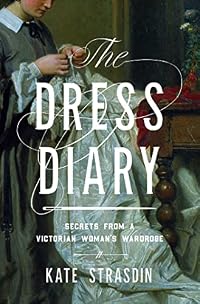
The Dress Diary: Secrets from a Victorian Woman's Wardrobe
by Kate Strasdin
On This Page
Description
A revealing and unique portrait of Victorian life as told through the discovery of one woman's textile scrapbook. In 1838, a young woman was given a diary on her wedding day. Collecting snippets of fabric from a range of garments, some her own, others donated by family and friends, she carefully annotated each one, creating a unique record of their lives. Her name was Mrs. Anne Sykes. Nearly two hundred years later, the diary fell into the hands of Kate Strasdin, a fashion historian and show more museum curator. Using her expertise, Strasdin spent the next six years unraveling the secrets contained within the album's pages, and the lives of the people within. Her findings are remarkable. Piece by piece, she charts Anne's journey from the mills of Lancashire to the port of Singapore before tracing her return to England in later years. Fragments of cloth become windows into Victorian life: pirates in Borneo, the complicated etiquette of mourning, poisonous dyes, the British Empire in full swing, rioting over working conditions, and the terrible human cost of Britain's cotton industry. This is life writing that celebrates ordinary people: not the grandees of traditional written histories, but the hidden figures, the participants in everyday life. Through the evidence of waistcoats, ball gowns, and mourning outfits, Strasdin lays bare the whole of human experience in the most intimate of mediums: the clothes we choose to wear. show lessTags
Recommendations






Member Reviews
A lovely bit of social and material history centered on the "dress diary" kept by one English woman during the 19th century. Anne Sykes is not ordinarily the kind of person about whom a work of history would be written—she wasn't a public figure or a member of a great family, wasn't caught up in some famous historical event, wasn't the author of great literature or even a surviving cache of letters. We have no photos of her, and much of what we know of her life comes from terse references in official records or census returns.
But her "dress diary"—a scrapbook containing hundreds of swatches of fabric from clothing and other items owned by Anne, her friends and family—survives, each with a brief annotation in tiny copperplate show more writing. Anne kept her diary for decades, and it travelled with her from England to Singapore and China and back again, as her husband's business required.
Kate Strasdin does a great job of piecing together the clues provided by the diary to fill out as much as she can about the Sykes, thinking through what a historian can or cannot know—we can touch samples of the same cloth that touched Anne's skin or covered her armchairs, for instance, an odd kind of intimacy, but we will likely never know if her marriage was a happy one or what she thought of her world travels. Strasdin also uses individual fabric swatches as jumping off points to talk about the broader history of the 19th century, everything from the invention of aniline dyes to Borneo pirates. There are a couple of places where she's briefly giving deeper historical background on certain topics where she bobbles things a bit—Sir John Mandeville didn't see cotton in India in the 14th century because he was a fictional character/persona—but on the whole I found this an engaging and multifaceted read. show less
But her "dress diary"—a scrapbook containing hundreds of swatches of fabric from clothing and other items owned by Anne, her friends and family—survives, each with a brief annotation in tiny copperplate show more writing. Anne kept her diary for decades, and it travelled with her from England to Singapore and China and back again, as her husband's business required.
Kate Strasdin does a great job of piecing together the clues provided by the diary to fill out as much as she can about the Sykes, thinking through what a historian can or cannot know—we can touch samples of the same cloth that touched Anne's skin or covered her armchairs, for instance, an odd kind of intimacy, but we will likely never know if her marriage was a happy one or what she thought of her world travels. Strasdin also uses individual fabric swatches as jumping off points to talk about the broader history of the 19th century, everything from the invention of aniline dyes to Borneo pirates. There are a couple of places where she's briefly giving deeper historical background on certain topics where she bobbles things a bit—Sir John Mandeville didn't see cotton in India in the 14th century because he was a fictional character/persona—but on the whole I found this an engaging and multifaceted read. show less
Kate Strasdin is a fashion historian, museum curator, and academic. When a friend gave her a Victorian-era “dress diary” found in a London market stall, she was fascinated by its 400+ pages of fabric scraps and captions. But whose diary was this? Where did they live, and how did they amass such a sizable collection? The captions provided minimal information, usually just a name and date, but well into the diary Strasdin found one written in the first person. The diary was a gift to Anne Sykes from her husband Adam, soon after their 1838 wedding. Adam filled the first page with fabrics from Anne’s wedding attire; Anne continued collecting fabric into the 1860s, from her own wardrobe as well as contributions from family and show more friends.
Through extensive public records research, Strasdin pieced together Anne’s life story, identified many of the (mostly) women who contributed scraps to this lifelong pursuit, and described how Victorian fashion and the global fabric trade influenced their wardrobes and home decor. Yet even as Anne and her contemporaries were brought to life, so much about them remains tantalizingly just out of reach. Even if you have only dabbled in genealogical research you will understand the excitement of making a verified connection, the disappointment when a person simply cannot be found, and the frustration of never knowing details of their daily lives, thoughts, and emotions.
I also enjoyed Strasdin’s forays Into the development of textiles and dye methods, and how they shaped fashion (and vice versa). The need to remain anchored in Anne’s story often limited the depth of these topics, but the author’s Notes on Sources can be a jumping-off point for further reading. show less
Through extensive public records research, Strasdin pieced together Anne’s life story, identified many of the (mostly) women who contributed scraps to this lifelong pursuit, and described how Victorian fashion and the global fabric trade influenced their wardrobes and home decor. Yet even as Anne and her contemporaries were brought to life, so much about them remains tantalizingly just out of reach. Even if you have only dabbled in genealogical research you will understand the excitement of making a verified connection, the disappointment when a person simply cannot be found, and the frustration of never knowing details of their daily lives, thoughts, and emotions.
I also enjoyed Strasdin’s forays Into the development of textiles and dye methods, and how they shaped fashion (and vice versa). The need to remain anchored in Anne’s story often limited the depth of these topics, but the author’s Notes on Sources can be a jumping-off point for further reading. show less
I really enjoyed this nonfiction book. The author comes upon a "dress diary" - a journal with over 2000 small swatches of fabric that are described briefly. Sometimes the description says who wore the dress, the event it was worn for, or what the fabric was used for (usually women's dresses, sometimes a man's vest, or upholstery). [[Strasdin]] is able to figure out the owner of the book, Anne Sykes, from one of the entries. After finding her name, she begins to piece together tidbits about this Victorian-Era woman's life. British Anne Sykes spent time in Singapore and China with her husband. Her journal is filled with swatches of fabric that her friends and family wore.
In addition to try to illuminate Anne Sykes life, Strasdin uses the show more book to other aspects of life for Victorian women. She explores the textile industry, laundering/mending clothes, dyeing practices, friendship, living abroad, mourning rituals, etc.
The information is a bit light on depth - but it gave me a lot to think about and I was fascinated by the idea of this journal existing and being studied so many years later. I definitely recommend. show less
In addition to try to illuminate Anne Sykes life, Strasdin uses the show more book to other aspects of life for Victorian women. She explores the textile industry, laundering/mending clothes, dyeing practices, friendship, living abroad, mourning rituals, etc.
The information is a bit light on depth - but it gave me a lot to think about and I was fascinated by the idea of this journal existing and being studied so many years later. I definitely recommend. show less
Anne Sykes was born in Manchester to a family of cloth workers. She married a cloth merchant and travelled with him to Singapore and Shanghai before settling back in the North-West. However her story has only been unearthed when Strasdin was given a battered book, one in which Anne Sykes had documented clothing and household textiles throughout her married life. Strasdin has researched the life of Anne Sykes and her friends and family through the remnants of family. However the story is more than just this, the lives are placed into the context in which they were used, a history of fashion, textile manufacture, trade with the East and the development of industry in England. It's an endlessly fascinating tale.
How I have enjoyed both Anne's journey and also Kate Strasdin's journey tracing her and her world.
19th C englishwoman kept a scrapbook of fabric swatches. historian draws out the stories she can dig up.
Ratings
Members
- Recently Added By
Lists

TBR of Books I Don't Own
132 works; 1 member
Author Information

5 Works 247 Members
Kate Strasdin is Senior Lecturer in Cultural Studies at the Fashion and Textiles Institute, Falmouth University, UK, and a Visiting Lecturer at DeTao Masters Academy in Shanghai, China. She is Deputy Curator at the Totnes Fashion and Textile Museum, one of the largest private collections of dress in the UK.
Awards and Honors
Awards
Distinctions
Notable Lists
Common Knowledge
- Original publication date
- 2023
- People/Characters
- Anne Sykes
- Important places
- Lancashire, England, UK; Singapore; Shanghai, China
- Dedication
- For Stuart
- First words
- (Preface) In January of 2016 I was given an extraordinary gift. (Preface)
The very first page of my book, now bulging with the fabrics of many lives, began with just two people: Anne and Adam Sykes and their wedding, which took place on 20 September 1838 in St. George's Church, Tyldesley, an indust... (show all)rial town near Manchester. - Last words
- (Click to show. Warning: May contain spoilers.)Not through her written word do we find these women, and Anne Sykes herself, but through these precious pieces of cloth.
- Blurbers
- Finlay, Victoria; Knight, Lynn; Flanders, Judith; Hunter, Clare; Graham, Ysenda Maxtone; Anderson, Hephzibah
- Original language
- English
Classifications
- Genres
- History, Art & Design, General Nonfiction, Nonfiction, Sexuality and Gender Studies, Biography & Memoir
- DDC/MDS
- 391.00941 — Society, Government, and Culture Customs, etiquette & folklore Costume and personal appearance Standard subdivisions History, geographic treatment, biography Europe British Isles
- LCC
- GT737 .S77 — Geography, Anthropology and Recreation Manners and customs (General) Manners and customs (General) Costume. Dress. Fashion
- BISAC
Statistics
- Members
- 219
- Popularity
- 148,224
- Reviews
- 6
- Rating
- (3.93)
- Languages
- English
- Media
- Paper, Audiobook, Ebook
- ISBNs
- 10
- ASINs
- 5