On This Page
Description
"A truly wonderful writer...marvellously readable, lucid, simple, absolutely in tune with that world he creates.". HTML:Monsieur Monde is a successful middle-aged businessman in Paris. One morning he walks out on his life, leaving his wife asleep in bed, leaving everything.
Not long after, he surfaces on the Riviera, keeping company with drunks, whores and pimps, with thieves and their marks. A whole new world, where he feels surprisingly at home--at least for a while.
Georges Simenon knew show more how obsession, buried for years, can come to life, and about the wreckage it leaves behind. He had a remarkable understanding of how bizarrely unaccountable people can be. And he had an almost uncanny ability to capture the look and feel of a given place and time. Monsieur Monde Vanishes is a subtle and profoundly disturbing triumph by the most popular of the twentieth century's great writers.
. show less
Tags
Recommendations































Member Reviews
I am beginning to see why Anita Brookner and so many others--the introduction here is by Larry McMurtry--love Georges Simenon so much. He is an exemplar of the spare style. This comes across quite well in translation since much of what he writes about is concrete: acts and things, showing versus telling. Though Simenon does have his philosophical flights, they are usually brief. Sartre he isn't, thank goodness. The storyline is simple: a Parisian businessman, fed up with life, drops out of sight, vanishes. The adventure he then has marks him in a way not entirely expected. The following is a cliché said about certain writers but here it is also true. One feels that Simenon does not waste a single word. Everything works harmoniously. He show more upends expectations, surprises and excites. He entertains. Apparently, he would write about six or seven such books per year. In a bad year only two or three. ; ) show less
"I have made love to ten thousand women." - Georges Simenon
Fortunately for his reading pubic, Georges took out time to also write over 400 novels.
When Belgian novelist Georges Simenon (1903-1989) neared his 70th birthday, he unplugged his typewriter and abruptly stopped writing. But one thing is certain: nobody could ever accuse Simenon of being a slacker, for after all, he authored over 200 novels under his own name (including dozens of crime novels featuring a detective, one Inspector Jules Maigret) and 300 novels under various noms de plume. So, in terms of sheer numbers, this novel, the subject of my review, is simply one of many. However, if Monsieur Monde Vanishes was Simenon’s one and only work of fiction, I wonder if the show more author would be considered a key existentialist and this book a classic study of identity and alienation.
On the topic of identity and alienation, one prime text is Erich Fromm’s The Sane Society and it is this classic of social psychology I will quote below and pair with my commentary as a way of highlighting the wisdom nectar contained in Georges Simenon’s fine novel.
“By alienation is meant a mode of experience in which the person experiences himself as an alien. He has become, one might say, estranged from himself. He does not experience himself as the center of his world, as the creator of his own acts—but his acts and their consequences have become his masters, whom he obeys, or whom he may even worship.” ---------- Monsieur Monde turns forty-eight but will his wife, his son, his daughter, his business associates remember and wish him a happy birthday? Is Monsieur the center of his own world? Is he really alive? Monsieur recognizes the answer to all of the above is “no” - at the same time he also realizes it is time to make a quick exit from his comfortable, predictable, deadening upper-upper-middle class life and hit the road. And that is exactly what Monsieur does.
“Man cannot live statically because his inner contradictions drive him to seek for an equilibrium.” ---------- Monsieur Monde has been living in his role as an ideal husband, father and business leader. But enough is enough – life is much more, much richer, much freer beyond the stifling boundaries of role. He takes the dramatic first step in shedding his role. We read, “Near Boulevard Sebastopol he noticed a third-rate barbershop and went in, took his place in line behind other customers, and, when his turn came to sit in the hinged chair, told the barber to shave off his mustache.” Shave off his mustache! It doesn’t get more dramatic than that for such a solid, stolid, sedentary member of the bourgeoisie.
“Thus, the ultimate choice for man, inasmuch as he is driven to transcend himself, is to create or to destroy, to love or to hate.” ---------- After the shaving of his mustache, Monsieur begins to feel the ecstasy of release, the bliss of transformation. The author writes about Monsieur’s transformation with such subtlety and tenderness, a true master of the craft of developing character. The subsequent events in the novel are made all the richer by the reality of the ‘new’ Monsieur Monde.
“As with the need for relatedness, rootedness, and transcendence, this need for a sense of identity is so vital and imperative that man could not remain sane if he did not find some way of satisfying it.” ---------- After setting out with his new Self, Monsieur senses the risk and dangers involved in shedding habitual categories, as in when the author writes, “He did not know where he was going or what he would do. He had set off. Nothing lay behind him any more: nothing lay before him. He was in space.”
“All passions and strivings of man are attempts to find an answer to his existence or, as we may also say, they are an attempt to avoid insanity.” ---------- “He was lucid, not with an everyday lucidity, the sort one finds acceptable, but on the contrary the sort of which one subsequently feels ashamed, perhaps because it confers on supposedly commonplace things the grandeur ascribed to them by poetry and religion.” Monsieur Monde is better able to sense the answer to the riddles: Does a dog have the Buddha nature? What is the sound of one hand clapping?
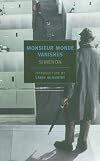
“The fact that millions of people share the same vices does not make these vices virtues. The fact that they share so many errors does not make the errors to be truths, and the fact that millions of people share the same forms of mental pathology does not make these people sane.” --------- Is it time for serious transformation in your life? Need some inspiration? Go ahead – pick up this petite jewel published by New York Review Books (NYRB) featuring an introductory essay by Larry McMurtry and cover photo from Jacques Tati’s Playtime. It just might prove to be the right first step leading to something big. show less
"I have made love to ten thousand women." - Georges Simenon
Fortunately for his reading pubic, Georges took out time to also write over 400 novels.
When Belgian novelist Georges Simenon (1903-1989) neared his 70th birthday, he unplugged his typewriter and abruptly stopped writing. But one thing is certain: nobody could ever accuse Simenon of being a slacker, for after all, he authored over 200 novels under his own name (including dozens of crime novels featuring a detective, one Inspector Jules Maigret) and 300 novels under various noms de plume. So, in terms of sheer numbers, this novel, the subject of my review, is simply one of many. However, if Monsieur Monde Vanishes was Simenon’s one and only work of fiction, I wonder if the show more author would be considered a key existentialist and this book a classic study of identity and alienation.
On the topic of identity and alienation, one prime text is Erich Fromm’s The Sane Society and it is this classic of social psychology I will quote below and pair with my commentary as a way of highlighting the wisdom nectar contained in Georges Simenon’s fine novel.
“By alienation is meant a mode of experience in which the person experiences himself as an alien. He has become, one might say, estranged from himself. He does not experience himself as the center of his world, as the creator of his own acts—but his acts and their consequences have become his masters, whom he obeys, or whom he may even worship.” ---------- Monsieur Monde turns forty-eight but will his wife, his son, his daughter, his business associates remember and wish him a happy birthday? Is Monsieur the center of his own world? Is he really alive? Monsieur recognizes the answer to all of the above is “no” - at the same time he also realizes it is time to make a quick exit from his comfortable, predictable, deadening upper-upper-middle class life and hit the road. And that is exactly what Monsieur does.
“Man cannot live statically because his inner contradictions drive him to seek for an equilibrium.” ---------- Monsieur Monde has been living in his role as an ideal husband, father and business leader. But enough is enough – life is much more, much richer, much freer beyond the stifling boundaries of role. He takes the dramatic first step in shedding his role. We read, “Near Boulevard Sebastopol he noticed a third-rate barbershop and went in, took his place in line behind other customers, and, when his turn came to sit in the hinged chair, told the barber to shave off his mustache.” Shave off his mustache! It doesn’t get more dramatic than that for such a solid, stolid, sedentary member of the bourgeoisie.
“Thus, the ultimate choice for man, inasmuch as he is driven to transcend himself, is to create or to destroy, to love or to hate.” ---------- After the shaving of his mustache, Monsieur begins to feel the ecstasy of release, the bliss of transformation. The author writes about Monsieur’s transformation with such subtlety and tenderness, a true master of the craft of developing character. The subsequent events in the novel are made all the richer by the reality of the ‘new’ Monsieur Monde.
“As with the need for relatedness, rootedness, and transcendence, this need for a sense of identity is so vital and imperative that man could not remain sane if he did not find some way of satisfying it.” ---------- After setting out with his new Self, Monsieur senses the risk and dangers involved in shedding habitual categories, as in when the author writes, “He did not know where he was going or what he would do. He had set off. Nothing lay behind him any more: nothing lay before him. He was in space.”
“All passions and strivings of man are attempts to find an answer to his existence or, as we may also say, they are an attempt to avoid insanity.” ---------- “He was lucid, not with an everyday lucidity, the sort one finds acceptable, but on the contrary the sort of which one subsequently feels ashamed, perhaps because it confers on supposedly commonplace things the grandeur ascribed to them by poetry and religion.” Monsieur Monde is better able to sense the answer to the riddles: Does a dog have the Buddha nature? What is the sound of one hand clapping?
“The fact that millions of people share the same vices does not make these vices virtues. The fact that they share so many errors does not make the errors to be truths, and the fact that millions of people share the same forms of mental pathology does not make these people sane.” --------- Is it time for serious transformation in your life? Need some inspiration? Go ahead – pick up this petite jewel published by New York Review Books (NYRB) featuring an introductory essay by Larry McMurtry and cover photo from Jacques Tati’s Playtime. It just might prove to be the right first step leading to something big. show less
I saw some mentions of this being noir & I suppose it is, in a way. (It's also a bit blatantly obvious about the main character's "everyman" status since he is named named "Monsieur Monde".) The everyman here is a rich & successful businessman who walks away from his Parisian life one day, just disappearing from work & home life. A short time later he resurfaces in Nice, living with a pseudonym, a lower class job, mingling with "regular" people, living a "regular" life. While there are some deeper philosophical & psychological musings to be made, they aren't made in the novel itself as it is a fairly straight retelling of Monde's actions day to day & not much more. Overall, the book was fine, but Monde had such a flat affect as a show more character that I never felt fully pulled into his journey. True to its everyman status, it is a book I neither disliked nor loved, a squarely okay novel about which I mostly feel ambivalent. show less
Monsieur Monde is a moderately successful, though extremely wealthy businessman, living in the house where he was born with his second wife, and his two children from his fist marriage. One day, he simply disappears, and fetches up in Marseilles. Mid-life crisis? Perhaps. He seems to allow things to happen to him. He drifts along with the people he happens upon, and seems to sense that everything that happens to him is in some way pre-ordained. The thieves, gamblers and prostitutes of his new life, and the woman ... spoiler alert ... whom he helps cause him to go back home at last, wanly resigned to the previous status quo. A disturbing and understated story of obsession, which captures the feeling of the places Monsieur Monde show more temporarily calls home. show less
character driven, good read. interesting introduction to this edition by Larry McMurtry.
A minor effort by Simenon. Not nearly as engaging as other novels of his that I have read.
Members
- Recently Added By
Lists

Top Five Books of 2013
1,562 works; 715 members
Author Information

1,336+ Works 63,275 Members
The prolific Belgian-born writer Georges Simenon produced hundreds of fictional works under his own name and 17 pseudonyms, in addition to more than 70 books about Inspector Maigret, long "the favorite sleuth of highbrow detective-story readers" (SR). More than 50 "Simenons" have been made into films. In addition to his mystery stories, he wrote show more what he called "hard" books, the serious psychological novels numbering well over 100. The autobiographical Pedigree, set in his native town of Liege, is perhaps his finest work. The publication of Simenon's intimate memoirs also attracted considerable attention. Simenon himself once said that he would never write a "great novel." Yet Gide called him "a great novelist, perhaps the greatest and truest novelist we have in French literature today," and Thornton Wilder (see Vol. 1) found that Simenon's narrative gift extends "to the tips of his fingers." The following are some of Simenon's novels, exclusive of the Maigret detective stories, that are in print. (Bowker Author Biography) Georges Simenon was born on February 13, 1903 in Liege, Belgium. He wrote more than 200 fiction works under 16 different pseudonyms. His first book, The Case of Peter the Lent led to 80 more of the like including the main character, Inspector Maigret. He published over 400 books that were translated into 50 different languages and sold by the millions. He also wrote psychological novels, including The Man Who Watched the Train Go By. He died on September 4, 1989 in Lausanne. (Bowker Author Biography) show less
Some Editions
Series

Work Relationships
Common Knowledge
- Canonical title
- Monsieur Monde Vanishes
- Original title
- La fuite de Monsieur Monde
- Original publication date
- 1945 (French) (French); 1967 (English translation) (English translation)
- People/Characters*
- Norbert Monde
- Important places*
- Marseille, Bouches-du-Rhône, Provence-Alpes-Côte d'Azur, France; Nice, Alpes-Maritimes, Provence-Alpes-Côte d'Azur, France
- First words*
- Il était cinq heures de l'après-midi, à peine un peu plus ─ une légère flexion de la grande aiguille vers la droite ─, quand, le 16 janvier, Mme Monde fit irruption, en même temps qu'un courant d'air glacé, dans la... (show all) salle commune du commissariat de police.
- Original language*
- Français
*Some information comes from Common Knowledge in other languages. Click "Edit" for more information.
Classifications
- Genres
- Fiction and Literature, General Fiction, Mystery
- DDC/MDS
- 843.912 — Literature & rhetoric French Literature French fiction 1900- 20th Century 1900-1945
- LCC
- PQ2637 .I53 .F813 — Language and Literature French, Italian, Spanish and Portuguese literatures French literature Modern literature 1900-1960
- BISAC
Statistics
- Members
- 379
- Popularity
- 83,103
- Reviews
- 12
- Rating
- (3.66)
- Languages
- 8 — Dutch, English, Finnish, French, German, Italian, Portuguese, Spanish
- Media
- Paper, Ebook
- ISBNs
- 14
- ASINs
- 5