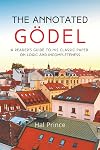
The Annotated Gödel: A Reader's Guide to his Classic Paper on Logic and Incompleteness
by Hal Prince, Kurt Gödel (Author)
On This Page
Description
"The Annotated Gödel offers a guided tour of Kurt Gödel's 1931 article on incompleteness, which demonstrated unexpected limits to the power of many logical systems. Today we call these results Gödel's First and Second Incompleteness Theorems. The book includes the complete article in a new English translation, interleaved with commentary that guides the reader through Gödel's work, step by step. The commentary concentrates on Gödel’s exposition. It describes what he is doing at each show more point, and how it relates to other parts of the article. It elaborates on his proofs by outlining them, for example, or by making a table of his variables and their uses, or by filling in gaps in his arguments. The translation uses modern mathematical notation and terminology. It replaces Gödel's function and relation names, based on German word fragments, with English equivalents. Its language is less formal than that of the existing translations, which date from the 1960s. The book assumes some familiarity with mathematical definitions and proofs, at the level of an undergraduate abstract math course. It also assumes some knowledge of formal logic, from an introductory course or the equivalent." -- show lessTags
Recommendations










Member Reviews
Does what it says on the tin, and contains only one typo that I spotted, so that's good.
However, this really *is* just an annotation of Gödel's paper, with very little added. In particular, there are no proper worked-through examples to provide a context for all the logic proofs, so at the end of the day, unless the reader is already familiar with the subject, he or she is likely to be left wondering, "OK, but so what?".
And one minor nitpick: for reasons that are unstated, the author has chosen to replace Gödel's original multiplication operator (.) with a centred dot; this leads to places where, for those of us who are from a country that use the same convention as Germany, and a centred dot has quite a different meaning, the text is show more harder to follow than it should be. I can't imagine why, if he felt the need to change the glyph used for the multiplication operator, he didn't use the ordinary "times" symbol (×) instead, since, as far as I know, that is unambiguous, at least in the relevant context.
Perhaps I'm being unfair: the author does a great job of rendering the original paper into comprehensible English, including switching Gödel's idiosyncratic naming into something much more accessible to an English speaker. Maybe that was all that he intended to do. But the subtitle if the book is "A Reader's Guide...", and this particular reader was expecting something rather less arcane, bridging the gap between the original paper and a hypothetical non-expert reader who wasn't already familiar with the subject. show less
However, this really *is* just an annotation of Gödel's paper, with very little added. In particular, there are no proper worked-through examples to provide a context for all the logic proofs, so at the end of the day, unless the reader is already familiar with the subject, he or she is likely to be left wondering, "OK, but so what?".
And one minor nitpick: for reasons that are unstated, the author has chosen to replace Gödel's original multiplication operator (.) with a centred dot; this leads to places where, for those of us who are from a country that use the same convention as Germany, and a centred dot has quite a different meaning, the text is show more harder to follow than it should be. I can't imagine why, if he felt the need to change the glyph used for the multiplication operator, he didn't use the ordinary "times" symbol (×) instead, since, as far as I know, that is unambiguous, at least in the relevant context.
Perhaps I'm being unfair: the author does a great job of rendering the original paper into comprehensible English, including switching Gödel's idiosyncratic naming into something much more accessible to an English speaker. Maybe that was all that he intended to do. But the subtitle if the book is "A Reader's Guide...", and this particular reader was expecting something rather less arcane, bridging the gap between the original paper and a hypothetical non-expert reader who wasn't already familiar with the subject. show less
Kurt Gödel was a mathematician. His work changed our understanding of mathematics. The Annotated Gödel is a book by Hal Prince. In the book, Prince explains Gödel's Incompleteness Theorems section by section. Prince also provides a new translation of the book that modernizes the text.
The Incompleteness Theorems are statements that proclaim their incompleteness. Gödel invented a method called Gödel Numbering and used arithmetic to provide proof. It's akin to saying this sentence is false.
Prince's book is not for the layman, but it does make Gödel's statements and methods more straightforward.
I enjoyed the book. It still wasn't easy to understand, but I did enjoy it. Thanks for reading my review, and see you next time.
The Incompleteness Theorems are statements that proclaim their incompleteness. Gödel invented a method called Gödel Numbering and used arithmetic to provide proof. It's akin to saying this sentence is false.
Prince's book is not for the layman, but it does make Gödel's statements and methods more straightforward.
I enjoyed the book. It still wasn't easy to understand, but I did enjoy it. Thanks for reading my review, and see you next time.
Members
- Recently Added By
Author Information

13+ Works 138 Members

Kurt Godel was probably the most outstanding logician of the first half of the twentieth century. Born in Czechoslovakia, Godel studied and taught in Vienna and then came to the United States in 1940 as a member of the Institute for Advanced Study at Princeton University. In 1953 he was made a professor at the institute, where he remained until show more his death in 1978. Godel is especially well known for his studies of the completeness of logic, the incompleteness of number theory, the consistency of the axiom of choice and the continuum hypothesis. Godel is also known for his work on constructivity, the decision problem, and the foundations of computation theory, as well as his views on the philosophy of mathematics; especially his support of a strong form of Platonism in mathematics. (Bowker Author Biography) show less
Classifications
Statistics
- Members
- 42
- Popularity
- 703,207
- Reviews
- 2
- Rating
- (4.50)
- Languages
- English
- Media
- Paper
- ISBNs
- 1
- ASINs
- 2