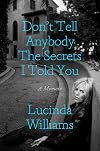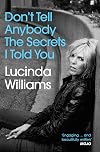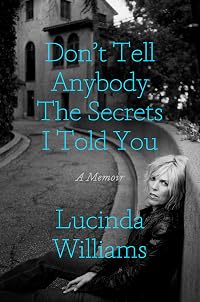
Don't Tell Anybody the Secrets I Told You: A Memoir
by Lucinda Williams
On This Page
Description
"The iconic singer-songwriter and three-time Grammy winner opens up about her traumatic childhood in the Deep South, her years of being overlooked in the music industry, and the stories that inspired her enduring songs. Lucinda Williams's rise to fame was anything but easy. Raised in a working-class family in the Deep South, she moved from town to town each time her father-a poet, a textbook salesman, a professor, a lover of parties-got a new job, totaling twelve different places by the time show more she was eighteen. Her mother suffered from severe mental illness and was in and out of hospitals. And when Williams was about a year old, she had to have an emergency tracheotomy-an inauspicious start for a singing career. But she was also born a fighter, and she would develop a voice that has captivated millions. In Don't Tell Anybody the Secrets I Told You, Williams takes readers through the events that shaped her music-from performing for family friends in her living room to singing at local high schools and colleges in Mexico City, to recording her first album with Folkway Records and headlining a sold-out show at Radio City Music Hall. She reveals the inspirations for her unforgettable lyrics, including the doomed love affairs with "poets on motorcycles" and the gothic southern landscapes of the many different towns of her youth, including Macon, Lake Charles, Baton Rouge, and New Orleans. Williams spent years working at health food stores and record stores during the day so she could play her music at night, and faced record companies who told her that her music was not "finished," that it was "too country for rock and too rock for country." But her fighting spirit persevered, leading to a hard-won success that spans seventeen Grammy nominations and a legacy as one of the greatest and most influential songwriters of our time. Raw, intimate, and honest, Don't Tell Anybody the Secrets I Told You is an evocative reflection on an extraordinary woman's life journey"-- show lessTags
Recommendations





Member Reviews
This memoir is as honest and no-frills as the songwriter herself. Her background, with a mother with mental illness and a mercurial poet father, sends Lucinda into the arms of many "poets on motorcycles", "cultural chameleons capable of jaw-dropping magic", the good bad boys or bad good boys, who fill her songbook. She loves to travel, feels comfortable commuting between LA, Nashville, and New Orleans. She didn't come into her fame until her forties, being "too rock for country and too country for rock". The song lyrics she includes in the book are lyrical poems, and to hear them sung in her gravel hard voice is to feel how her heart beats along with yours.
Quotes: "I think a lot of my decisions back then were fear-based. I had to grow show more through different levels of my work. I had trouble communicating what I felt and heard in my head. I wanted to rock before I was able to."
" It takes enormous fortitude to create the work in the first place, but then once it's time to put it out into the world, the confidence required to go public is unrelated to the audacity that created the work." show less
Quotes: "I think a lot of my decisions back then were fear-based. I had to grow show more through different levels of my work. I had trouble communicating what I felt and heard in my head. I wanted to rock before I was able to."
" It takes enormous fortitude to create the work in the first place, but then once it's time to put it out into the world, the confidence required to go public is unrelated to the audacity that created the work." show less
I've been a fan of Lucinda Williams for 25 years or so, and she's certainly an artist I wanted to learn more about. This memoir has been described as "honest and raw" and I'd say that's on the mark. She's certainly open about her own faults and vulnerabilities, as well as the many times she's been discarded or marginalized by men in the music industry. You'll learn how she grew up with a schizophrenic mom and poet dad, and how her family dynamic affected her artistry and her relationships. You'll learn how this gifted songwriter was selling sausages and smoothies (and other odd jobs) well into her thirties because she'd yet to land her big break.
You'll learn about her time in Flannery O'Connor's house, how Rodney Crowell posted bail show more for her college-aged friends, how Steve Earle influenced her seminal album "Car Wheels on a Gravel Road", and how Rick Rubin - without malice - put her breakthrough album on hold for two years. She sheds some light on her brief, intense relationships with fellow musicians Ryan Adams and Paul Westerberg. And most importantly, she talks about what inspired so many of her truly hypnotic, poetic songs. Her insights and 'secrets' have transformed some of those songs for me, and given them even more layers of meaning.
I will say, I listened to Lu read this as an audiobook and her thick, slow New Orleans drawl takes some getting used to. You might want to listen to a sample before downloading the audiobook to make sure you will enjoy her speaking voice (vs. buying the hardback or digital book version). But her "voice" as a writer and storyteller is phenomenally strong, so don't pass up this book in whatever format if you enjoy Lucinda's music and want to know more about how she became the unique artist she grew into. show less
You'll learn about her time in Flannery O'Connor's house, how Rodney Crowell posted bail show more for her college-aged friends, how Steve Earle influenced her seminal album "Car Wheels on a Gravel Road", and how Rick Rubin - without malice - put her breakthrough album on hold for two years. She sheds some light on her brief, intense relationships with fellow musicians Ryan Adams and Paul Westerberg. And most importantly, she talks about what inspired so many of her truly hypnotic, poetic songs. Her insights and 'secrets' have transformed some of those songs for me, and given them even more layers of meaning.
I will say, I listened to Lu read this as an audiobook and her thick, slow New Orleans drawl takes some getting used to. You might want to listen to a sample before downloading the audiobook to make sure you will enjoy her speaking voice (vs. buying the hardback or digital book version). But her "voice" as a writer and storyteller is phenomenally strong, so don't pass up this book in whatever format if you enjoy Lucinda's music and want to know more about how she became the unique artist she grew into. show less
I'm not a fan of celebrity memoirs, but I love Lucinda Williams' music (she is one of only a few live concerts I've gone to in later life), so I picked this up. I know a lot of her songs pretty well, and what I probably liked best about this book was her descriptions of how and when she wrote the lyrics and what events in her life they related to and what people.
I also liked learning about her growing up years--she led a pretty peripatetic life in those years, with a father moving for a series of teaching jobs at colleges and schools, mostly in the the south, but with a couple of stints in LA, a year in Chile and a year in Mexico, until he finally got tenure at the University of Arkansas. Lucinda never graduated from high school, and in show more fact she was getting herself expelled from high school in New Orleans around 1968, after she and her friends spent their time wandering around New Orleans, uptown and in the Quarter. Around this time, I arrived in New Orleans to start college, and I like to think our paths might have crossed on the streetcar or the "Freret Jet" or in some coffee shop.
I also found interesting her experiences showing how difficult it was (and still might be) for a musician, particularly a female musician to control how they want their music to sound. By taking control of her "sound" Lucinda got labeled as "difficult." a label that a male artist probably would not have been given. After years of being overlooked, but constantly plugging away, years that shaped her music, Lucinda became an "overnight" success.
I would recommend this to Lucinda fans. show less
I also liked learning about her growing up years--she led a pretty peripatetic life in those years, with a father moving for a series of teaching jobs at colleges and schools, mostly in the the south, but with a couple of stints in LA, a year in Chile and a year in Mexico, until he finally got tenure at the University of Arkansas. Lucinda never graduated from high school, and in show more fact she was getting herself expelled from high school in New Orleans around 1968, after she and her friends spent their time wandering around New Orleans, uptown and in the Quarter. Around this time, I arrived in New Orleans to start college, and I like to think our paths might have crossed on the streetcar or the "Freret Jet" or in some coffee shop.
I also found interesting her experiences showing how difficult it was (and still might be) for a musician, particularly a female musician to control how they want their music to sound. By taking control of her "sound" Lucinda got labeled as "difficult." a label that a male artist probably would not have been given. After years of being overlooked, but constantly plugging away, years that shaped her music, Lucinda became an "overnight" success.
I would recommend this to Lucinda fans. show less
I hadn't heard of this singer/songwriter, but my husband had. I wanted to read this memoir as it had great reviews. Her story is interesting, how she bucked the norm and fought for her artistry. She makes no excuses for leading the life of a rock and roll star, the sex, drugs, and drinking. She discusses how she wanted control over her music and the sound produced. Her gamble eventually paid off, although in the male dominated world of the record industry, it was quite a struggle.
She also overcame childhood trauma due to her mother's mental illness and the need for acceptance from her father. I am glad she has finally found true love with her husband and is honored for her unique work.
Interesting life, quick read.
She also overcame childhood trauma due to her mother's mental illness and the need for acceptance from her father. I am glad she has finally found true love with her husband and is honored for her unique work.
Interesting life, quick read.
This is an excellent autobiography with the audio delivered by the author herself. She is very forthcoming on dysfunction with her family, which was only one of the many obstacles overcome in building a successful artist's career later in life than most and after the folk revival which she arrived in NYC to search any remaining echoes of at the end of the 70s. (She didn't find it, but she did witness the rising success of Suzanne Vega.)
It is very interesting that Lucinda's inspiration and artistic roots are as much or more literacy than musical. Her father, the poet Miller Williams, worked as a visiting professor in Mexico and different parts of the United States, including Baton Rouge; New Orleans; Jackson, Mississippi; and Utah show more before settling at the University of Arkansas in Fayetteville. This peripatetic career made Lucinda comfortable with a roving existence and direct experience with boisterous, innovative writers, such as Charles Bukowski. show less
It is very interesting that Lucinda's inspiration and artistic roots are as much or more literacy than musical. Her father, the poet Miller Williams, worked as a visiting professor in Mexico and different parts of the United States, including Baton Rouge; New Orleans; Jackson, Mississippi; and Utah show more before settling at the University of Arkansas in Fayetteville. This peripatetic career made Lucinda comfortable with a roving existence and direct experience with boisterous, innovative writers, such as Charles Bukowski. show less
This is not your typical autobiography mainly because Lucinda Williams is one of a kind and lived a tumultuous life. Raised having two ministers as grandfathers, (one liberal and one the opposite) a mentally ill alcoholic mother and a very liberal and tolerant father, she learns to be a survivor with a rebellious streak which she brings to her music. Then there are the men - dozens of flings mainly with bad boy types she mostly regrets later.Ultimately she powers through and writes this memoir from a stable space,
Straightforward, no-nonsense memoir from the celebrated singer/songwriter. Williams describes her difficult childhood and long road to success without self-pity or blame. Her matter-of-fact description of her mother's mental illness and her father's peripatetic career that moved the family 12 times in Williams' first 18 years doesn't allow for any wallowing, but it kept me from fully engaging with her story. But the emotion is all there in her brilliant songs, which are about to be in heavy rotation on my playlist.
Members
- Recently Added By
Lists

Bitter Southerner Summer Reading Roundup
198 works; 8 members
Author Information

45+ Works 571 Members
Awards and Honors
Awards
Notable Lists
Common Knowledge
- People/Characters
- Lucinda Williams
Classifications
- Genres
- Music, Biography & Memoir, Nonfiction
- DDC/MDS
- 782.421642092 — Arts & recreation Music Vocal music Secular forms of vocal music Songs General principles and musical forms Traditions of secular songs {genres} Western popular songs Country western
- LCC
- ML420 .W5520 .A3 — Music Literature on music Literature on music History and criticism Biography
- BISAC
Statistics
- Members
- 171
- Popularity
- 192,290
- Reviews
- 12
- Rating
- (3.77)
- Languages
- English
- Media
- Paper, Audiobook, Ebook
- ISBNs
- 6
- ASINs
- 3