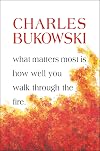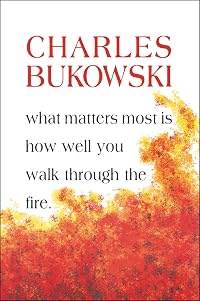
What Matters Most is How Well You Walk Through the Fire
by Charles Bukowski
On This Page
Description
This second posthumous collection from Charles Bukowski takes readers deep into the raw, wild vein of writing that extends from the early 70s to the 1990s.Tags
Recommendations




Member Reviews
it is hard to find a man
whose poems do not
finally disappoint you."
-- 'Vallejo', pg. 98.
It proved to be alright in the end, but for a while I thought this was going to be my first two-star Bukowski book. Bukowski's poetry collections have always had a lot of misfires, but usually there's been a handful of knock-out poems which redeem the rest. This posthumous collection didn't really have that, although 'Neither a Borrower Nor a Lender Be' and 'On Lighting a Cigar' came rather close. There were some other above-average ones but for a book about 400 pages long, that's not really enough for me.
"and I don't believe in
perfection, I believe in keeping the
bowels loose
so I've got to agree with my critics
when they say I write a lot of shit."
-- show more 'Christmas Poem to a Man in Jail', pg. 118." show less
whose poems do not
finally disappoint you."
-- 'Vallejo', pg. 98.
It proved to be alright in the end, but for a while I thought this was going to be my first two-star Bukowski book. Bukowski's poetry collections have always had a lot of misfires, but usually there's been a handful of knock-out poems which redeem the rest. This posthumous collection didn't really have that, although 'Neither a Borrower Nor a Lender Be' and 'On Lighting a Cigar' came rather close. There were some other above-average ones but for a book about 400 pages long, that's not really enough for me.
"and I don't believe in
perfection, I believe in keeping the
bowels loose
so I've got to agree with my critics
when they say I write a lot of shit."
-- show more 'Christmas Poem to a Man in Jail', pg. 118." show less
One look at the 'also by this author' page at the front of this book is wholly intimidating to any would-be or actual poet. I count 33 titles listed. What an output! And these are just the books! This book, 'what matters most is how well you walk through the fire', contains about 200 poems. Multiply that by 33 and you have 6,600! Well, a few of the titles are novels, so say 5000. That's still a lot of poems.
But wait a minute! Are they all cracking good poems? No. And there really must have been some effort put into combing through C's literary remains to assemble those 8 volumes which are posthumous to his death in 1994, of which this book is one. But I have to say that, having read several Bukowski books by this time (Dec 2009), even show more the most ephemeral offering does have something about it that makes it worth publishing. And what a tribute THAT is to ANY poet!
On one of his other books there's a blurb comparing him to Wordsworth in the way he uses the language of the ordinary man. Blurbs mostly make preposterous claims but I think that this particular claim has a lot of truth in it. Even at this distance, Wordsworth's Prelude has an immediate appeal. Bukowski too. He 'cuts to the chase' very often and the nub of the matter at hand is dealt with without any prancing around and also without being damaged by too soon an exposure. I'm really stuck to chose a poem rom this book which best exemplifies this directness (200 to chose from, remember!) but if I have to, then might pick 'more argument', a list poem that escapes being a mere list poem (and how boring they are!) due to the presence of the man himself having one of those interminable rows with one of the women that come and go throughout his poetry. Anyway, it's not the list that is the meat of the poem. It's the row! Or maybe I'd chose 'the first one', a wonderfully minimalist treatment of loss.
By the way, I think anyone who has read Seamus Heaney's 'The Early Purges' would be interested to see how Bukowski handles the same subject in his poem in this book called 'the mice'. Heaney's poem looks forward to many a dilemma created in the future by farmhand's actions. Bukowski's focus is on an unhappier past. Both youngsters are deeply affected.
Great poet. One my favourites. show less
But wait a minute! Are they all cracking good poems? No. And there really must have been some effort put into combing through C's literary remains to assemble those 8 volumes which are posthumous to his death in 1994, of which this book is one. But I have to say that, having read several Bukowski books by this time (Dec 2009), even show more the most ephemeral offering does have something about it that makes it worth publishing. And what a tribute THAT is to ANY poet!
On one of his other books there's a blurb comparing him to Wordsworth in the way he uses the language of the ordinary man. Blurbs mostly make preposterous claims but I think that this particular claim has a lot of truth in it. Even at this distance, Wordsworth's Prelude has an immediate appeal. Bukowski too. He 'cuts to the chase' very often and the nub of the matter at hand is dealt with without any prancing around and also without being damaged by too soon an exposure. I'm really stuck to chose a poem rom this book which best exemplifies this directness (200 to chose from, remember!) but if I have to, then might pick 'more argument', a list poem that escapes being a mere list poem (and how boring they are!) due to the presence of the man himself having one of those interminable rows with one of the women that come and go throughout his poetry. Anyway, it's not the list that is the meat of the poem. It's the row! Or maybe I'd chose 'the first one', a wonderfully minimalist treatment of loss.
By the way, I think anyone who has read Seamus Heaney's 'The Early Purges' would be interested to see how Bukowski handles the same subject in his poem in this book called 'the mice'. Heaney's poem looks forward to many a dilemma created in the future by farmhand's actions. Bukowski's focus is on an unhappier past. Both youngsters are deeply affected.
Great poet. One my favourites. show less
Is there even a point to rating or reviewing a Charles Bukowski book if you've done so already? It's a limited scope and he drills the same spot every time but as with the Halo mechanism it's not about getting any new thrills, it's about getting one thrill for a little bit and repeating it as much as possible. Of his posthumous books, however, I like this one and Sifting Through Madness For The Word, The Line, The Way the most. Highly recommended.
I finally finished What Matters Most is How Well You Walk Through The Fire by Charles Bukowski. I’ve been nibbling on it for four years I think, mainly between books for school, etc. The book consists of poems from the Bukowski archive, which essentially means it’s a way for his wife to keep getting royalty checks now that he’s dead. It is naturally not his best work; otherwise, it would have already been published. That being said if you like Bukowski, you’ll like the book. The title alone should make you want to buy it. The poems were written between 1970 and 1990, and the subject matter ranges from Bukowski’s feelings about fame to his reminiscence about childhood to his thoughts on old age. The usual Bukowski fare of hard show more drinking, gambling, unrequited love, and living in poverty are all there. show less
a good collection of poetry. not his best but still enjoyable
Ratings
Members
- Recently Added By
Author Information

546+ Works 53,003 Members
Charles Bukowski was born in Andernach, Germany, on August 16, 1920. He came to the United States with his parents when he was three years old and spent his early years in poverty. As a young man he was a transient, doing odd jobs. He lived most of his live in boarding houses in the Los Angeles area. He attended Los Angeles City College briefly. show more He worked for the United States Postal Service for about ten years. Bukowski was at home with street people and his work contains a brutal realism and graphic imagery. He began publishing short stories in the mid-1940s. Starting with Flower, Fist and Bestial Wail in 1959, he produced poetry collections almost once a year. His following had grown by the time his collection of poetry about down-and-outers titled It Catches My Heart in Its Hands appeared in 1963. His short story collections include Dirty Old Man and Ejaculations, Exhibitions and General Tales of Ordinary Madness. His novels, with an autobiographical character called Henry Chinaski, include Post Office and Factotum. Bukowski wrote the screenplay for the 1987 motion picture Barfly. He later wrote about the filming of Barfly in his novel, Hollywood. Bukowski died in San Pedro, California, on March 9, 1994. (Bowker Author Biography) show less
Common Knowledge
- Canonical title*
- What matters most is how well you walk through the fire
- Original title
- What Matters Most is How Well You Walk Through the Fire
- Original publication date
- 1999
- Dedication
- for Marina Louise Bukowski
- First words*
- my father believed in work.
- Last words*
- (Click to show. Warning: May contain spoilers.)you will ride light straight to
perfect laughter, it's
the only good fight
there is. - Original language
- English
*Some information comes from Common Knowledge in other languages. Click "Edit" for more information.
Classifications
Statistics
- Members
- 606
- Popularity
- 48,449
- Reviews
- 5
- Rating
- (4.11)
- Languages
- English, French, Spanish
- Media
- Paper, Ebook
- ISBNs
- 6
- ASINs
- 3