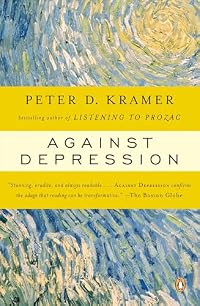
Against depression
by Peter D. Kramer
On This Page
Description
A decade ago, with Listening to Prozac, Kramer revolutionized the way we think about antidepressants and the culture in which they are so widely used. Now, he returns with a look at the condition those medications treat. Depression, linked in our culture to a long tradition of "heroic melancholy," is often regarded as ennobling--a source of soulfulness and creativity. Tracing this belief from Aristotle to the Romantics to Picasso, and to present-day memoirs of mood disorder, Kramer suggests show more that the pervasiveness of the illness has distorted our sense of what it is to be human. There is nothing heroic about depression, he argues, and he presents the latest scientific findings to support the fact that depression is a disease.--Publisher description. show lessTags
Recommendations










































Member Reviews
I like the overall thesis of this book: that depression isn't something glamorous or romantic or necessary for artistic creation. It's a disease and it's terrible and if we could eradicate it, we should. I just don't like all of the stuff that's stuffed into the other 300+ pages. It's just one of those books that's so obviously written by an older white guy. So much philosophical rambling about dead white male philosophers. So much artistic rambling about dead white male artists. So much pontificating about dead white male authors. He couldn't think of a single woman to write about? Plath? Dickinson? Really?
Anyway. There's also the annoying (to me) insistence on some biological models of depression that are far from being medically show more proven. The author even says things like (and I'm paraphrasing here) "despite conflicting studies" and then goes on to talk about how depression causes holes in the hippocampus as though it's something the entire medical community has agreed upon. (It's not.) There's also some evo-psych in here. And about two paragraphs after he won me over saying (again, I'm paraphrasing) "I really dislike evo-psych, because how on earth can anybody know what our paleolithic ancestors were really doing". He then goes on to use evo-psych arguments about how men are attracted to depressed women, and about how depression could be argued to be either useful in an evolutionary perspective or a spandrel. OR IT COULD BE NEITHER OF THOSE. JUST SAYING.
Great thesis, could have been rephrased to be less pretentious-white-male-rambling and filled up about 100 pages, and then I would have liked it much more. show less
Anyway. There's also the annoying (to me) insistence on some biological models of depression that are far from being medically show more proven. The author even says things like (and I'm paraphrasing here) "despite conflicting studies" and then goes on to talk about how depression causes holes in the hippocampus as though it's something the entire medical community has agreed upon. (It's not.) There's also some evo-psych in here. And about two paragraphs after he won me over saying (again, I'm paraphrasing) "I really dislike evo-psych, because how on earth can anybody know what our paleolithic ancestors were really doing". He then goes on to use evo-psych arguments about how men are attracted to depressed women, and about how depression could be argued to be either useful in an evolutionary perspective or a spandrel. OR IT COULD BE NEITHER OF THOSE. JUST SAYING.
Great thesis, could have been rephrased to be less pretentious-white-male-rambling and filled up about 100 pages, and then I would have liked it much more. show less
This is a magnificent book, definitely required reading for those who have suffered from major depression or anyone who has ever been close to a depressive. Kramer (the author of the also-excellent Listening to Prozac) makes it clear from the start that he believes that depression is an insidious disease that does not deserve the romanticization that has long surrounded it. He compares depression and the culture of melancholy to the way people used to romanticize tuberculosis, which used to be seen as a romantic disease that indicated refinement and tragic beauty. He offers up a lot of evidence to back up his beliefs, both from his own practice and from scientific studies that illustrate the physical effects (and possible causes) of show more depression. Even so, he is not unsympathetic to the impulses that lead us to romanticize depression and feel uncomfortable about the idea of eradicating it completely, and this book never edges into polemic. Reading it is sort of like having a series of dinner table talks with a very intelligent friend. show less
As the author lectured on depression, after the success of his previous book “Listening to Prozac” he heard the question “What if Van Gogh had been on prozac?” many times. This prompted the current volume, a statement of why he thinks depression is a disease, debilitating, and deserving treatment, not a fashionable affliction. He cites multiple scientific studies documenting the association of depression with neuronal cell death due to stress hormone effects, particularly the work of Robert Sapolsky in cell culture. He cites numerous statistics showing how very prevalent depression is, how much is costs to care for and the significant health problems it causes. He also tackles the associations of depression in the popular mind show more with deep thought, with artistic creation, and the idea that depression is a state of mind that is a thoughtful response to the sorry state of the world. He notes that women who are depressed are often attractive to men of a certain type, and that depression is often viewed as charming by others. The argument is wide, citing sources from art and literature, science and personal experience with his patients. I found it convincing, and appreciated his view that depression is a lack of resilience to stress. show less
This book is a wake up call to anyone who has been ambivelent about the treatment of depression, either in themselves or in someone close to them. Peter Kramer explains, systematically and convincingly, why depression is a disease that needs to be treated agressively and not a temperament or attitude that should be clung to for it's side benefits. The explanation is easily understood and engaging. Altogether an enlightening book.
On balance a very solid work, though the author makes no bones that he is anything close to be objective when it comes to this topic. Of particular interest was the discussion the most recent developments re: the physiology of the brain in this area, and his thoughts on how neuroscience may change things in the future.
The first part of the book ("what if") was the weakest, get through that and you'll find the rest of the work excellent.
The first part of the book ("what if") was the weakest, get through that and you'll find the rest of the work excellent.
NOTE: This book is written from the perspective of a clinical practitioner. It contains observations and theories about depression as an illness, its development, and its impact in society today. It is not written from a therapeutic lens and the language used is not client-centered. It may not be helpful for those in the middle of a depressive episode, however it can be interesting for those who enjoy the study of neuroscience and human behaviour in relation to depression.
A very readable and encouraging book about the current thinking and research on depression as a disordered chemistry of the brain. .
Members
- Recently Added By
Lists

Penguin Random House
458 works; 4 members
Author Information

13+ Works 1,729 Members
Peter D. Kramer is a clinical professor of psychiatry at Brown University.
Some Editions
Awards and Honors
Distinctions
Common Knowledge
- Canonical title
- Against depression
- Original publication date
- 2005
- Dedication
- For Grossmutti,
the Omas and the Opas,
and Eric and Lore - First words
- I hope that this book will prove helpful in ways that are concrete and immediate. (Prologue)
Shortly after the publication of Listening to Prozac, twelve years ago, I became immersed in depression. - Last words
- (Click to show. Warning: May contain spoilers.)How glorious it will be to free ourselves from depression.
- Blurbers
- Oates, Joyce Carol; Goleman, Daniel; Coles, Robert; Sapolsky, Robert; Groopman, Jerome
Classifications
- Genres
- Nonfiction, General Nonfiction
- DDC/MDS
- 616.8527 — Technology Medicine & health Diseases Diseases of nervous system and mental disorders Miscellaneous Neuroses Depression
- LCC
- RC537 .K725 — Medicine Internal medicine Internal medicine Neurosciences. Biological psychiatry. Neuropsychiatry Psychiatry Psychopathology Neuroses
- BISAC
Statistics
- Members
- 330
- Popularity
- 95,144
- Reviews
- 8
- Rating
- (3.93)
- Languages
- English, Norwegian (Bokmål), Portuguese
- Media
- Paper, Audiobook, Ebook
- ISBNs
- 10
- UPCs
- 1
- ASINs
- 2