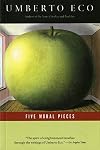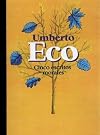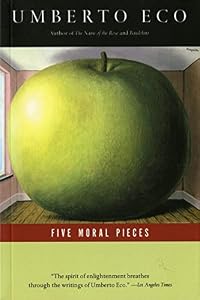
Five Moral Pieces
by Umberto Eco
On This Page
Description
In this prescient essay collection, the acclaimed author of Foucault's Pendulum examines the cultural trends and perils at the dawn of the 21stcentury. In the last decade of the 20thcentury, Umberto Eco saw an urgent need to embrace tolerance and multiculturalism in the face of our world's ever-increasing interconnectivity. At a talk delivered during the first Gulf War, he points out the absurdity of armed conflict in a globalized economy where the flow of information is unstoppable and show more the enemy is always behind the lines. Elsewhere, he questions the influence of the news media and identifies its contribution to our collective disillusionment with politics. In a deeply personal essay, Eco recalls his boyhood experience of Italy's liberation from fascism. He then analyzes the universal elements of fascism, including the "cult of tradition" and a "suspicion of intellectual life." And finally, in an open letter to an Italian cardinal, Eco reflects on a question underlying all the reflections in the book: What does it mean to be moral or ethical when one doesn't believe in God? " At just 111 pages, Five Moral Pieces packs a philosophical wallop surprising in such a slender book. Or maybe not so surprising. Eco's prose here is beautiful."- January Magazine show lessTags
Recommendations









Member Reviews
This collection seems a bit eccentric when considered as a whole, on account of the different topics covered and the different audiences and tones for which the essays were written. They are unified by the spark of clarified brilliance that defines Eco's writing, which is precise and incisive.
Though it seems absurd to select favorites from a pool of only five, Ur-Fascism stands out as a blend of personal experience, political and historical analysis, and theoretical distillation of what fascism means as a term and how it functions. On the Press also feels relevant as a discussion of where the media is as an industry and where it is going. Although this essay is limited to a specifically Italian scope, the principles are widely show more applicable--and in 1995, Eco predicted the limitations of a self-selected news source like the algorithm-based feeds available to us today. The other three are gems as well. show less
Though it seems absurd to select favorites from a pool of only five, Ur-Fascism stands out as a blend of personal experience, political and historical analysis, and theoretical distillation of what fascism means as a term and how it functions. On the Press also feels relevant as a discussion of where the media is as an industry and where it is going. Although this essay is limited to a specifically Italian scope, the principles are widely show more applicable--and in 1995, Eco predicted the limitations of a self-selected news source like the algorithm-based feeds available to us today. The other three are gems as well. show less
We shall not get out of this circle until it is decided that when exceptional events occur, humanity cannot afford to apply the laws currently in force, but must shoulder the responsibility of sanctioning new ones.
Five Moral Pieces is another collection of Eco's essays and lectures, these are from the 1990s and as suggested by the title refer to plotting a moral course in a world revising its codes and transmitting mediums. The first few weren't encouraging, focusing o a new virtual definition f war and whether it was possible to for the godless to be good. Interesting as always, my spirits were not encouraged until the final two essays: Ur-Fascism and Migration, Tolerance and the Intolerable. Both appear to a response to our daily show more headlines and the clamor for expulsion from Charlotte to Hamburg. show less
Five Moral Pieces is another collection of Eco's essays and lectures, these are from the 1990s and as suggested by the title refer to plotting a moral course in a world revising its codes and transmitting mediums. The first few weren't encouraging, focusing o a new virtual definition f war and whether it was possible to for the godless to be good. Interesting as always, my spirits were not encouraged until the final two essays: Ur-Fascism and Migration, Tolerance and the Intolerable. Both appear to a response to our daily show more headlines and the clamor for expulsion from Charlotte to Hamburg. show less
A decent read, for a collection of five disconnected essays. The piece on Ur-Fascism is definitely worthwhile, as are the ones on the press (even if Italian-focused, the themes resonant to modern American media) and tolerance & the intolerable. I didn't care for the essay on war; it was too abstract and removed from reality.
In his introduction, Umberto Eco writes that the five essays in this book are occasional pieces and ethical pieces. Their occasional nature arises from their being speeches given in some conferences or articles commissioned for publication. Their ethical nature is what makes them moral pieces: “they treat of what we ought to do, what we ought not to do, and what we must not do at any cost.”
What we ought to do, or what fans of Eco ought to, is read this short book – a mere 111 pages. These are only slight pieces – meaning they are short and minor essays, yet with big themes. And I hasten to add, they are highly readable pieces, even if they are structured to be knotty moral-philosophical arguments.
The essays are not of uniform show more quality. Some strikes me as well thought out, others are just plain fillers. “Reflections on War” (1991), the first essay, was written at the start of the Gulf War but its relevance surpasses its time. The principles in this polemical essay are prescient as they apply to modern warfare in general. Eco discusses on technology's role in modern war and why this outdates and revises the art of war given by Clausewitz.
Eco’s reflections in all the essays are not really too focused or too tight. Yet his conclusions and assertions, even if predictable in parts, are nonetheless powerful and explored creatively. This is because he arrived at them obliquely. Eco has this unique style of circling around ideas playfully before confronting the issues full frontal.
The essay that I consider the weakest, and which I find too theoretical, is “Ur-Fascism.” The essay typifies several hybrids of fascism and Nazism and differentiates between and among these types. It is the sort of essay that is limited by its geographic experience and scope (Europe) though not by its subjects (racism and intolerance).
My full review here: http://booktrek.blogspot.com/2009/07/five-moral-pieces-umberto-eco.html show less
What we ought to do, or what fans of Eco ought to, is read this short book – a mere 111 pages. These are only slight pieces – meaning they are short and minor essays, yet with big themes. And I hasten to add, they are highly readable pieces, even if they are structured to be knotty moral-philosophical arguments.
The essays are not of uniform show more quality. Some strikes me as well thought out, others are just plain fillers. “Reflections on War” (1991), the first essay, was written at the start of the Gulf War but its relevance surpasses its time. The principles in this polemical essay are prescient as they apply to modern warfare in general. Eco discusses on technology's role in modern war and why this outdates and revises the art of war given by Clausewitz.
Eco’s reflections in all the essays are not really too focused or too tight. Yet his conclusions and assertions, even if predictable in parts, are nonetheless powerful and explored creatively. This is because he arrived at them obliquely. Eco has this unique style of circling around ideas playfully before confronting the issues full frontal.
The essay that I consider the weakest, and which I find too theoretical, is “Ur-Fascism.” The essay typifies several hybrids of fascism and Nazism and differentiates between and among these types. It is the sort of essay that is limited by its geographic experience and scope (Europe) though not by its subjects (racism and intolerance).
My full review here: http://booktrek.blogspot.com/2009/07/five-moral-pieces-umberto-eco.html show less
Although I don't quite agree with some material with which he predicates his arguments (mostly picky historical bits that I have a tendency to give excessive importance or centrality), I like what Eco wants to do (namely, reflect on 'what it means to be moral or ethical when one doesn't believe in God') and am excited to finish this book and hear his conclusions.
"Пять эссе на темы этики" включают в себя размышления знаменитого ученого и писателя по поводу наиболее острых нравственных проблем современности.
I really enjoyed this little book and go back to it frequently. This is a group of five essays written by Eco for different publications, focusing mainly on Italian fascismo and the changes in Europe's make-up since the end of WWII. As always, Eco's writing is elegant and witty to a fault.
Members
- Recently Added By
Author Information

501+ Works 115,124 Members
Umberto Eco was born in Alessandria, Italy on January 5, 1932. He received a doctorate of philosophy from the University of Turin in 1954. His first book, Il Problema Estetico in San Tommaso, was an extension of his doctoral thesis on St. Thomas Aquinas and was published in 1956. His first novel, The Name of the Rose, was published in 1980 and won show more the Premio Strega and the Premio Anghiar awards in 1981. In 1986, it was adapted into a movie starring Sean Connery. His other works include Foucault's Pendulum, The Island of the Day Before, Baudolino, The Prague Cemetery, and Numero Zero. He also wrote children's books and more than 20 nonfiction books including Serendipities: Language and Lunacy. He taught philosophy and then semiotics at the University of Bologna. He also wrote weekly columns on popular culture and politics for L'Espresso. He died from cancer on February 19, 2016 at the age of 84. (Bowker Author Biography) show less
Some Editions
Series
Belongs to Publisher Series
Common Knowledge
- Canonical title
- Five Moral Pieces
- Original title
- Cinque scritti morali
- Original publication date
- 1997
Classifications
Statistics
- Members
- 776
- Popularity
- 35,842
- Reviews
- 9
- Rating
- (3.72)
- Languages
- 18 — Catalan, Danish, Dutch, English, French, German, Greek, Hungarian, Italian, Japanese, Norwegian (Bokmål), Polish, Portuguese, Russian, Serbian, Spanish, Swedish, Turkish
- Media
- Paper, Ebook
- ISBNs
- 40
- ASINs
- 8