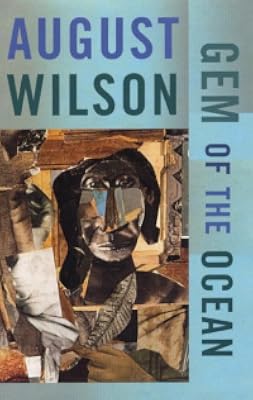
Gem of the Ocean
by August Wilson
Century Cycle: Chronological Order (1900s), Century Cycle: Production Order (play 9)
On This Page
Description
Set in 1904 Pittsburgh, it is chronologically the first work in August Wilson's decade-by-decade cycle dramatizing the African American experience during the 20th century-an unprecedented series that includes the Pulitzer Prize-winning plays Fences and The Piano Lesson. Aunt Esther, the drama's 287-year-old fiery matriarch, welcomes into her Hill District home Solly Two Kings, who was born into slavery and scouted for the Union Army, and Citizen Barlow, a young man from Alabama searching for show more a new life. show lessTags
Recommendations



































Member Reviews
Citizen Barlowe, a very troubled young man with a guilty conscience, seeks help from Aunt Ester Tyler, an ancient woman gifted with the wisdom of the ages. She sets him a task, and then takes him on a spiritual journey to the "City of Bones" where he atones for his sin and learns to "be right with himself". I enjoyed reading this play, but have trouble imagining it on the stage. There is little action, and not a lot of dialog. Mainly, various characters deliver longish speeches--Aunt Ester and Solly tell stories, Caesar rants. I think I would have appreciated it better in the form of a short story. Still, powerful voices speaking here.
I read an August Wilson biography in February of last year after watching Fences with Denzel Washington and being captivated by the dialog and storytelling. Although Fences is probably the Wilson's most famous work, he wrote a The Century Cycle, 10 plays that follow the African American experience by decade of the 20th century. Gem of the Ocean, though the 9th play produced, covers the 1900 decade.
Written in 2003, performed on Broadway in 2005 and nominated for a Tony award for Best Play, Gem of the Ocean is about Citizen Barlow visiting Aunt Ester, looking for cleansing and redemption. Through a cast of characters of former slaves and a story of racial and social tensions, the spiritual Aunt Ester takes Citizen Barlow to the City of show more Bones.
This play is mystical and lyrical, with chanting and singing. Though I enjoyed reading it, I would love to see a production of it. Denzel Washington has claimed he will make each play into a movie.
Ceaser Wilkes was my favorite character to analyze. He is an African American policeman who has an obsession with upholding the law.
I look forward to the rest of the plays in this series. show less
Written in 2003, performed on Broadway in 2005 and nominated for a Tony award for Best Play, Gem of the Ocean is about Citizen Barlow visiting Aunt Ester, looking for cleansing and redemption. Through a cast of characters of former slaves and a story of racial and social tensions, the spiritual Aunt Ester takes Citizen Barlow to the City of show more Bones.
This play is mystical and lyrical, with chanting and singing. Though I enjoyed reading it, I would love to see a production of it. Denzel Washington has claimed he will make each play into a movie.
Ceaser Wilkes was my favorite character to analyze. He is an African American policeman who has an obsession with upholding the law.
I look forward to the rest of the plays in this series. show less
This is the first play in August Wilson's Century Cycle set in 1904 in the Hill district in Pittsburgh, PA. All of the action in the play takes place in in the parlor of the home of Eli, Aunt Ester and Black Mary at 1839 Wylie Avenue.
The Gem of the Ocean is a paper boat made by Aunt Ester out of a bill of sale that was made out for her when she was a slave. Aunt Ester made the Gem of the Ocean to take Citizen Barlow to the Island of Bones to get his soul washed. Citizen Barlow needed to wash his soul to get clean from a sin he had committed.
Caesar Wilks, the ward constable, is the brother of Black Mary. She moved away from Caesar when he shot someone who was running away after stealing a loaf of bread. Caesar is a hard man who found show more success keeping law and order for the white men who run the community.
Solly Two Kings and Eli are friends from the days of the Underground Railroad. Rutherford Selig is a traveling peddler who often visits at the house on 1839 Wylie Avenue.
I found two themes in the play, violence and spirituality. The violence that runs through different incidents in the play is the violence of the oppression of African-Americans. The violence that has kept these people in poverty and powerless to control their fate. Caesar is for me a black man who becomes an instrument of oppression motivated by his greed and desire for power.
The spirituality of the characters provides their strength. This strength they brought from across the ocean and carry within themselves. I cannot help but feel that there is a connection between the Island of Bones and those who died on the Middle Passage. Citizen Barlow's trip to the Island of Bones has a great deal of symbolism in the singing and actions of the other characters involved.
This is a play that must be seen to be fully appreciated. There is a performance of Jitney, another Wilson play, coming to my area in April and I will be sure to see it.
I dare not give away the details of the play. What I can say is that it provides a connection with the lives of African-Americans of this time that is an important experience. show less
The Gem of the Ocean is a paper boat made by Aunt Ester out of a bill of sale that was made out for her when she was a slave. Aunt Ester made the Gem of the Ocean to take Citizen Barlow to the Island of Bones to get his soul washed. Citizen Barlow needed to wash his soul to get clean from a sin he had committed.
Caesar Wilks, the ward constable, is the brother of Black Mary. She moved away from Caesar when he shot someone who was running away after stealing a loaf of bread. Caesar is a hard man who found show more success keeping law and order for the white men who run the community.
Solly Two Kings and Eli are friends from the days of the Underground Railroad. Rutherford Selig is a traveling peddler who often visits at the house on 1839 Wylie Avenue.
I found two themes in the play, violence and spirituality. The violence that runs through different incidents in the play is the violence of the oppression of African-Americans. The violence that has kept these people in poverty and powerless to control their fate. Caesar is for me a black man who becomes an instrument of oppression motivated by his greed and desire for power.
The spirituality of the characters provides their strength. This strength they brought from across the ocean and carry within themselves. I cannot help but feel that there is a connection between the Island of Bones and those who died on the Middle Passage. Citizen Barlow's trip to the Island of Bones has a great deal of symbolism in the singing and actions of the other characters involved.
This is a play that must be seen to be fully appreciated. There is a performance of Jitney, another Wilson play, coming to my area in April and I will be sure to see it.
I dare not give away the details of the play. What I can say is that it provides a connection with the lives of African-Americans of this time that is an important experience. show less
The earliest time period of Wilson's Century series. It tells the story of Aunt Ester.
It is hard to read a play rather than seeing it. While I understood the story, I did not feel an emotional attachment to any character. I hope one day to see a performance of Gem of the Ocean so I can then pick up the nuances and emotions of the play. I have seen 2 other plays in the Century Series and loved them.
It is hard to read a play rather than seeing it. While I understood the story, I did not feel an emotional attachment to any character. I hope one day to see a performance of Gem of the Ocean so I can then pick up the nuances and emotions of the play. I have seen 2 other plays in the Century Series and loved them.
Set in 1904 Pittsburgh, Gem of the Ocean is the play that begins August Wilson's ten-play cycle dramatizing the African American experience during the twentieth century - a series that includes the plays Fences and The Piano Lesson. Aunt Ester, the drama's 285-year-old fiery matriarch, welcomes into her Hill District home Solly Two Kings, who was born into slavery and scouted for the Union Army, and Citizen Barlow, a young man from Alabama searching for a new life.
Ratings
Members
- Recently Added By
Lists

My Play Collection
769 works; 3 members

Next Plays / 2025
352 works; 1 member
Author Information

28+ Works 5,928 Members
Playwright August Wilson was born on April 27, 1945 in Pittsburgh, Pennsylvania. His experiences of living in a primarily black community and then being the only black student in his class at a Roman Catholic high school would inform his dramatic writings. He dropped out of school at the age of 15 and continued his education on his own. Wilson show more wrote a ten play cycle that chronicles each decade of the black experience in the 20th century. Each of his plays focuses on what he perceived as the largest issue to confront African-Americans in that decade. He won the Pulitzer Prize for Drama for Fences and Piano Lesson, the best play Tony Award for Fences, and seven New York Drama Critics' Circle awards. He also received the Whiting Foundation Award, the American Theatre Critics Award, the 1999 National Humanities Medal awarded by the President, and numerous honorary degrees. He died of liver cancer on October 2, 2005 at the age of 60. (Bowker Author Biography) show less
Awards and Honors
Awards
Series


Common Knowledge
- Original publication date
- 2003
- Important places
- Pittsburgh, Pennsylvania, USA
Classifications
Statistics
- Members
- 207
- Popularity
- 158,333
- Reviews
- 6
- Rating
- (4.02)
- Languages
- English
- Media
- Paper
- ISBNs
- 3
- ASINs
- 1