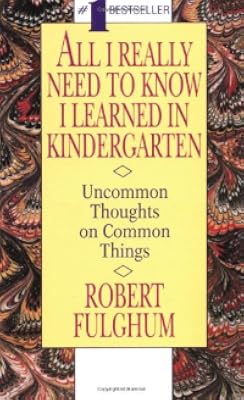
All I Really Need to Know I Learned in Kindergarten: Uncommon Thoughts on Common Things
by Robert Fulghum
On This Page
Description
Fulghum's book on appreciating life's simple lessons and pleasures began as a sermon to his Unitarian congregation, then found its way into a Dear Abby column before taking its current form. From the lessons learned in kindergarten (Share everything. Play fair. Flush.) Fulghum comes to realizations about his own life. For example, rather than emulating a neighbor who battles the elements, raking the autumn leaves and shoveling the winter snow, Fulghum learns to let the leaves and the snow show more pile up, to fertilize and water the next generation of plants. Our nostalgia for the simple principles of kindergarten is tempered by the cheering thought that we can apply them in real life. Fulghum's gentle perambulations will appeal to all who have spent too long in the fast lane. show lessTags
Recommendations


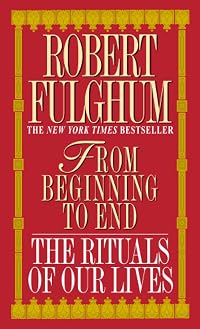
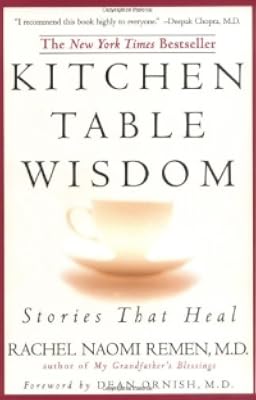
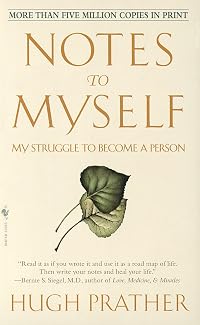
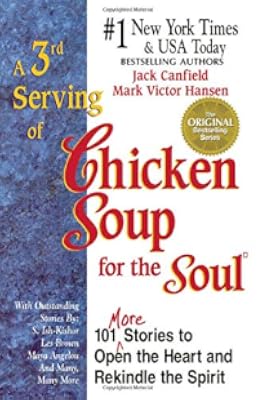
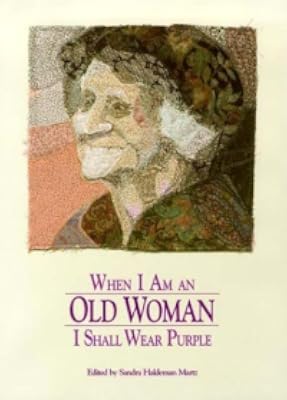




Member Recommendations
amarie There is a similar love of the best things/people/places/experiences in life that may be overlooked sometimes.
Member Reviews
Robert Fulghum engages with musings on life, death, love, pain, joy, sorrow, and the best chicken-fried steak in the continental United States. The little seed in the Styrofoam cup offers a reminder about our own mortality and the delicate nature of life . . . a spider who catches (and loses) a full-grown woman in its web one fine morning teaches us about surviving catastrophe . . . the love story of Jean-Francois Pilatre and his hot-air balloon reminds us to be brave and unafraid to “fly” . . . life lessons hidden in the laundry pile . . . magical qualities found in a box of crayons . . . hide-and-seek vs. sardines—and how these games relate to the nature of God. All I Really Need to Know I Learned in Kindergarten is brimming show more with the very stuff of life and the significance found in the smallest details. show less
1990 Jul 30
Fulghum is chock full of advice on how to be a decent person and enjoy your life.
***
2020 June 6
This was an excellent choice for me right now. I needed some positivity. And very short essays ate so doable, even when I have the attention span of a litter of 10 week old puppies. There have been many distracting events of late. Sometimes real life doesn't feel so real when you are living through multiple history-making events simultaneously.
I am, and want to remain, grateful to the Fulghum of thirty years ago, and the many voices on Twitter, at work, and on the steps of my local courthouse, all telling me not just what I know, that I need to do better, but what is more important to me at the moment: how to do better.
I know that show more Black Lives Matter, that policing in the United States is institutionalized racism, that the criminal justice system in the US is institutionalized racism, that our two-party political system is institutionalized racism, that in fact every system established in the US since the first colonizers arrived is just more institutionalized racism: from the privately-owned hospitals where more proportionally more Black women and infants die, through to the end, when cancer or COVID-19 disproportionately kills more, and younger, Black people.
It's racism all the way down.
I know it, I have almost always known it, but other than educating myself, supporting efforts to increase diversity in books and publishing, and voting always for the lesser of two evils, I haven't ever managed to do much else.
I must do better, and more, always.
I want to live in a country which is good, and just, and kind. So I had better get to work: there is so damn much to get done. show less
Fulghum is chock full of advice on how to be a decent person and enjoy your life.
***
2020 June 6
This was an excellent choice for me right now. I needed some positivity. And very short essays ate so doable, even when I have the attention span of a litter of 10 week old puppies. There have been many distracting events of late. Sometimes real life doesn't feel so real when you are living through multiple history-making events simultaneously.
I am, and want to remain, grateful to the Fulghum of thirty years ago, and the many voices on Twitter, at work, and on the steps of my local courthouse, all telling me not just what I know, that I need to do better, but what is more important to me at the moment: how to do better.
I know that show more Black Lives Matter, that policing in the United States is institutionalized racism, that the criminal justice system in the US is institutionalized racism, that our two-party political system is institutionalized racism, that in fact every system established in the US since the first colonizers arrived is just more institutionalized racism: from the privately-owned hospitals where more proportionally more Black women and infants die, through to the end, when cancer or COVID-19 disproportionately kills more, and younger, Black people.
It's racism all the way down.
I know it, I have almost always known it, but other than educating myself, supporting efforts to increase diversity in books and publishing, and voting always for the lesser of two evils, I haven't ever managed to do much else.
I must do better, and more, always.
I want to live in a country which is good, and just, and kind. So I had better get to work: there is so damn much to get done. show less
I read this book long ago, when I was in high school. I remember thinking it was a really deep, important book at the time. On re-reading it in adulthood, I no longer think it is either deep or important.
There is a sort of smug satisfaction cloaked in humility in a lot of these very short essays about life, and they now feel like someone who is trying to seem wise, rather than someone who is wise.
But, there is definite value to be found in this book. I especially like his idea that we shouldn't bother searching for the meaning of life, and instead should be looking, all the time, to find the meaning in life.
Perhaps this book is best enjoyed by dipping into it here and there, rather than reading it from start to finish in a short period show more of time. show less
There is a sort of smug satisfaction cloaked in humility in a lot of these very short essays about life, and they now feel like someone who is trying to seem wise, rather than someone who is wise.
But, there is definite value to be found in this book. I especially like his idea that we shouldn't bother searching for the meaning of life, and instead should be looking, all the time, to find the meaning in life.
Perhaps this book is best enjoyed by dipping into it here and there, rather than reading it from start to finish in a short period show more of time. show less
I recently reread this book and found it as wonderful as I remembered. Fulghum is funny and smart and his remarks can be touching and endearing. I agree with so much of his philosophy of life and, like him, would treasure having one day, even one hour, of my childhood back. His memory of riding in a pickup truck with an elderly dog for company is priceless.
ALL I REALLY NEED TO KNOW I LEARNED IN KINDERGARTEN is a book that I have read many times over many years -- and each time I connect with something different depending on where I am in my life at that moment. After attending a writing workshop and discussing freelance writing opportunities -- this book came to mind. In the author's note at the beginning of the book, Fulghum calls the book a collection of "my stuff -- a written report about what goes on in my head and life."
Well that is what I want to do -- and I got some wonderful introspections for my own "stuff" by rereading this classic and letting my mind wander into different places and topics.
My favorite selections
Giants, wizards, and dwarfs (p83)
I'm in charge of the laundry show more (p11)
Playing Sardines (p58)
The year I didn't receive any Christmas cards (p89)
The best quote that I have carried around with me for 20 years is on page 20 --"Sticks and stones may break our bones, but words will break our hearts..."
So I will put this title back on the bookshelf where one fine day I will run across it again and take it off the shelf and thumb through its pages to find yet another encounter with words wonderful. show less
Well that is what I want to do -- and I got some wonderful introspections for my own "stuff" by rereading this classic and letting my mind wander into different places and topics.
My favorite selections
Giants, wizards, and dwarfs (p83)
I'm in charge of the laundry show more (p11)
Playing Sardines (p58)
The year I didn't receive any Christmas cards (p89)
The best quote that I have carried around with me for 20 years is on page 20 --"Sticks and stones may break our bones, but words will break our hearts..."
So I will put this title back on the bookshelf where one fine day I will run across it again and take it off the shelf and thumb through its pages to find yet another encounter with words wonderful. show less
I get a kick outta reading "uncommon thoughts on common things" from different people's perspectives. Fulghum's thoughts were about silly things AND deep stuff, and usually with a great deal of humor. His goal in writing this book didn't seem to be profound wisdom or anything so self-helpy: I appreciated that. His voice was very down to earth and conversational. While I enjoyed most of the essays, the collection was just okay for me. Yet I did find a few bits I want to remember and, someday, possibly throw my own uncommon thoughts on the same or related topics into the mix.
3.5 stars
"It's the spirit here that counts. The time may be long, the vehicle may be strange or unexpected. But if the dream is held close to the heart, and show more imagination is applied to what there is close at hand, everything is still possible (139)."
"Innate skepticism or innate stupidity? I confess I do not know. A psychiatrist friend tells me it's a sample of an unconscious need to deny--that everyone wants the road or The Way to continue on instead of ending. So you drive as far as you can, even when you can clearly read the sign. You want to think you are exempt, that it doesn't apply to you. But it does (161-62)."
"Murphy's Law does not always hold, says Grandfather Sam. Every once in a while the fundamental laws of the universe seem to be momentarily suspended, and not only does everything go right, nothing seems to be able to keep it from going right. It's not always something as dramatic as the long bomb or the slam-dunk that wins ball games (178)." He goes on to list examples like dropping a glass in the sink, it bounces a gazillion times, and not only does not break but doesn't even chip. A near-miss at an intersection. Jumping in the right lane (the one that's moving) in a traffic jam. show less
3.5 stars
"It's the spirit here that counts. The time may be long, the vehicle may be strange or unexpected. But if the dream is held close to the heart, and show more imagination is applied to what there is close at hand, everything is still possible (139)."
"Innate skepticism or innate stupidity? I confess I do not know. A psychiatrist friend tells me it's a sample of an unconscious need to deny--that everyone wants the road or The Way to continue on instead of ending. So you drive as far as you can, even when you can clearly read the sign. You want to think you are exempt, that it doesn't apply to you. But it does (161-62)."
"Murphy's Law does not always hold, says Grandfather Sam. Every once in a while the fundamental laws of the universe seem to be momentarily suspended, and not only does everything go right, nothing seems to be able to keep it from going right. It's not always something as dramatic as the long bomb or the slam-dunk that wins ball games (178)." He goes on to list examples like dropping a glass in the sink, it bounces a gazillion times, and not only does not break but doesn't even chip. A near-miss at an intersection. Jumping in the right lane (the one that's moving) in a traffic jam. show less
I have no idea why I bought this book. It was.... an impulse buy, I guess. It was 10cents at a thrift store and I added it to my pile of books without really thinking.
I put off reading it for a long time. It just didn't jump out at me. I flipped through the pages, read a few paragraphs, and always seemed to come to the same conclusion: "meh".
The thing is, I think this is one of those books that *seems* so cliched and annoyingly simple and maybe even stupid, that so many people (including myself) don't want to admit it's underlying awesomeness.
Because that's what it really is. Awesomeness. Pure and simple. I'm not going to say that my life was changed by this book, but I do know for sure that it's lifted my spirits on more then one show more occasion. Made me think about simpler things, even if only for a minute. Made me realize the little truths that seem so obvious. It's not an end all be all book, and I don't know if I'm any better of a person for reading it. But it put a smile on my face and hope in my heart, and that is more then enough for me. show less
I put off reading it for a long time. It just didn't jump out at me. I flipped through the pages, read a few paragraphs, and always seemed to come to the same conclusion: "meh".
The thing is, I think this is one of those books that *seems* so cliched and annoyingly simple and maybe even stupid, that so many people (including myself) don't want to admit it's underlying awesomeness.
Because that's what it really is. Awesomeness. Pure and simple. I'm not going to say that my life was changed by this book, but I do know for sure that it's lifted my spirits on more then one show more occasion. Made me think about simpler things, even if only for a minute. Made me realize the little truths that seem so obvious. It's not an end all be all book, and I don't know if I'm any better of a person for reading it. But it put a smile on my face and hope in my heart, and that is more then enough for me. show less
Members
- Recently Added By
Published Reviews
Fulghum, a retired Unitarian minister, does not express uncommon thoughts here: his thoughts are those we all wish were true.... Fulghum approaches each topic here with lump-in-the-throat sentimentality, which is sure to feed the public's perceived hunger for happy talk.
added by Lemeritus
Lists

Which Books Made You Laugh Out Loud (Literally)
23 works; 2 members

Books tagged "feel good"
129 works; 20 members

Life and How to Live It
21 works; 4 members

Books featured on I Don't Even Own a Television
167 works; 3 members

Favorite Book Titles
35 works; 1 member

Books With the Most Memorable Titles
478 works; 158 members

Books We Love to Reread
688 works; 296 members

Books With Complete Sentence Titles
502 works; 17 members
Author Information

45+ Works 10,855 Members
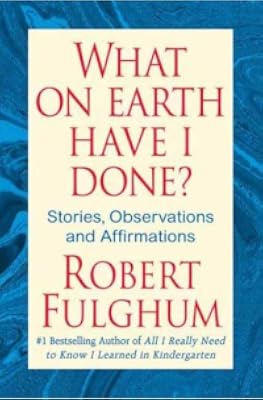
Robert Fulghum was born in Waco, Tex. in 1937. He attended the University of Colorado and obtained a degree in history and philosophy from Baylor University. He also spent some time at a Zen Buddhist monastery in Japan. Fulghum's ideas about how to make life better and appreciate its simple joys inspired him to write the bestselling All I Really show more Need to Know I Learned in Kindergarten. Several other successful books authored by Fulghum have followed, such as It Was On Fire When I Lay Down On It, Maybe (Maybe Not), Uh-Oh: Some Observations From Both Sides of the Refrigerator Door, From Beginning to End, True Love, What On Earth Have I Done?, and Third Wish. (Bowker Author Biography) show less
Awards and Honors
Awards
Distinctions
Series
Belongs to Publisher Series
Lélekbúvár könyvek (20)
Common Knowledge
- Canonical title
- All I Really Need to Know I Learned in Kindergarten: Uncommon Thoughts on Common Things
- Original publication date
- 1989-12
- First words
- Each spring, for many years, I have set myself the task of writing a personal statement of belief: a Credo.
- Quotations
- And it still is true, no matter how old you are -- when you go out into the world,it is best to hold hands and stick together. (p. 8)
Sticks and stones may break our bones, but words will break our hearts... (p. 20)
But sometimes something slips through the net of prejudice, some small bit of a sign that is so clean and true and real that it wedges open the rusting Iron Curtain long enough for us to see not an enemy but fellow travelers,... (show all) joined to us by membership in the Fellowship of Joy-and-Pain. (p. 31)
The man said he would like to go about doing good without knowing about it. God granted his wish. And then God decided that it was such a good idea, he would grant that wish to all human beings. And so it has been to this day... (show all). (p. 80)
Well, where do the Mermaids stand? All the "Mermaids" -- all those who are different, who do not fit the norm and who do not accept the available boxes and pigeonholes? (p. 84)
So, in other words, what's behind my bed and bookcase and dresser and chest is mostly me and stardust. (p. 123)
He said, "Ignorance and power and pride are a deadly mixture, you know." (p. 130)
But to be human is to know and care and ask. (p. 161)
Or the bliss of just what was-for-a-day when nothing special took place -- life just worked. (p. 179)
Peace is not something you wish for; it's something you make, something you do, something you are, and something you give away! (p. 192) - Last words
- (Click to show. Warning: May contain spoilers.)The next time I will tell you about frogs; Miss Emily Phipps; a sign in a grocery store in Pocatello, Idaho; the most disastrous wedding of all time; a Greek phrase, asbests gelos (unquenchable laughter); the Salvation Navy; the man who knew then what he knows now; the smallest circus in the world; the truth about high school; and the time when the bed was on fire when I lay down on it; and
- Canonical DDC/MDS
- 128
- Canonical LCC
- BD431
Classifications
Statistics
- Members
- 4,745
- Popularity
- 3,016
- Reviews
- 55
- Rating
- (3.74)
- Languages
- 14 — Czech, Dutch, English, Finnish, German, Hungarian, Japanese, Lithuanian, Polish, Portuguese, Croatian, Spanish, Swedish, Thai
- Media
- Paper, Audiobook, Ebook
- ISBNs
- 53
- UPCs
- 2
- ASINs
- 26