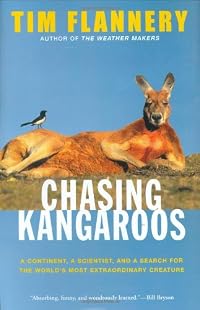
Chasing Kangaroos: A Continent, a Scientist, and a Search for the World's Most Extraordinary Creature
by Tim Flannery, Tim F. Flannery
On This Page
Description
Conservationist Flannery draws on three decades of travel, research, and field work to craft a love letter to his native land and one of its most unique and beloved inhabitants: the kangaroo. Crisscrossing the continent, Flannery shows us how the destiny of this extraordinary creature is inseparable from the environment that created it. Along the way he uses encounters with ancient aboriginal cultures and eccentric fossil hunters, farmers and scientists, kangaroo advocates and kangaroo show more hunters, to explore how Australia's deserts and rainforests have shaped human responses to the continent--and how kangaroos have evolved to handle the resulting challenges. A synthesis of memoir, travel, natural history, and evolutionary science.--From publisher description. show lessTags
Recommendations












Member Reviews
Why do kangaroos hop? It sounds like the start to a marsupial joke. Tim Flannery wants to tell you the punch line. Chasing Kangaroos is a fun exploration into the evolution of kangaroos all the way up to the extinction of Australia's megaflora. Flannery will explain the journey of kangaroos across the planet as Europeans brought them to places like London and Hawaii. Royalty wanted them as exotic pets to roam their palace grounds. Flannery's style of explanation makes every kangaroo-related subject matter interesting and entertaining. I found myself pondering facts like the footbones of animals, kangaroo chromosomes, why some kangaroos do not hop, why some kangaroos live in trees, and how they are related to the possum. I know more show more about the male anatomy of a kangaroo than I ever wanted to know. For male readers, heads up. Flannery will urge you to trace your own male anatomy for evidence of ancestral evolution of the scrotum before the penis. You're welcome.
At the end of Chasing Kangaroos Flannery ends on a hopeful note, speculating that some species previously thought extinct might actually still be around. show less
At the end of Chasing Kangaroos Flannery ends on a hopeful note, speculating that some species previously thought extinct might actually still be around. show less
I enjoyed this book more than I had expected to. The story of an Australian palaeontologist in the 1970s to 1990s also shows us a little seen side of Australia that has been lost in history. The struggle for proper funding in the sciences has always been there. Finally reading this book will possibly give you more information about kangaroos than you might wish to know. It was really interesting though.
This is basically a biology and ecology book, but is also part memoir. Flannery spends decades searching the Australian outback and outer islands for the fossil remains of now extinct species of kangaroo. He compares these remains to the anatomy of the over 70 species of kangaroo in existence in Australia. He's searching for the species that is the grandfather of all kangaroos. Flannery wants to determine the evolution of kangaroos , esp in regards to hopping and when kangaroos developed this unique form of locomotion. Flannery includes the biology of not just kangaroos, but walabys, quokkas, musky rat-kangaroos, euros, opossums and more. Kangaroo pregnancy and digestion (interesting but completely disgusting) are also discussed. The show more anatomy and physiology of kangaroos and their relationship to the flora and larger ecology of the land is the focus of the book. We learn almost nothing of the social aspects of kangaroo life apart from reproduction.
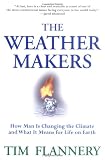
This is the first Tim Flannery book I've read. I have two of his books on my TBR pile -- The Future Eaters and The Weather Makers. I probably should have read The Future Eaters prior to this book. Throughout the book Flannery mentions how new discoveries fit in with his "Future eaters hypothesis". He neglects to mention what his hypothesis refers to until the last chapter. Some of the chapters felt like they came from other writings, they didn't flow with the rest of the book. Also ,-- and I say this as someone who reads scientific and medical journals for work -- he utilizes scientific nomenclature too frequently in a book that's meant for a general audience. In a nutshell -- educational with a few funny bits, but occasionally boring. It did make me interested in learning more about Australian ecology. show less
This is the first Tim Flannery book I've read. I have two of his books on my TBR pile -- The Future Eaters and The Weather Makers. I probably should have read The Future Eaters prior to this book. Throughout the book Flannery mentions how new discoveries fit in with his "Future eaters hypothesis". He neglects to mention what his hypothesis refers to until the last chapter. Some of the chapters felt like they came from other writings, they didn't flow with the rest of the book. Also ,-- and I say this as someone who reads scientific and medical journals for work -- he utilizes scientific nomenclature too frequently in a book that's meant for a general audience. In a nutshell -- educational with a few funny bits, but occasionally boring. It did make me interested in learning more about Australian ecology. show less
The tagline and picture made me believe this was more of an adventure than it really was - it is a science and history book. Not that there's anything wrong with that, but it was not nearly as interesting a read as I had anticipated. His search, to me as an American, was confusing - even with the occasional map to reference and a few pictures of some of the animals. He uses terms that might make perfect sense to somebody Down Under, but there were a few sentences I couldn't even begin to interpret for lack of knowledge of Australian slang.
The overall concept is interesting and the main point is that all of the ecology is related - survival or extinction of the kangaroos can tell you a good deal about the state of the rest of the land. show more Unfortunately, most of the book is spent lamenting the lack of historical information in many time periods of Australia's history and reminding us that these are all just hypotheses since nothing can be proven to be true, only proven wrong.
All in all, people really interested in Australia's history and the current state of the environment may find this very interesting. Natives of other countries with little knowledge of the geography of Australia will probably be somewhat lost and not learn nearly as much from this science lesson. show less
The overall concept is interesting and the main point is that all of the ecology is related - survival or extinction of the kangaroos can tell you a good deal about the state of the rest of the land. show more Unfortunately, most of the book is spent lamenting the lack of historical information in many time periods of Australia's history and reminding us that these are all just hypotheses since nothing can be proven to be true, only proven wrong.
All in all, people really interested in Australia's history and the current state of the environment may find this very interesting. Natives of other countries with little knowledge of the geography of Australia will probably be somewhat lost and not learn nearly as much from this science lesson. show less
The evolution and conservation of kangaroos, as told through the anecdotes of a field biologist. Very readable, full of amazing facts and stories.
Another great book from Flannery, this time just as direct and entertaining but more specific about Kangaroos, a great way to begin understanding the evolution of life in Australia.
Full review: ( http://bachlab.balbach.net/coolread4.html#kangaroo ) in summary: quick easy read, but has its problems.
Members
- Recently Added By
Author Information

45+ Works 5,116 Members

55+ Works 5,574 Members
Common Knowledge
- Original publication date
- 2007
- Important places
- Australia
- Epigraph
- If you want to study the history of this country, you'll have to have the will to fail.
Tom Rich - Dedication
- To my mother
Valda Joyce Flannery
a woman of boundless compassion and understanding - First words
- When I was young I met a man whose arse bore the bite-mark of a Tasmanian tiger.
- Last words
- (Click to show. Warning: May contain spoilers.)By the time spring brings its brief blossoming to the island there will be nine banded hare wallabies roaming Faure, for the three females released all had tiny, pink young in their pouches.
- Blurbers
- Bryson, Bill
- Original language
- English
Classifications
Statistics
- Members
- 192
- Popularity
- 169,660
- Reviews
- 7
- Rating
- (3.82)
- Languages
- English
- Media
- Paper, Ebook
- ISBNs
- 9
- ASINs
- 4