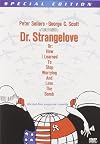
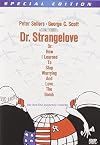
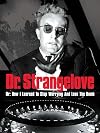
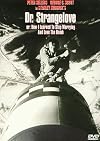
Dr. Strangelove or: How I Learned to Stop Worrying and Love the Bomb [1964 film]
by Stanley Kubrick (Director/Screenwriter), Peter George (Screenwriter), Peter Sellers, Terry Southern (Screenwriter)
On This Page
Description
A satire in which the U.S. president and his military advisors struggle ineptly to avert a holocaust after a psychotic Air Force general launches a nuclear attack on the Soviet Union because he fears that the Russians are poisoning the water supply in the United States.Tags
Recommendations
















Member Reviews
A US general orders an attack on the Soviet Union.
There was a time, many years ago, when I considered this my favorite movie. My opinion of it has dropped quite a bit since then, but I still love it.
Concept: A
Story: A
Characters: A
Dialog: A
Pacing: B
Cinematography: A
Special effects/design: C
Acting: B
Music: A
Enjoyment: A plus
GPA: 3.7/4
(Sep. 2010)
There was a time, many years ago, when I considered this my favorite movie. My opinion of it has dropped quite a bit since then, but I still love it.
Concept: A
Story: A
Characters: A
Dialog: A
Pacing: B
Cinematography: A
Special effects/design: C
Acting: B
Music: A
Enjoyment: A plus
GPA: 3.7/4
(Sep. 2010)
Closed captioned for the hearing impaired. | Special features: in English (mono), French, Spanish & Portuguese, with subtitles in English, French, Spanish, Portuguese, Chinese, Korean, & Thai ; new documentary: The art of Stanley Kubrick from short films to Strangelove ; Inside the making of Dr. Strangelove ; original split-screen interview with Peter Sellers and George C. Scott ; original advertising gallery ; theatrical trailers ; talent files ; animated menus ; production notes ; scene selections. | Based on the book Red alert by Peter George. | A videodisc release of the 1963 motion picture by Columbia Pictures. | Rated PG.
edit collections
Seen after 60 years, Dr. Strangelove seems remarkably fresh and undated - a clear-eyed, irreverant, dangerous satire. And its willingness to follow the situation to its logical conclusion - nuclear annihilation - has a purity that today's lily-livered happy-ending technicians would probably find a way around. Kubrick's comic gem sparkles with enduring relevance.
Jan 7, 2026English (UK)
Il generale Jack D. Ripper (il cui nome in inglese è un riferimento per assonanza al celeberrimo assassino di fine '800 Jack lo squartatore, Jack the ripper in inglese), comandante della base aerea statunitense di Burpelson, trasmette al suo stormo di 34 bombardieri strategici B-52 in quel momento in volo l'esecutivo del piano "R", ossia il piano di reazione nucleare ad un attacco nemico, allo scopo di iniziare una guerra nucleare contro l'Unione Sovietica. Normalmente solo il Presidente degli Stati Uniti può autorizzare l'utilizzo di armi nucleari, ma tale manovra era stata stabilita per consentire anche ai generali di beneficiare di questo privilegio, come deterrente contro attacchi a sorpresa nel caso in cui il Presidente fosse show more ucciso o in caso di immediato ed urgente bisogno militare. Gli equipaggi dei bombardieri, in particolare quello comandato dal maggiore T.J. "King" Kong, accolgono increduli la direttiva ma, ricevuta conferma dalla base, eseguono gli ordini e si dirigono verso i rispettivi obiettivi. L'offensiva dei sovietici, in realtà, non si è mai verificata. show less
May 11, 2018Italian
Ratings
Members
- Recently Added By
Author Information

61+ Works 6,568 Members
Stanley Kubrick was born in the Bronx, New York, and became a skilled photographer before he went into directing. He achieved fame with the fine antiwar film Paths of Glory in 1957, and his output since then has been extremely diversified. Through it all, however, runs a deep vein of pessimism. Dr. Strangelove (1964), 2001: A Space Odyssey (1968), show more and A Clockwork Orange (1972) express his vision of an apocalyptic future, while Spartacus (1959) and Barry Lyndon (1975) reveal his dark view of futility in the past. Kubrick has been able to work independently for most of his career, enjoying the rare right to make the final cuts of his films without studio interference. Some of his other notable films are Lolita (1954), based on Vladimir Nabokov's novel, and Full Metal Jacket (1987), about troops in the Vietnam War. (Bowker Author Biography) show less


24+ Works 1,116 Members

All Editions
Some Editions
Awards and Honors
Awards
Series
Belongs to Publisher Series
Criterion Laserdiscs (143)
The Criterion Collection (821)
Work Relationships
Is contained in
Is an adaptation of
Has the adaptation
Common Knowledge
- Canonical title
- Dr. Strangelove or: How I Learned to Stop Worrying and Love the Bomb [1964 film]
- Original title
- Dr. Strangelove or: How I Learned to Stop Worrying and Love the Bomb
- Alternate titles
- Dr. Strangelove
- Original publication date
- 1964-01-29
- People/Characters
- Lionel Mandrake; Merkin Muffley; Dr. Strangelove; Buck Turgidson; Jack D. Ripper; Bat Guano (show all 12); Mr. Staines; T. J. Kong; Alexei de Sadeski; Lothar Zogg; Miss Scott; Ace Owens
- Important places
- Pentagon, Arlington, Virginia, USA; Arlington, Virginia, USA; Virginia, USA
- Important events
- Cold War
- Related movies
- Dr. Strangelove or: How I Learned to Stop Worrying and Love the Bomb (1964 | IMDb)
- Canonical DDC/MDS
- 791.4372
- Canonical LCC
- PN1995.9.C55
Classifications
- DDC/MDS
- 791.4372 — Arts & recreation Recreation, sports, and performing arts Public performances Motion pictures, radio, television, podcasting Motion pictures Films; screenplays Single films
- LCC
- PN1995.9 .C55 — Language and Literature Literature (General) Literature (General) Drama Motion pictures
- BISAC
Statistics
- Members
- 767
- Popularity
- 36,496
- Reviews
- 6
- Rating
- (4.42)
- Languages
- English, French, Spanish, Thai
- ISBNs
- 18
- UPCs
- 13
- ASINs
- 40