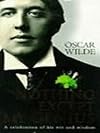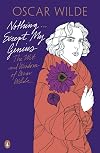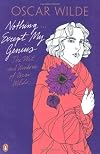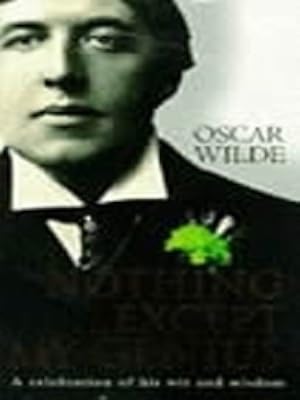
Nothing...Except My Genius
by Oscar Wilde 
On This Page
Description
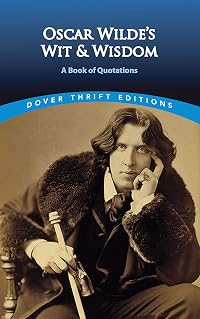
'I have nothing to declare,' Wilde once told an American customs official, 'except my genius.' A socialite, a wit, a man who flaunted convention and was unafraid to shock, Oscar Wilde was a great writer and a great man. This new collection of wit and wisdom demonstrates the brilliance of his vision, the audacity of his style. Such is the scope of the material, it brings to life the Wilde of great feeling as well as the Wilde of great art.Tags
Recommendations















Member Reviews
For that matter who doesn't acknowledge that Wilde was a misunderstood genius, but one wonders what this hotch-potch was meant to serve to a reader. Its definitely readable but probably by a 15 year old who might want to have a collection of Wilde's quotable quotes on bedside. Its hard to imagine that its a Penguin 'classic'.
The most disappointing thing for me is that the title quote is not anywhere in the book! How funny!
This is a nice little book of quotations by Oscar Wilde, many that come directly from his works. As a book of quotations, you can't really read it cover to cover in one sitting; it's something you need to pick up and read a few pages of and then set down again.
Did I like it, well, yes as far as a book of quotes goes. I went through and tabbed a number of my favorites. It's funny that as I look at it now, most of the tabs are in the first half of the book - and as the book is generally organized in the order of when the author said the quote or when the work was published, I guess you can say that I wasn't really enjoying Oscar's later show more works and thoughts as much.
Here are some of my favorite quotes:
"The supreme object of live is to live. Few people live. It is true life only to realize one's own perfection, to make one's every dream a reality."
"...nothing is worth doing except what the world says is impossible."
"...English people are far more interested in American barbarism than they are in American civilization."
"In America the young are always ready to give to those who are older than themselves the full benefits of their inexperience...it may be truly said that no American child is ever blind to the deficiencies of its parents, no matter how much it may love them."
"There is no such thing as a stupid American. Many Americans are horrid, vulgar, intrusive and impertinent, just as many English people are also; but stupidity is not one of the national vices. Indeed, in America there is no opening for a fool. They expect brains from a boot-black, and get them."
"America has never quite forgiven Europe for having been discovered somewhat earlier in history than itself."
"I am so clever that sometimes I don't understand a single word of what I am saying."
"Thinking is the most unhealthy thing in the world, and people die of it just as they die of any other disease. Fortunately, in England at any rate, thought is not catching."
"High hopes were once formed of democracy; but democracy means simply the bludgeoning of the people by the people for the people."
"The aim of love is to love: no more, and no less."
A good outcome of this book has been an increased desire to read more of Wilde's works; besides The Picture of Dorian Gray, I haven't read anything else, and I'm definitely more interested now. So, a good book. show less
This is a nice little book of quotations by Oscar Wilde, many that come directly from his works. As a book of quotations, you can't really read it cover to cover in one sitting; it's something you need to pick up and read a few pages of and then set down again.
Did I like it, well, yes as far as a book of quotes goes. I went through and tabbed a number of my favorites. It's funny that as I look at it now, most of the tabs are in the first half of the book - and as the book is generally organized in the order of when the author said the quote or when the work was published, I guess you can say that I wasn't really enjoying Oscar's later show more works and thoughts as much.
Here are some of my favorite quotes:
"The supreme object of live is to live. Few people live. It is true life only to realize one's own perfection, to make one's every dream a reality."
"...nothing is worth doing except what the world says is impossible."
"...English people are far more interested in American barbarism than they are in American civilization."
"In America the young are always ready to give to those who are older than themselves the full benefits of their inexperience...it may be truly said that no American child is ever blind to the deficiencies of its parents, no matter how much it may love them."
"There is no such thing as a stupid American. Many Americans are horrid, vulgar, intrusive and impertinent, just as many English people are also; but stupidity is not one of the national vices. Indeed, in America there is no opening for a fool. They expect brains from a boot-black, and get them."
"America has never quite forgiven Europe for having been discovered somewhat earlier in history than itself."
"I am so clever that sometimes I don't understand a single word of what I am saying."
"Thinking is the most unhealthy thing in the world, and people die of it just as they die of any other disease. Fortunately, in England at any rate, thought is not catching."
"High hopes were once formed of democracy; but democracy means simply the bludgeoning of the people by the people for the people."
"The aim of love is to love: no more, and no less."
A good outcome of this book has been an increased desire to read more of Wilde's works; besides The Picture of Dorian Gray, I haven't read anything else, and I'm definitely more interested now. So, a good book. show less
Ratings
Members
- Recently Added By
Author Information

1,762+ Works 120,827 Members
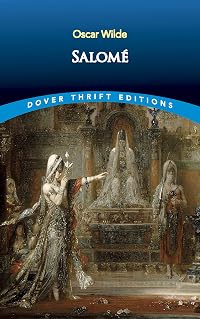
Flamboyant man-about-town, Oscar Wilde had a reputation that preceded him, especially in his early career. He was born to a middle-class Irish family (his father was a surgeon) and was trained as a scholarship boy at Trinity College, Dublin. He subsequently won a scholarship to Magdalen College, Oxford, where he was heavily influenced by John show more Ruskin and Walter Pater, whose aestheticism was taken to its radical extreme in Wilde's work. By 1879 he was already known as a wit and a dandy; soon after, in fact, he was satirized in Gilbert and Sullivan's Patience. Largely on the strength of his public persona, Wilde undertook a lecture tour to the United States in 1882, where he saw his play Vera open---unsuccessfully---in New York. His first published volume, Poems, which met with some degree of approbation, appeared at this time. In 1884 he married Constance Lloyd, the daughter of an Irish lawyer, and within two years they had two sons. During this period he wrote, among others, The Picture of Dorian Gray (1891), his only novel, which scandalized many readers and was widely denounced as immoral. Wilde simultaneously dismissed and encouraged such criticism with his statement in the preface, "There is no such thing as a moral or an immoral book. Books are well written or badly written. That is all." In 1891 Wilde published A House of Pomegranates, a collection of fantasy tales, and in 1892 gained commercial and critical success with his play, Lady Windermere's Fan He followed this comedy with A Woman of No Importance (1893), An Ideal Husband (1895), and his most famous play, The Importance of Being Earnest (1895). During this period he also wrote Salome, in French, but was unable to obtain a license for it in England. Performed in Paris in 1896, the play was translated and published in England in 1894 by Lord Alfred Douglas and was illustrated by Aubrey Beardsley. Lord Alfred was the son of the Marquess of Queensbury, who objected to his son's spending so much time with Wilde because of Wilde's flamboyant behavior and homosexual relationships. In 1895, after being publicly insulted by the marquess, Wilde brought an unsuccessful slander suit against the peer. The result of his inability to prove slander was his own trial on charges of sodomy, of which he was found guilty and sentenced to two years of hard labor. During his time in prison, he wrote a scathing rebuke to Lord Alfred, published in 1905 as De Profundis. In it he argues that his conduct was a result of his standing "in symbolic relations to the art and culture" of his time. After his release, Wilde left England for Paris, where he wrote what may be his most famous poem, The Ballad of Reading Gaol (1898), drawn from his prison experiences. Among his other notable writing is The Soul of Man under Socialism (1891), which argues for individualism and freedom of artistic expression. There has been a revived interest in Wilde's work; among the best recent volumes are Richard Ellmann's, Oscar Wilde and Regenia Gagnier's Idylls of the Marketplace , two works that vary widely in their critical assumptions and approach to Wilde but that offer rich insights into his complex character. (Bowker Author Biography) show less
Oscar Wilde has a Legacy Library. Legacy libraries are the personal libraries of famous readers, entered by LibraryThing members from the Legacy Libraries group.
Some Editions
Common Knowledge
- Canonical title
- Nothing...Except My Genius
- Original publication date
- 1997
- First words
- A few years ago, I sat for the British artist Maggi Hambling as she painted a series of portraits for me. (Playing Oscar by Stephen Fry)
Classifications
Statistics
- Members
- 126
- Popularity
- 258,279
- Reviews
- 2
- Rating
- (3.04)
- Languages
- English
- Media
- Paper
- ISBNs
- 7
- ASINs
- 1