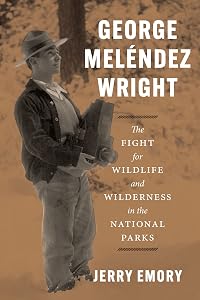
George Meléndez Wright: The Fight for Wildlife and Wilderness in the National Parks
by Jerry Emory
On This Page
Description
"In 1927, at the age of twenty-three, George Meléndez Wright conceptualized and eventually funded the first wildlife survey of western National Parks, radically changing how the National Park Service (NPS) would manage natural resources under its charge. By the time Wright arrived in Yosemite National Park to work as a ranger naturalist-the first Hispanic person to occupy a professional position in the NPS-he had already visited every national park in the Western United States. At a time show more when national parks routinely fed bears garbage as part of "shows" and killed "bad" predators such as wolves and coyotes, Wright's new ideas for conservation set the stage for modern scientific management of parks and other public lands. Before his revolutionary ideas began to influence Park Service policy, however, Wright faced persistent pushback by an entrenched culture that disregarded wildlife apart from the role that fauna played as a tourist attraction. Nonetheless, he prevailed. Wright died tragically in a car accident in 1936, while working to establish parks and wildlife refuges on the US-Mexico border, and yet, to this day, he remains a celebrated figure among conservationists, wildlife experts, and park managers. Jerry Emory, a writer connected to Wright's family, draws on hundreds of letters, field notes, interviews, and other primary documents to offer both a biography of Wright and a historical account of a crucial period in the evolution of our parks. Including a foreword by former National Park Service director Jonathan Jarvis, the book explores and celebrates Wright's vision for science-based wildlife management and his vocal support of wilderness in our parks and asks if current practices have achieved his goals"-- show lessTags
Member Reviews
Celebrating the life and work of George Melendez Wright, this well-researched biography traces Wright’s vision for science-based wildlife management. Wright’s work set the standard for National Park Service policies and American conservation practices today. Because he died early in this career, it’s taken almost a century for him to become know to the general public.
Using primary source documents including field notes, letters, interviews, the author skillfully weaves together Wright’s personal and professional life. A champion of science-based wildlife management and conservation, Wright was trained as a field scientist. Many of Wright’s approaches were ahead of his time. His innovate work changed how natural resources are show more managed in national parks. Although many of his recommendations weren’t adopted until decades after his death, his wildlife studies conducted in the 1930s are still referenced today. His field studies were used to establish science-based wildlife management practice.
Emory’s conversational approach makes this compelling biography enjoyable to read. Whether exploring Wright’s early family life or his adventures conducting wildlife surveys, Emory builds an engaging narrative that helps readers understand his passion for both family and wildlife conservation and the tragedy of a life and career cut short. show less
Using primary source documents including field notes, letters, interviews, the author skillfully weaves together Wright’s personal and professional life. A champion of science-based wildlife management and conservation, Wright was trained as a field scientist. Many of Wright’s approaches were ahead of his time. His innovate work changed how natural resources are show more managed in national parks. Although many of his recommendations weren’t adopted until decades after his death, his wildlife studies conducted in the 1930s are still referenced today. His field studies were used to establish science-based wildlife management practice.
Emory’s conversational approach makes this compelling biography enjoyable to read. Whether exploring Wright’s early family life or his adventures conducting wildlife surveys, Emory builds an engaging narrative that helps readers understand his passion for both family and wildlife conservation and the tragedy of a life and career cut short. show less
We read some books strictly for enjoyment; this was not that kind of book. This is an insightful book about George Melendez Wright's fight for wildlife and wilderness in the national parks. So interesting! His personality won over even his most ardent adversaries, his knowledge and critical thinking skills were remarkable, and his fierce determination to protect and preserve wildness reached the highest levels of government. The tragedy was his untimely, accidental death.
This is a MUST READ for anyone concerned about the wildlife in National Parks, the National Forests, and other wild habitats.
This is a MUST READ for anyone concerned about the wildlife in National Parks, the National Forests, and other wild habitats.
Members
- Recently Added By
Author Information
4+ Works 86 Members
Classifications
- Genres
- Nonfiction, Economics, Science & Nature, Biography & Memoir, General Nonfiction, Sports and Leisure
- DDC/MDS
- 333.720973 — Society, government, & culture Economics Economics of land and energy Conservation, Alternative Energy Sources Conservation & protection Biography And History North America United States
- LCC
- QH76 .E46 — Science Natural history – Biology Natural history (General) General
- BISAC
Statistics
- Members
- 12
- Popularity
- 1,878,063
- Reviews
- 2
- Rating
- (5.00)
- Languages
- English
- Media
- Paper, Ebook
- ISBNs
- 2