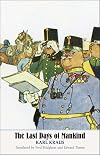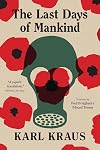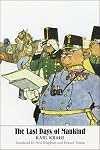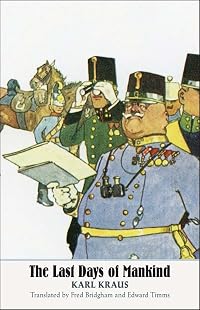
The Last Days of Mankind: The Complete Text
by Karl Kraus
On This Page
Description
Kraus's iconic WWI drama, a satirical indictment of the glory of war, now in English in its entirety for the first time One hundred years after Austrian satirist Karl Kraus began writing his dramatic masterpiece, The Last Days of Mankind remains as powerfully relevant as the day it was first published. Kraus's play enacts the tragic trajectory of the First World War, when mankind raced toward self-destruction by methods of modern warfare while extolling the glory and ignoring the horror of show more an allegedly "defensive" war. This volume is the first to present a complete English translation of Kraus's towering work, filling a major gap in the availability of Viennese literature from the era of the War to End All Wars. Bertolt Brecht hailed The Last Days as the masterpiece of Viennese modernism. In the apocalyptic drama Kraus constructs a textual collage, blending actual "ations from the Austrian army's call to arms, people's responses, political speeches, newspaper editorials, and a range of other sources. Seasoning the drama with comic invention and satirical verse, Kraus reveals how bungled diplomacy, greedy profiteers, Big Business complicity, gullible newsreaders, and, above all, the sloganizing of the press brought down the Austro-Hungarian Empire. In the dramatization of sensationalized news reports, inurement to atrocities, and openness to war as remedy, today's readers will hear the echo of the fateful voices Kraus recorded as his homeland descended into self-destruction. show lessTags
Recommendations
















Member Reviews
I'm not sure I'm capable of writing a balanced review of this book. I expected to like it more than I did, but I also liked it more than I expected to--the sheer bulk of the thing, its relentlessness, and the flaws in this edition (see below) made it less enjoyable than I had hoped. The genius of its construction, the emotional impact, and the utter refusal to button up anything, on the other hand, make it a model of what literature should be. Perhaps nobody ever had a finer eye for the telling detail, and there are thousands of them here, which can be exhausting. But, as the self-reflective Kraus tells us, that's important. The Optimist complains at one point that the Grumbler (i.e., Kraus) shouldn't fixate on particular details, but show more see the glory and virtue that the war should be about, at its best. Piling up the details is the only way to crush this kind of idiocy, and so, here's the pile. There's little development, because stupidity, hypocrisy, and greed don't develop, they just squat on the world. But the final scene (V, 55) and the Epilogue are astonishing nonetheless. One might just read them, and get the gist, but their emotional weight comes from the hundreds of preceding pages. Once you're thoroughly drained by all of that, the conclusion is far more telling.
So, I'm very glad this has been translated, and Bridgham and Timms have made it thoroughly readable. There is one major flaw: rather than footnotes, or even endnotes, we have a 'glossary.' That's fine if you're just looking up names, but not so great if you're looking up, say, what he's talking about with the postcards of atrocities. There is a glossary entry for them, but it's not under postcards, or atrocity, and so on. In general, if you think something's worth a footnote, it's in the glossary, but you'll have to read the glossary all the way through to find it. Speaking of postcards, there are very few illustrations here; the now out of print German edition has a bunch, which are very helpful in giving you a sense for what enraged Kraus so much. These were genuinely horrible people. Kraus himself wasn't perfect--his attitude towards 'the Jews' (more particularly: bourgeois, i.e., rich, Jews) is, with hindsight, disturbing--but you know what he wasn't doing? Demanding that they be slaughtered in the name of German honor.
One small thing I noticed in the translation: there's a cheeky allusion to Celan's 'Tod ist ein Meister aus Deutschland' in the epilogue ('Death is a master from Berlin'); that doesn't really exist in the German. The sense is there, perhaps, but I do wonder how many other liberties the translators took. That could have been reined in if there'd been, you know, footnotes, so the reader could check the supposed allusions. Some more American-English speakers might find the lingo a bit odd, as well.
Also: best last line of any book I've ever read, but readers might miss the irony, because, you know, no footnote. Though it is in the glossary, of course. show less
So, I'm very glad this has been translated, and Bridgham and Timms have made it thoroughly readable. There is one major flaw: rather than footnotes, or even endnotes, we have a 'glossary.' That's fine if you're just looking up names, but not so great if you're looking up, say, what he's talking about with the postcards of atrocities. There is a glossary entry for them, but it's not under postcards, or atrocity, and so on. In general, if you think something's worth a footnote, it's in the glossary, but you'll have to read the glossary all the way through to find it. Speaking of postcards, there are very few illustrations here; the now out of print German edition has a bunch, which are very helpful in giving you a sense for what enraged Kraus so much. These were genuinely horrible people. Kraus himself wasn't perfect--his attitude towards 'the Jews' (more particularly: bourgeois, i.e., rich, Jews) is, with hindsight, disturbing--but you know what he wasn't doing? Demanding that they be slaughtered in the name of German honor.
One small thing I noticed in the translation: there's a cheeky allusion to Celan's 'Tod ist ein Meister aus Deutschland' in the epilogue ('Death is a master from Berlin'); that doesn't really exist in the German. The sense is there, perhaps, but I do wonder how many other liberties the translators took. That could have been reined in if there'd been, you know, footnotes, so the reader could check the supposed allusions. Some more American-English speakers might find the lingo a bit odd, as well.
Also: best last line of any book I've ever read, but readers might miss the irony, because, you know, no footnote. Though it is in the glossary, of course. show less
Why do I do things? My head is filled of Hitchhiker's Guide to the Galaxy stuff right now, so I feel like Zaphod when he realizes he's locked off part of his brains from himself. But, instead of stealing space ships, I'm like why did I request a six hundred page Austrian satirical play from the 1920s to read? What possessed me to do that? At least I managed to request it in English and didn't get six hundred pages of Austrian-German vernacular when my German skills are roughly on par with reading books in German that have one noun per page, i.e. Katze (underneath picture of cat), Hund (underneath picture of dog), etc.
So why do I do things? I don't know.
So I spent the past week reading my six hundred page Austrian satirical play from show more the 1920s. I read an act a day, plus the intro and the glossary at the back. I have an epub and there doesn't seem to be any clever way of getting back and forth between the glossary and the play itself (am I missing something on my kobo or is it really just not possible to do this simply), so I simply read the glossary after finishing the play. That was no real problem. Likely I missed a lot of the specific political jokes, but I don't feel like I was really missing that much. Most of what the play says is this: the war benefits the rich, manipulates the press, and sends the poor to their deaths. So lots of fat men bemoaning a lack of butter while war amputees wander about in the foreground. About five hundred pages of this reiterated, then a descent into a Boschian bacchanal of talking hyenas and Martians. I seem to read a lot of books where aliens suddenly appear. Do I have some subliminal interest in surprise aliens? I'll add that question to the why do I do things one.
Basically The Last Days of Mankind is an unperformable play. There are stage directions such as continue for two hours and I think something like forty googol characters. I don't even know how one would stage certain parts, although I guess projecting film on a screen behind might solve that problem. I couldn't help thinking that if one is going to write an unperformable play, why not recast it as a novel? I guess art comes to the artist as it comes, but essentially, long soliloquies in the play are taken from newspaper articles of the time, so there are pages and pages that already reads less like a play and more like a creative non-fiction essay. But it's a play. So a play it is.
I know I'm sounding really down on The Last Days of Mankind, but it ends up transcending a lot of my complaints (not the one about surprise aliens though). I gave it four stars out of five. It's surprisingly prescient for a play from the 1920s. There's the foreshadowing of Nazis with the casual antisemitism (although Kraus was ethnically Jewish, so it isn't necessarily his antisemitism, more a comment on the antisemitism of the time). There's a harsh critique of globalisation. The Grumbler, Kraus himself inserted into his own play, has media critiques that would fit into any modern issue of AdBusters. It's surprisingly readable, in part due to Kraus and in part due to the translation, which has been, as the translators explain, modernized for an English speaking audience. But it is long, and it hits many of the same points again and again: War is Hell, in a democracy we are all complicit, and those who profit from it aim to keep it going for as long as they can. I don't know if I needed six hundred pages to hammer that point home.
And Martians.
The Last Days of Mankind by Karl Kraus, newly translated by Fred Bridgham and Edward Timms went on sale November 24, 2015.
I received a copy free from Netgalley in exchange for an honest review. show less
So why do I do things? I don't know.
So I spent the past week reading my six hundred page Austrian satirical play from show more the 1920s. I read an act a day, plus the intro and the glossary at the back. I have an epub and there doesn't seem to be any clever way of getting back and forth between the glossary and the play itself (am I missing something on my kobo or is it really just not possible to do this simply), so I simply read the glossary after finishing the play. That was no real problem. Likely I missed a lot of the specific political jokes, but I don't feel like I was really missing that much. Most of what the play says is this: the war benefits the rich, manipulates the press, and sends the poor to their deaths. So lots of fat men bemoaning a lack of butter while war amputees wander about in the foreground. About five hundred pages of this reiterated, then a descent into a Boschian bacchanal of talking hyenas and Martians. I seem to read a lot of books where aliens suddenly appear. Do I have some subliminal interest in surprise aliens? I'll add that question to the why do I do things one.
Basically The Last Days of Mankind is an unperformable play. There are stage directions such as continue for two hours and I think something like forty googol characters. I don't even know how one would stage certain parts, although I guess projecting film on a screen behind might solve that problem. I couldn't help thinking that if one is going to write an unperformable play, why not recast it as a novel? I guess art comes to the artist as it comes, but essentially, long soliloquies in the play are taken from newspaper articles of the time, so there are pages and pages that already reads less like a play and more like a creative non-fiction essay. But it's a play. So a play it is.
I know I'm sounding really down on The Last Days of Mankind, but it ends up transcending a lot of my complaints (not the one about surprise aliens though). I gave it four stars out of five. It's surprisingly prescient for a play from the 1920s. There's the foreshadowing of Nazis with the casual antisemitism (although Kraus was ethnically Jewish, so it isn't necessarily his antisemitism, more a comment on the antisemitism of the time). There's a harsh critique of globalisation. The Grumbler, Kraus himself inserted into his own play, has media critiques that would fit into any modern issue of AdBusters. It's surprisingly readable, in part due to Kraus and in part due to the translation, which has been, as the translators explain, modernized for an English speaking audience. But it is long, and it hits many of the same points again and again: War is Hell, in a democracy we are all complicit, and those who profit from it aim to keep it going for as long as they can. I don't know if I needed six hundred pages to hammer that point home.
And Martians.
The Last Days of Mankind by Karl Kraus, newly translated by Fred Bridgham and Edward Timms went on sale November 24, 2015.
I received a copy free from Netgalley in exchange for an honest review. show less
This becomes rather difficult to rate. If one takes it at face value, as a play, the rating must be low indeed, for it doesn't work as a play. Too talky, too long, too many characters, and a proposal to present it over 10 nights to make it work. Most people would leave before the end of the prologue. If, however, one approaches it as a dialogue in the grand old tradition of dialogues, it becomes a master work on the day to day sentiments driving Austrians (and Germans to some extent) during World War I. It is a fascinating look at attitudes and ideas. Still, even as a dialogue, it could be trimmed. A lot of repetition, a lot of unnecessary cluttering of the record, could be trimmed out. I found it worthwhile, especially since my show more education was a bit fuzzy on WWI, since most of my instructors were more interested in WWII. The author is an Austrian who experienced the war first hand, and wrote about it while it was happening. What we see here is a more immediate response to the mood of the war, not a political analysis from someone far removed, and that's what makes it so interesting. There are analyses, usually in the mouth of the character known as The Grumbler (who seems to be the author's voice), and some interesting ruminations on war. Read it next time you have a month to spare. Or break it down into bite size pieces, and keep it going until you get to the end. show less
Ratings
Members
- Recently Added By
Lists

1001 Books You Must Read Before You Die
1,448 works; 1,137 members

World War I Fiction
94 works; 15 members

Hidden Classics
73 works; 15 members

Harold Bloom - The Western Canon: D. The Chaotic Age
833 works; 24 members

German Literature
518 works; 56 members
Author Information

275+ Works 2,173 Members
Some Editions
Series
Belongs to Publisher Series
Common Knowledge
- Canonical title
- The Last Days of Mankind: The Complete Text
- Original title
- Die letzten Tage der Menschheit: Tragödie in fünf Akten mit Vorspiel und Epilog
- Original publication date
- 1918
Classifications
Statistics
- Members
- 67
- Popularity
- 467,601
- Reviews
- 3
- Rating
- (4.00)
- Languages
- English
- Media
- Paper, Ebook
- ISBNs
- 3
- ASINs
- 1