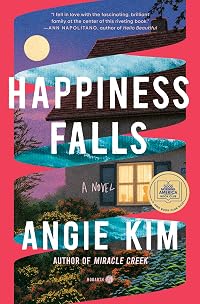
Happiness Falls
by Angie Kim
On This Page
Description
When a father goes missing, his family's desperate search leads them to question everything they know about him and one another in this thrilling page-turner, a deeply moving portrait of a family in crisis from the award-winning author of Miracle Creek. Longlisted for the New American Voices Award * "This is a story with so many twists and turns I was riveted through the last page."--Jodi Picoult "A brilliant, satisfying, compassionate mystery that is as much about language and show more storytelling as it is about a missing father. I loved this book."--Gabrielle Zevin, author of Tomorrow, and Tomorrow, and Tomorrow "I fell in love with the fascinating, brilliant family at the center of this riveting book."--Ann Napolitano, author of Hello Beautiful "We didn't call the police right away." Those are the electric first words of this extraordinary novel about a biracial Korean American family in Virginia whose lives are upended when their beloved father and husband goes missing. Mia, the irreverent, hyperanalytical twenty-year-old daughter, has an explanation for everything--which is why she isn't initially concerned when her father and younger brother Eugene don't return from a walk in a nearby park. They must have lost their phone. Or stopped for an errand somewhere. But by the time Mia's brother runs through the front door bloody and alone, it becomes clear that the father in this tight-knit family is missing and the only witness is Eugene, who has the rare genetic condition Angelman syndrome and cannot speak. What follows is both a ticking-clock investigation into the whereabouts of a father and an emotionally rich portrait of a family whose most personal secrets just may be at the heart of his disappearance. Full of shocking twists and fascinating questions of love, language, and human connection, Happiness Falls is a mystery, a family drama, and a novel of profound philosophical inquiry. With all the powerful storytelling she brought to her award-winning debut, Miracle Creek, Angie Kim turns the missing-person story into something wholly original, creating an indelible tale of a family who must go to remarkable lengths to truly understand one another. show lessTags
Recommendations










Member Reviews
What an exhilarating book! The main plot is about a missing husband and father, but Angie Kim has loaded an exceptionally immense amount of material into the narrative. There are several intriguing story arcs intermixed with the vanished father. Mia, the novel's narrator, has recently changed her college major to algorithmic composition, a mix of computer science, math, and music. Her footnotes and side comments about this subject are fascinating. Mia's brother, Eugene, has Angelman's syndrome and autism, which causes large motor dysfunctions and leaves him unable to speak. A great deal of information is given about this syndrome and some enthralling treatment ideas. Eugene was with his father when he disappeared. Adam, the father, was show more intensely interested in happiness and what he labeled the happiness quotient. He had been engaging in small experiments to test his theories. Mia reads his notes and history concerning this subject and discovers riveting and disturbing material.
Happiness Falls is a remarkably intelligent book that can be skimmed over in parts if the reader is not interested in the deeper subject matter. Much of this substance is located in the footnotes. I found each theme captivating. Angie Kim has truly outdone herself. This is an outstanding novel that should not be missed.
Many thanks to NetGalley and Random House Publishing for the ARC of the book. show less
Happiness Falls is a remarkably intelligent book that can be skimmed over in parts if the reader is not interested in the deeper subject matter. Much of this substance is located in the footnotes. I found each theme captivating. Angie Kim has truly outdone herself. This is an outstanding novel that should not be missed.
Many thanks to NetGalley and Random House Publishing for the ARC of the book. show less
We didn't call the police right away. Later, I would blame myself, wonder if things might have turned out differently if I hadn't shrugged it off, insisting Dad wasn't missing missing but just delayed, probably still in the woods looking for Eugene, thinking he'd run off somewhere. Mom says it wasn't my fault, that I was merely being optimistic, but I know better. I don't believe in optimism. I believe there's a fine line (if any) between optimism and willful idiocy, so I try to avoid optimism altogether, lest I fall over the line mistakenly.
"We didn't call the police right away," Mia tells us from the get-go. On that fateful day when her father went missing, her brother Eugene came running back from the park where he was hiking with her father, shoving Mia down on his way to the house. Then, she thought, her father returned as well, but by the time she figures out the mistake, he's been missing for hours.
What starts out as a missing persons investigation shifts focus when it becomes clear to Mia, her mother, Hannah, and her twin brother, John, that Eugene is the prime suspect in her father's disappearance. He has both autism and Angelman's, and is unable to communicate what happened on the hike. As the family tries to piece events together while protecting Eugene from an show more overzealous police officer, they come to learn their own biases and misunderstandings about each other. Narrator Mia, a twenty-year-old college student home during the COVID shutdown, reflects on events in her hyperverbal way, including footnotes for some of her tangents. Ultimately, she asks how well we can know another person and what it means when we humans tend to equate verbal acuity with intelligence. show less
What starts out as a missing persons investigation shifts focus when it becomes clear to Mia, her mother, Hannah, and her twin brother, John, that Eugene is the prime suspect in her father's disappearance. He has both autism and Angelman's, and is unable to communicate what happened on the hike. As the family tries to piece events together while protecting Eugene from an show more overzealous police officer, they come to learn their own biases and misunderstandings about each other. Narrator Mia, a twenty-year-old college student home during the COVID shutdown, reflects on events in her hyperverbal way, including footnotes for some of her tangents. Ultimately, she asks how well we can know another person and what it means when we humans tend to equate verbal acuity with intelligence. show less
One thing I've noticed about my 2023 reading year is that I've gotten pretty good at guessing whether I'm going to like a book or not before I read it. This book was a reminder that I'm not perfect at that skill, though. I picked it up skeptical that it would live up to the hype since I'm not super into murder mysteries, and put it down thinking it might be my favorite book of the year. It's not just that Kim masterfully constructs the story, adding new layers to consider at the perfect times. It's full of fascinating insights on happiness, living with special needs, and being Korean American—all while the characters are trying to solve a mystery during a pandemic. I ended up loving Mia's narration, too. I'm just going to say it: this show more book is flawless. I'm glad I gave it a chance. show less
This canny mystery turns out to be less a mystery and more of a philosophical treatise and a dive into family, duty, and the value of ambiguity, something many of us struggle with every day.
Briefly, the mystery is set in Covid times (but it is not about Covid) with a hyper-intelligent and engaged family thrown together when the 20-year-old twins return from college for lockdown. The third sibling has Angelman's Syndrome and autism and is non-speaking. One day he goes out for a hike with their father and returns home alone, extremely distressed and with blood under his nails. The book is built around the search for their husband/father. There are many twists and turns and subplots but you should read it to learn about those things. Kim show more is brilliant in a number of ways, but not least of all in how clearly she understands people who are like her, and also people who are not like her. There are some very good writers who understand their own motivations and actions well enough to write excellent characters who are like them, but there are far fewer who get the right people whose motivations and life experiences are very different from their own. Kim belongs to that rare and humbling second group.
The book touches on many issues of racism and ableism since they impact everyone's choices here and Kim does this with a blessedly deft touch. This book is not about racism and ableism, but it also is not exactly not about those things since everyone's psyches are touched by those forces and they impact many assumptions, actions and inactions. One cool thing Kim does is put the explication of racist and ableist beliefs and actions in footnotes with a thorough but brief explanation. This works surprisingly well and tells us so much about everyone's choices without getting in the way of the central story. This is masterful. I did not read Kim's first book but it has been on my TBR. I need to get to that soon. I am very impressed. show less
Briefly, the mystery is set in Covid times (but it is not about Covid) with a hyper-intelligent and engaged family thrown together when the 20-year-old twins return from college for lockdown. The third sibling has Angelman's Syndrome and autism and is non-speaking. One day he goes out for a hike with their father and returns home alone, extremely distressed and with blood under his nails. The book is built around the search for their husband/father. There are many twists and turns and subplots but you should read it to learn about those things. Kim show more is brilliant in a number of ways, but not least of all in how clearly she understands people who are like her, and also people who are not like her. There are some very good writers who understand their own motivations and actions well enough to write excellent characters who are like them, but there are far fewer who get the right people whose motivations and life experiences are very different from their own. Kim belongs to that rare and humbling second group.
The book touches on many issues of racism and ableism since they impact everyone's choices here and Kim does this with a blessedly deft touch. This book is not about racism and ableism, but it also is not exactly not about those things since everyone's psyches are touched by those forces and they impact many assumptions, actions and inactions. One cool thing Kim does is put the explication of racist and ableist beliefs and actions in footnotes with a thorough but brief explanation. This works surprisingly well and tells us so much about everyone's choices without getting in the way of the central story. This is masterful. I did not read Kim's first book but it has been on my TBR. I need to get to that soon. I am very impressed. show less
Does happiness fall? That's the way I started thinking about this novel, the second after Angie Kim's intricately plotted Miracle Creek. This story is similarly dense, here focussing on the Parson/Park (the kids are the Parksons) family. One of the kids, Mia of the Mia/John fraternal twin pair is our 20-year-old narrator. And she starts with a bang: "We didn't tell the police right away."
With that fairly electric first line, we're off. Turns out that the dad, Adam, has gone missing. He'd gone to the park as usual with Eugene, the 14-year-old brother who has both autism and Angelman syndrome and cannot talk. So what happened? That is the crux of the matter.
Now this is a slightly unusual family. Mom Hannah, Korean-born, is a linguist. Dad show more Adam, American-born, is a corporate higher-up who has been delving deeply into psycho-social studies and 'happiness research' for lack of a better term. And the story takes these two major themes and weaves them in with the conditions Eugene lives with, how it affects the family, and what it has to do with the disappearance. Adam's notes are discovered early on: seems he's been....conducting experiements on the family? (To analyze the effect of various factors on happiness, but still.) Then Mia herself is verbose and sticks footnotes copiously through her narration. One doesn't have to read these, but I did and they didn't bother me as it might do for some readers. And that heavy foreshadowing! Couldn't you have left out all those ominous warnings, girl?
However. As well-executed as all this was, I began to get the uncomfortable feeling that what I was reading was not entirely fiction. Being alienated for not speaking Korean while living for a few years there as children; the automatic association of lower intelligence with certain accents; even the episodes of Eugene's therapists and his various meltdowns; casual racism towards black people in the U.S.: all this felt too on the nose, as though I were reading a real account of a family's toughest times. I began to wonder if there were just one too many threads here. That I couldn't work out which one could have been dispensed with is a testament to the author's skill, I suppose.
Then I read that author's note at the end. And sure enough some of my doubts were validated. I am still glad I read this, just that the subject matter almost felt theoretical in some sense, a bit of a slog. Nevertheless, Happiness Falls is a worthy work. I had to wait a long time for the library to loan me a copy and I'm glad I waited. show less
With that fairly electric first line, we're off. Turns out that the dad, Adam, has gone missing. He'd gone to the park as usual with Eugene, the 14-year-old brother who has both autism and Angelman syndrome and cannot talk. So what happened? That is the crux of the matter.
Now this is a slightly unusual family. Mom Hannah, Korean-born, is a linguist. Dad show more Adam, American-born, is a corporate higher-up who has been delving deeply into psycho-social studies and 'happiness research' for lack of a better term. And the story takes these two major themes and weaves them in with the conditions Eugene lives with, how it affects the family, and what it has to do with the disappearance. Adam's notes are discovered early on: seems he's been....conducting experiements on the family? (To analyze the effect of various factors on happiness, but still.) Then Mia herself is verbose and sticks footnotes copiously through her narration. One doesn't have to read these, but I did and they didn't bother me as it might do for some readers. And that heavy foreshadowing! Couldn't you have left out all those ominous warnings, girl?
However. As well-executed as all this was, I began to get the uncomfortable feeling that what I was reading was not entirely fiction. Being alienated for not speaking Korean while living for a few years there as children; the automatic association of lower intelligence with certain accents; even the episodes of Eugene's therapists and his various meltdowns; casual racism towards black people in the U.S.: all this felt too on the nose, as though I were reading a real account of a family's toughest times. I began to wonder if there were just one too many threads here. That I couldn't work out which one could have been dispensed with is a testament to the author's skill, I suppose.
Then I read that author's note at the end. And sure enough some of my doubts were validated. I am still glad I read this, just that the subject matter almost felt theoretical in some sense, a bit of a slog. Nevertheless, Happiness Falls is a worthy work. I had to wait a long time for the library to loan me a copy and I'm glad I waited. show less
When I was a teenager I heard my grandmother talk about a neighbors whose wife was unable to move or talk, and they had no idea if she was mentally normal. He parked her in front of the television when he left for work. That terrified me, the idea that someone could be mentally normal but unable to communicate or move. (It also terrified me to think of being forced to watch daytime tv all day long.)
Angie Kim’s new novel Happiness Falls is a mystery and a family drama concerning the disappearance of the father, a son who cannot communicate the only witness. For Eugene’s mosaic Angelman syndrome means he is unable to talk, and he has motor difficulties, the fixed smile on his face giving no clue to his feelings.
Father Adam and mother show more Hannah came to odds over the false hope of Eugene learning to communicate, leading to Adam becoming a stay-at-home dad and Hannah returning to her career.
Twins Mia and John are nothing alike. They take after different parents, so a teacher thought Mia was Asian and John was Caucasian. John is an optimist, easier to like. Mia is a sceptic, logical, snarky.
Every day, Adam took Eugene for a walk in a park. One day, Eugene ran back home alone, distraught, blood on his clothes. Adam was nowhere to be found.
Secrets come out that bring doubt about Adam’s activities. Mia is especially interested in her father’s notebook discussing what he called the Happiness Quotient, a scientific exploration of how people’s optimism or pessimism affects their happiness level under differing situations.
When the police arrest Eugene, the family has to work fast to try to understand what happened on the walk near the Falls. What they learn is shocking and life-changing for them all.
What sets this book apart is Mia’s delving into the Happiness Quotient and exploring philosophical questions, and its addressing issues of communication. The family experience includes Hannah adjusting as a non-English speaking immigrant, and the family spending time in Korea where Mia felt categorized as an idiot for not speaking Korean. Eugene is presumed to be child-like in his mental development because he can’t communicate.
In the Author’s Note, Kim warns that we should not judge people based on their external appearance, nor should we judge people’s intelligence by their verbal skills, something she experienced as a young immigrant to America.
Yes, the passages from Adam’s notebook slow the book down, but this is not a page-turner, plot-driven beach read. Narrated by Mia, we see the story unravel through a complicated series of revelations that engage us, while he grappling with larger issues informs and elevates us.
Thanks to the publisher for a free book. show less
Angie Kim’s new novel Happiness Falls is a mystery and a family drama concerning the disappearance of the father, a son who cannot communicate the only witness. For Eugene’s mosaic Angelman syndrome means he is unable to talk, and he has motor difficulties, the fixed smile on his face giving no clue to his feelings.
Father Adam and mother show more Hannah came to odds over the false hope of Eugene learning to communicate, leading to Adam becoming a stay-at-home dad and Hannah returning to her career.
Twins Mia and John are nothing alike. They take after different parents, so a teacher thought Mia was Asian and John was Caucasian. John is an optimist, easier to like. Mia is a sceptic, logical, snarky.
Every day, Adam took Eugene for a walk in a park. One day, Eugene ran back home alone, distraught, blood on his clothes. Adam was nowhere to be found.
Secrets come out that bring doubt about Adam’s activities. Mia is especially interested in her father’s notebook discussing what he called the Happiness Quotient, a scientific exploration of how people’s optimism or pessimism affects their happiness level under differing situations.
When the police arrest Eugene, the family has to work fast to try to understand what happened on the walk near the Falls. What they learn is shocking and life-changing for them all.
What sets this book apart is Mia’s delving into the Happiness Quotient and exploring philosophical questions, and its addressing issues of communication. The family experience includes Hannah adjusting as a non-English speaking immigrant, and the family spending time in Korea where Mia felt categorized as an idiot for not speaking Korean. Eugene is presumed to be child-like in his mental development because he can’t communicate.
In the Author’s Note, Kim warns that we should not judge people based on their external appearance, nor should we judge people’s intelligence by their verbal skills, something she experienced as a young immigrant to America.
Yes, the passages from Adam’s notebook slow the book down, but this is not a page-turner, plot-driven beach read. Narrated by Mia, we see the story unravel through a complicated series of revelations that engage us, while he grappling with larger issues informs and elevates us.
Thanks to the publisher for a free book. show less
Members
- Recently Added By
Lists

Top Five Books of 2023
767 works; 317 members

Fiction With Familiar Settings
280 works; 93 members
Author Information

8 Works 2,960 Members
Awards and Honors
Awards
Distinctions
Notable Lists
Common Knowledge
- Canonical title
- Happiness Falls
- Original title
- Happiness Falls
- Original publication date
- 2023-08-29
- Original language*
- Englisch
*Some information comes from Common Knowledge in other languages. Click "Edit" for more information.
Classifications
Statistics
- Members
- 1,249
- Popularity
- 19,721
- Reviews
- 59
- Rating
- (3.81)
- Languages
- English, German
- Media
- Paper, Audiobook, Ebook
- ISBNs
- 17
- ASINs
- 7