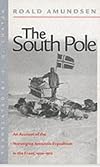
The South Pole: An Account of the Norwegian Antarctic Expedition in the Fram, 1910-1912
by Roald Amundsen
Roald Amundsen explorations (2)
On This Page
Description
On 14 December 1911, Roald Amundsen (1872-1928) and his Norwegian team became the first humans to reach the South Pole, a month before their ill-fated British rivals under the leadership of Robert Falcon Scott. Reissued here is the 1912 English translation of Amundsen's two-volume account of how this extraordinary and perilous feat was achieved. Illustrated throughout with illuminating maps and photographs, the text contains important details relating to matters of climate, equipment, diet, show more sledging and survival in forbiddingly cold conditions over uncertain terrain. Underpinning Amundsen's success, the use of dogs, skis and fur clothing made possible the dash to the pole and back without the loss of human life. While careful to present the expedition in the best light, Amundsen's work remains essential reading in the history of Antarctic exploration. Volume 1 covers the early stages of the expedition prior to the start for the pole in October 1911. show lessTags
Recommendations





















Member Reviews
The South Pole (1912) is Norwegian explorer Roald Amundsen's account of the first expedition to reach the South Pole and plant the "giant nail". He is most famous today as the foil or contrast to British explorer Robert F. Scott who died attempting the same journey at about the same time in a sort of "race for the pole". Much more has been written and sung about Scott whose story is very dramatic, while Amundsen's comparatively uneventful trip has mostly been forgotten. This is a shame because Amundsen is a model of preparedness, on how to do things correctly. It lacks the tragic aspect of Scott, but it has a secure feeling of confidence in the face of adversity, of a well made plan executed perfectly. After reading so many tragic show more Arctic and Antarctic explorer stories - Scott and Shackleton and Franklin etc. - what a delight to read about one that went well, no one died (or came close to dieing), and the goal was achieved.
As a literary work Amundsen's account is pretty good, it is vivid and never really bogs down in repetitive detail. Chapter 8, "A Day At Framheim" is particularly good. The snow-tunnel fortress will forever live in my memory. The sauna, the "crystal palace", the smell of American pancakes. The descriptions of the dogs are excellent.
If there is criticism, it is that Amundsen is somewhat aniseptic in washing out anything that would make him or the expedition look bad. As we learn in The Last Place on Earth, there was a serious problem between Amundsen and Johanseen (which eventually led to Johanseen's suicide in 1913), but it is completely excised from the book. One wonders what else was left out.
I read the book using two excellent sources. The original edition is available as a scanned PDF, which includes numerous maps and photographs that are indispensable. There is also a LibriVox audio-book version, from which I found certain chapters to be enjoyable read aloud.
--Review by Stephen Balbach, via CoolReading (c) 2010 cc-by-nd show less
As a literary work Amundsen's account is pretty good, it is vivid and never really bogs down in repetitive detail. Chapter 8, "A Day At Framheim" is particularly good. The snow-tunnel fortress will forever live in my memory. The sauna, the "crystal palace", the smell of American pancakes. The descriptions of the dogs are excellent.
If there is criticism, it is that Amundsen is somewhat aniseptic in washing out anything that would make him or the expedition look bad. As we learn in The Last Place on Earth, there was a serious problem between Amundsen and Johanseen (which eventually led to Johanseen's suicide in 1913), but it is completely excised from the book. One wonders what else was left out.
I read the book using two excellent sources. The original edition is available as a scanned PDF, which includes numerous maps and photographs that are indispensable. There is also a LibriVox audio-book version, from which I found certain chapters to be enjoyable read aloud.
--Review by Stephen Balbach, via CoolReading (c) 2010 cc-by-nd show less
Without a doubt, Amundsen is a giant among polar explorers, having lead the first open-sea voyage of the Northwest Passage and, several years later, the first successful expedition to the South Pole. But there have always been questions about his tactics while racing to be the first at the Pole, and they do dim the glory of his achievement. This book is Amundsen's account of the endeavor, and it leaves some gaping holes; it's also not nearly as enthralling as some other accounts of polar explorers, such as those by Apsley Cherry-Garrard and Douglas Mawson. This is only partly due to the relative ease of his Antarctic adventures compared with theirs.
Amundsen was an extraordinarily prepared explorer. He and his crew, a total of 19, grew show more up in Norway and skied from a young age. Amundsen felt strongly that the best way to travel over polar terrain was by ski, with Eskimo-dog-drawn sledges carrying supplies. Although he was fund-raising to try for the North Pole, Peary and Cook both made claims before he was ready, so without telling his financial backers or crew, he secretly planned to try for the South Pole instead, knowing that Robert Scott was already planning such an expedition. Only after they were on their way did he let the crew in on his plans and telegraph Scott with the news. Scott was already southward-bound at the time, and Amundsen would have known it would be months before Scott received the telegram, long after he could alter his own plans. This sneakiness, in a world typically governed by gentlemanly behavior, has tarnished his superb accomplishment.
The account is interesting but not particularly gripping. Amundsen left out most problems that arose, especially his falling out with a young expedition member who had been foisted on him by a financial backer; he describes in glowing terms most aspects of their preparations, interpersonal relations, and run for the Pole. The trip was indeed a complete success: Pole realized, crew in good shape, and back early. The dispassionate descriptions of dogs and seals being slaughtered and used for food were pretty disagreeable - especially the crew's enjoyment of dog steaks. But it was a different time, of course.
An essential read for the Antarctic enthusiast, but I wouldn't read this one first. Better to start with some of the more emotionally involving accounts about Scott, Mawson, and Shackleton. show less
Amundsen was an extraordinarily prepared explorer. He and his crew, a total of 19, grew show more up in Norway and skied from a young age. Amundsen felt strongly that the best way to travel over polar terrain was by ski, with Eskimo-dog-drawn sledges carrying supplies. Although he was fund-raising to try for the North Pole, Peary and Cook both made claims before he was ready, so without telling his financial backers or crew, he secretly planned to try for the South Pole instead, knowing that Robert Scott was already planning such an expedition. Only after they were on their way did he let the crew in on his plans and telegraph Scott with the news. Scott was already southward-bound at the time, and Amundsen would have known it would be months before Scott received the telegram, long after he could alter his own plans. This sneakiness, in a world typically governed by gentlemanly behavior, has tarnished his superb accomplishment.
The account is interesting but not particularly gripping. Amundsen left out most problems that arose, especially his falling out with a young expedition member who had been foisted on him by a financial backer; he describes in glowing terms most aspects of their preparations, interpersonal relations, and run for the Pole. The trip was indeed a complete success: Pole realized, crew in good shape, and back early. The dispassionate descriptions of dogs and seals being slaughtered and used for food were pretty disagreeable - especially the crew's enjoyment of dog steaks. But it was a different time, of course.
An essential read for the Antarctic enthusiast, but I wouldn't read this one first. Better to start with some of the more emotionally involving accounts about Scott, Mawson, and Shackleton. show less
It's interesting to compare this account with Apsley Cherry-Garrard's story of the Scott expedition. They were both racing for the south pole but Amundsen relied on very careful preparation and an experienced team + a great respect for the conditions whereas Scott was poorly prepared, trusting more in late victorian macho imperialism famously represented by his man pulled sledges. Everything works right for Amundsen in this excellent account of turn of the century polar exploration.
no one dies on his watch, and yet Scott is the hero?? quoi?!
Ratings
Members
- Recently Added By
Lists

Polar exploration
54 works; 4 members
Author Information

107+ Works 612 Members
Norwegian explorer Roald Amundsen was born near Borge, Norway. Although he studied medicine, he abandoned that career to pursue a life at sea. In 1897 he went to the Antarctic with a Belgian expedition. The ship, Belgica, became the first vessel to spend a winter in Antarctica. From 1902 to 1906, Amundsen explored the Northwest Passage, becoming show more the first person to navigate this waterway in both directions. In 1910 Amundsen set out hoping to be the first person to reach the North Pole. But when the news that the American Robert Peary had reached the pole, Amundsen shifted his attention to the South Pole. He became the first person to reach the South Pole, on in December 14, 1911, the month before Captain Robert Falcon Scott. Amundsen disappeared in the Arctic in 1928 while searching by plane for his airship Italia, which had been missing. Among the books that Amundsen wrote about his adventures, most notably is his autobiography, My Life as an Explorer (1927). (Bowker Author Biography) show less
Some Editions
Awards and Honors
Notable Lists
Series

Belongs to Publisher Series
Work Relationships
Common Knowledge
- Canonical title*
- Южный полюс
- Original title
- The South pole; an account of the Norwegian Antarctic expedition in the "Fram," 1910-1912
- Original publication date
- 1912
- People/Characters
- Roald Amundsen
- Important places
- Antarctica; South Pole
- Important events*
- Eerste mens op de Zuidpool.
- First words
- On February 10, 1911, we started for the South to establish depots, and continued our journey until April 11.
- Last words
- (Click to show. Warning: May contain spoilers.)On June 7, 1912, the second anniversary of our leaving Christiania, all the members of the Expedition, except the Chief and myself, left for Norway, and the first half of the Expedition was thus brought to a fortunante conclusion. (Chapter XV)
*Some information comes from Common Knowledge in other languages. Click "Edit" for more information.
Classifications
- Genres
- Nonfiction, Travel, General Nonfiction, History, Biography & Memoir
- DDC/MDS
- 919.89 — History & geography Geography & travel Geography of and travel in Australasia, Pacific Ocean islands, Atlantic Ocean islands, Arctic islands, Antarctica and on extraterrestrial worlds Polar regions Antarctica
- LCC
- G850 — Geography, Anthropology and Recreation Geography (General) Arctic and Antarctic regions
- BISAC
Statistics
- Members
- 238
- Popularity
- 136,734
- Reviews
- 4
- Rating
- (4.00)
- Languages
- 10 — Czech, Dutch, English, German, Norwegian (Bokmål), Norwegian, Polish, Russian, Spanish, Swedish
- Media
- Paper, Ebook
- ISBNs
- 52
- ASINs
- 7