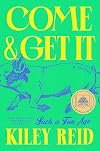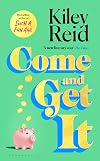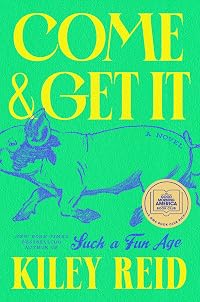
Come and Get It
by Kiley Reid
On This Page
Description
"It's 2017 at the University of Arkansas. Millie Cousins, a senior resident assistant, wants to graduate, get a job, and buy a house. So when Agatha Paul, a visiting professor and writer, offers Millie an easy yet unusual opportunity, she jumps at the chance. But Millie's starry-eyed hustle becomes jeopardized by odd new friends, vengeful dorm pranks, and illicit intrigue."--Tags
Recommendations





Member Reviews
I'm a total sucker for a campus novel (even I Am Charlotte Simmons by Tom Wolfe, which everyone else hated), and this one has emphatically fascinating conflicts. Agatha is a successful gay Black author in her late thirties, who takes a sabbatical from her tension-filled marriage to a dancer for a short-term teaching assignment at flagship U of Arkansas Fayetteville, rife with football and sororities. There she meets Millie, a 24 year old Black RA who strives for financial independence and yearns to buy a house, after spending happy years watching home renovation shows with her devoted mom. Millie is responsible for a floor in a dorm that includes a single and a triple, populated by traumatized former baton twirler Kennedy and her three show more mean girl suitemates. Agatha's initial intent is to conduct research for her upcoming book about weddings by interviewing the mean girls, but she becomes fascinated by their lives and privilege and uses Millie as her tool to eavesdrop on the trio to create viral, episodic online output for Teen Vogue. And that's just the start of the intertwining semester-long fortunes of Agatha, Millie, and Kennedy, taking many dramatic pathways that lead to a satisfying ending. I'm not sure how this would work as an audiobook, with so many viewpoints expressed, but as an old-fashioned campus tell-all, it's a gem. show less
Come and Get It by Kiley Reid is an engrossing novel that touches on so many subjects while still, ultimately, being about a handful of very real people.
I was a little surprised by a few of the reviews I read, not the professional ones but ones from regular readers, who claimed there was no plot whatsoever. I even reread the novel (only willing to do this because I liked it a lot and didn't mind revisiting any small things I missed the first time) to see if I was mistaken. No, there is a plot. What it didn't have was a typical popular fiction plot, like mystery or thriller or even science fiction and fantasy. Those tell you from the beginning what the big goal is, solving a murder, or saving the planet from an intergalactic attack. This show more is more subtle and, arguably, weaves a couple of subplots into a braided plotline. But there is a plot, so don't be misled by people who didn't like the book rationalizing their dislike by making it sound like the novel is fatally flawed. Like any novel, some readers won't care for it. Some of them can't simply say they didn't like it and have to drape it in rationalization.
These characters are presented to the reader initially within the context of their present at the University of Arkansas (which, by the way, is not a "small southern college" as one reader called it) with some foreshadowing of their personalities that will play key roles later in the story. As we progress through the semester and the tension builds, we learn a little more background about each as it becomes important to the plot, so that by the time the climax comes we understand how and why these characters act the way they do.
If you insist on liking a character in order to like a novel, you may have some difficulty. These characters are complex, you know, kinda like actual people. So you will like a character then find yourself disappointed in them. You will likely dislike a character and at some point find yourself at least feeling some empathy for them. In other words, there is very little black and white and a lot of gray. If caring about characters and wanting to know how or if they reach their goals doesn't appeal to you, this novel may not appeal to you.
What I found most impressive was the way topical issues, from race and class to mental health, were brought into the story without being preachy. There is a lot more nuance in how those topics are addressed than you often find. How does one remain in, or regain access to, one's community when you're also largely living and working outside of it? I recently reread John Edgar Wideman's Homewood Trilogy and some of the themes he addressed carried over into my reading of this novel, which made it even more interesting for me.
I would recommend this novel to those who enjoy character-driven stories that don't necessarily follow the typical pop novel structure, where the dynamics of small interactions between characters replaces big shootouts and explosions.
Reviewed from a copy made available by the publisher via NetGalley. show less
I was a little surprised by a few of the reviews I read, not the professional ones but ones from regular readers, who claimed there was no plot whatsoever. I even reread the novel (only willing to do this because I liked it a lot and didn't mind revisiting any small things I missed the first time) to see if I was mistaken. No, there is a plot. What it didn't have was a typical popular fiction plot, like mystery or thriller or even science fiction and fantasy. Those tell you from the beginning what the big goal is, solving a murder, or saving the planet from an intergalactic attack. This show more is more subtle and, arguably, weaves a couple of subplots into a braided plotline. But there is a plot, so don't be misled by people who didn't like the book rationalizing their dislike by making it sound like the novel is fatally flawed. Like any novel, some readers won't care for it. Some of them can't simply say they didn't like it and have to drape it in rationalization.
These characters are presented to the reader initially within the context of their present at the University of Arkansas (which, by the way, is not a "small southern college" as one reader called it) with some foreshadowing of their personalities that will play key roles later in the story. As we progress through the semester and the tension builds, we learn a little more background about each as it becomes important to the plot, so that by the time the climax comes we understand how and why these characters act the way they do.
If you insist on liking a character in order to like a novel, you may have some difficulty. These characters are complex, you know, kinda like actual people. So you will like a character then find yourself disappointed in them. You will likely dislike a character and at some point find yourself at least feeling some empathy for them. In other words, there is very little black and white and a lot of gray. If caring about characters and wanting to know how or if they reach their goals doesn't appeal to you, this novel may not appeal to you.
What I found most impressive was the way topical issues, from race and class to mental health, were brought into the story without being preachy. There is a lot more nuance in how those topics are addressed than you often find. How does one remain in, or regain access to, one's community when you're also largely living and working outside of it? I recently reread John Edgar Wideman's Homewood Trilogy and some of the themes he addressed carried over into my reading of this novel, which made it even more interesting for me.
I would recommend this novel to those who enjoy character-driven stories that don't necessarily follow the typical pop novel structure, where the dynamics of small interactions between characters replaces big shootouts and explosions.
Reviewed from a copy made available by the publisher via NetGalley. show less
Come and Get It is about people in a college setting (specifically the University of Arkansas in Fayetteville) confronted with terrible decisions they have made, the consequences of which shatter their sense of self-worth, and how they use economic transactions to paper things over. It is such a grounded novel, where the characters come to life with their patter and habits. The novel suggests that its atomized, lonely characters may have to find their only solace in trips to Target.
This took me on a nostalgic journey filled with drama and self-discovery. Having lived in a single-in-a-suite-style dorm during undergrad, I found myself nodding along to the younger characters' struggles to find their place on campus. Similarly, as someone who navigated grad school and worked as a teaching assistant, I resonated with the older students trying to navigate the complexities of adulthood while still figuring themselves out. Now, more than ten years removed from that life but still entrenched in academia, I empathized with the older characters grappling with what life looks like now. The spoiler? We never really have it all figured out, do we? Despite growing more confident, we keep making new mistakes along the way. Reid show more captures this sentiment beautifully. While it didn’t evoke every emotion on the spectrum, it offered an intriguing story that escalated in unexpected ways. I found myself wishing for more, wanting to linger in this world a little while longer. The exploration of relationships between characters at different stages of life struck a chord with me, and I saw bits of myself reflected in each of them. Reading this book felt eerily relatable, almost like peering into a mirror of my own experiences. Overall, this is a book I wholeheartedly recommend, though it might not resonate with everyone. It's familiar yet uncomfortable, much like revisiting old textbooks and notes from this time in my life. show less
Millie is a student paying her way through college by working as a residential aide in a dormitory building. She's older than the students, having taken time out, and she just wants to be able to afford the downpayment on a small house in Fayetteville. Agatha is a professor of English and a journalist. She has a commission to write about weddings but when she visits the dormitory she realises that the bigger story is the attitude of the students to money. Kennedy has come to Fayetteville for a fresh start. She is struggling to make friends and then she is rejected from the one course she really wants to take.
I liked Reid's first book but this is so much better! There is a lightness of writing which masks the really intense topics that show more are considered. Ostensibly about money, there is a lot about race that lurks under the surface as well as growing up and finding oneself and the pressures on college girls. show less
I liked Reid's first book but this is so much better! There is a lightness of writing which masks the really intense topics that show more are considered. Ostensibly about money, there is a lot about race that lurks under the surface as well as growing up and finding oneself and the pressures on college girls. show less
(29) I absolutely loved this author's book, "Such a Fun Age." But this one was not nearly the same quality in my opinion. I am still not quite sure what it was about. It seemed a bit rambley and it the narrative arc was uneven. It is about one year in the lives of some residents in a dorm including the RA and a visiting Professor who sets out to write a book partly about the culture of young University women that morphs into something else that walks back and forth over an ethical line involving spying, bribery, and inappropriate relationships. There were a handful of girls that were peripheral to the main characters and they were hard to keep straight. It was hard to really care about their lives. I wasn't sure what Reid was actually show more trying to evoke in the reader in regard to these women - it was not pathos I don't think. And if is was, she failed.
I feel sad if college women are this shallow? Or is it just Southern women? What are we trying to get at here? Living adjacent to several Southern U's most of my professional life after growing up in New England - she did nail the caricature of 'Christian' people gossiping... That was hilarious. And the contextual detail was effortless. I really feel like I had been living in a dorm for the last few weeks. All the way down to the dirty dishes in the shared sink, the move in day with the parents and the Target runs, the sounds of voices through the walls. Thank-God I never have to do that again.
But beyond that, I don't have much more to say. I didn't really get Millie and as she was our main focus, this detracted. Millie barely ever finished a sentence of dialogue - just alot of "Umm, Yeah, No... Its not like... Yeah, forget it." I am guessing that this is supposed to sound, or maybe really is, authentic to the way people speak, but it contributed to the feeling of an overall disjointed and random reading experience. I think this author is incredibly talented. There is probably more here that I am just not appreciating, but on the whole a disappointment from this big fan of 'Such a Fun Age.' show less
I feel sad if college women are this shallow? Or is it just Southern women? What are we trying to get at here? Living adjacent to several Southern U's most of my professional life after growing up in New England - she did nail the caricature of 'Christian' people gossiping... That was hilarious. And the contextual detail was effortless. I really feel like I had been living in a dorm for the last few weeks. All the way down to the dirty dishes in the shared sink, the move in day with the parents and the Target runs, the sounds of voices through the walls. Thank-God I never have to do that again.
But beyond that, I don't have much more to say. I didn't really get Millie and as she was our main focus, this detracted. Millie barely ever finished a sentence of dialogue - just alot of "Umm, Yeah, No... Its not like... Yeah, forget it." I am guessing that this is supposed to sound, or maybe really is, authentic to the way people speak, but it contributed to the feeling of an overall disjointed and random reading experience. I think this author is incredibly talented. There is probably more here that I am just not appreciating, but on the whole a disappointment from this big fan of 'Such a Fun Age.' show less
fiction - a 38y.o. white writer/professor Agatha Paul (fresh from a complicated, but more or less broken-up relationship with her Black dancer/spendthrift wife) meets a 24y.o. Black, super-senior and fiscally-responsible RA Millie Cousins (who took a year off to help her Glaucoma-suffering mother and save some money) at a primarily-white University of Arkansas in Fayetteville, where Agatha is conducting research on the dorm residents for a new book, among them being white student Kennedy (with severe social anxiety) and Black scholarship student Peyton (likes cooking, but also fastidious about kitchen neatness), and their (less flatteringly portrayed roommate Tyler and her sorority friends). CW/TW: depression, severe anxiety, suicidal show more ideation.
Really interesting to eavesdrop on these fascinating people and learn the backstories of the main characters; then everything gets super messy -- more trauma than I would hope for, but still a riveting read. I'm left with mixed feelings about some of the characters and their actions and it does deal with various race/class/money issues, so I can see how this would make a good book club selection.
February 2024 bingo challenge: book club selection, takes place at a school over fall semester, autumn move-in day into December/start of Winter break. show less
Really interesting to eavesdrop on these fascinating people and learn the backstories of the main characters; then everything gets super messy -- more trauma than I would hope for, but still a riveting read. I'm left with mixed feelings about some of the characters and their actions and it does deal with various race/class/money issues, so I can see how this would make a good book club selection.
February 2024 bingo challenge: book club selection, takes place at a school over fall semester, autumn move-in day into December/start of Winter break. show less
Members
- Recently Added By
Lists

Bitter Southerner Summer Reading Roundup
198 works; 8 members

LoanStars | Adult List: January 2024
10 works; 1 member

Books Read in 2024
4,727 works; 128 members

Southern fiction reading list
25 works; 1 member
Author Information

5 Works 5,228 Members
Some Editions
Awards and Honors
Awards
Distinctions
Common Knowledge
- Original publication date
- 2024
- People/Characters
- Millicent “Millie” Cousins; Agatha Paul; Glory Cousins-Arnold; Richard Cousins-Arnold; Peyton Nicole Shephard; Kennedy Washburn (show all 13); Tyler Hanna; Robin Silva; Nichelle Washburn; Josh; Colette; Ryland; Aimee Pearson
- Important places
- Fayetteville, Arkansas, USA; Joplin, Missouri, USA; University of Arkansas
- Epigraph
- I don't want to spend eternity with the lights off. I'll buy the most expensive, longest lasting bulbs, and charge them to my Amex.
—Lucy Biederman, The Walmart Book of the Dead
We're all working together: that's the secret.
—Sam Walton, Sam Walton: Made in America - Dedication
- For Caleb Way
- First words
- Agatha Paul stood in front of Belgrade Dormitory at 6:59 p.m.
- Last words
- (Click to show. Warning: May contain spoilers.)“Alright,” she said. “Let ‘s stretch our legs. We can just look around.”
- Blurbers
- Henry, Emily; Moore, Liz; Harding, Paul; Acevedo, Elizabeth
Classifications
Statistics
- Members
- 640
- Popularity
- 45,555
- Reviews
- 23
- Rating
- (3.21)
- Languages
- English
- Media
- Paper, Audiobook, Ebook
- ISBNs
- 15
- ASINs
- 4