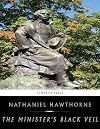
The Minister's Black Veil [short story]
by Nathaniel Hawthorne
On This Page
Description
'The Minister's Black Veil' by Nathaniel Hawthorne, first published in 1832, is a grim tale about Mr. Hooper, a preacher, who starts wearing a veil over the upper part of his face. He first wore the veil while delivering a sermon on secret sin, and never removes it, despite the dismay of the congregation or the pleas of his fiancée, who leaves him. Mr. Hooper develops into Father Hooper, a figure who makes converts of people who imagine themselves to also hide behind the veil. Through the show more narrative technique, Hawthorne ultimately implies that the exposed faces of people also function like veils in order to cover one or more of the deadly sins. show lessTags
Recommendations





















Member Reviews
A wonderful and powerful gothic tale published at a time when this sort of writing hadn't exisisted before; Its easy to see why this was one of the stories that shaped the genre. It's well written and while it reads as a simple enough story the underlying message is bold and powerful. Who would have thought that minister Hooper donning something as simple as a veil could cause such a scandal throughout the small town. While the townspeople are obsessed and put off Mr. Hooper see's more of his congregation than ever before; Seeing their souls rather than just their faces. So many questions are raised regarding society, truth, faith and the morals of mankind.
Outstanding. I'd give it 4.5 stars if I could. Definitely must read and with the show more slightness of the story there's no excuse not to read it! show less
Outstanding. I'd give it 4.5 stars if I could. Definitely must read and with the show more slightness of the story there's no excuse not to read it! show less
Nathaniel Hawthorne’s The Minister’s Black Veil is an iconic short story, read and taught for centuries, and still relevant today, for it is about human nature, and human nature has changed little since the 1700s.
The minister assumes, without explanation, the wearing of a black veil over his face. His parishioners immediately speculate upon the reason for this strange action, and all of their speculations center around a defect in the soul of the minister--what is he hiding beneath the veil?
His first sermon preached wearing the veil is described in this way:
The subject had reference to secret sin and those sad mysteries which we hide from our nearest and dearest, and would fain conceal from our own consciousness, even forgetting show more that the Omniscient can detect them. A subtle power was breathed into his words. Each member of the congregation, the most innocent girl and the man of hardened breast, felt as if the preacher had crept upon them behind his awful veil and discovered their hoarded iniquity of deed or thought.
And this would seem to be the theme of this story--the secret sin every man carries, attempts to conceal, perhaps even from himself, but can never conceal from God. But, one cannot help also assess the minister himself and his actions in terms of casting judgment on others, displaying so prominently what he feels are his own insights, and sacrificing a more human and loving relationship to his parishioners and his intended bride, whom he has alienated after promising to love, for a sort of proud display of his recognition of the subtle sins of himself and others. Is he usurping God’s domain?
When he dies and is buried in the veil, has he left a lasting lesson to his congregation that will enable them to more closely guard their lives and behavior? Or, has he died and been buried beneath a veil that separated him from them and kept him from being the mentor and guide he might have been otherwise, leaving them only a legacy of fear? Has he lived, or sacrificed the life God intended for him?
This is a complicated story with theological overtones, particularly regarding the nature of original sin and how that is interpreted by the faithful. I believe our collective view of original sin has changed significantly since the 1700s. We, as a people, are far from as strict in our interpretation of sin itself. But, I think we would all agree that each of us has our own secret moral lapses that we do not wish to share with others, perhaps lapses that are minor or perhaps lapses that we consider stains upon our lives. The story seems to me to be far from a black and white warning against sin, it rather leaves us with several views to ponder, and such pondering might be balm for the soul. show less
The minister assumes, without explanation, the wearing of a black veil over his face. His parishioners immediately speculate upon the reason for this strange action, and all of their speculations center around a defect in the soul of the minister--what is he hiding beneath the veil?
His first sermon preached wearing the veil is described in this way:
The subject had reference to secret sin and those sad mysteries which we hide from our nearest and dearest, and would fain conceal from our own consciousness, even forgetting show more that the Omniscient can detect them. A subtle power was breathed into his words. Each member of the congregation, the most innocent girl and the man of hardened breast, felt as if the preacher had crept upon them behind his awful veil and discovered their hoarded iniquity of deed or thought.
And this would seem to be the theme of this story--the secret sin every man carries, attempts to conceal, perhaps even from himself, but can never conceal from God. But, one cannot help also assess the minister himself and his actions in terms of casting judgment on others, displaying so prominently what he feels are his own insights, and sacrificing a more human and loving relationship to his parishioners and his intended bride, whom he has alienated after promising to love, for a sort of proud display of his recognition of the subtle sins of himself and others. Is he usurping God’s domain?
When he dies and is buried in the veil, has he left a lasting lesson to his congregation that will enable them to more closely guard their lives and behavior? Or, has he died and been buried beneath a veil that separated him from them and kept him from being the mentor and guide he might have been otherwise, leaving them only a legacy of fear? Has he lived, or sacrificed the life God intended for him?
This is a complicated story with theological overtones, particularly regarding the nature of original sin and how that is interpreted by the faithful. I believe our collective view of original sin has changed significantly since the 1700s. We, as a people, are far from as strict in our interpretation of sin itself. But, I think we would all agree that each of us has our own secret moral lapses that we do not wish to share with others, perhaps lapses that are minor or perhaps lapses that we consider stains upon our lives. The story seems to me to be far from a black and white warning against sin, it rather leaves us with several views to ponder, and such pondering might be balm for the soul. show less
didn't get the ending all that much
didn't get the ending all that much
Kleine novelle uit 1832. Volledig passend in het Gothic-genre en dus met overtrokken dramatiek. Toch werkt het wel, juist omdat de sluier die de dominee zijn hele leven voor zijn gezicht draagt, een heel krachtig symbool is voor mysterie, duisternis, de donkere en zondige kant van het leven en dus op iedereen uit zijn omgeving absolute angst uitoefent. In dit korte verhaal zien we ook al een voorafschaduwing van Kafka. Het wordt tijd dat ik mijn tanden zet in de "Scarlet Letter" van Hawthorne.
(gelezen in een Nederlandse vertaling van Frans Redant, naar aanleiding van Romeo Castellucci's toneelstuk, december 2016, Antwerpen).
(gelezen in een Nederlandse vertaling van Frans Redant, naar aanleiding van Romeo Castellucci's toneelstuk, december 2016, Antwerpen).
Dec 21, 2016Dutch
Ratings
Members
- Recently Added By
Lists

Books I read in high school
52 works; 1 member
Author Information

874+ Works 79,123 Members
Nathaniel Hawthorne was born on July 4, 1804 in Salem, Massachusetts. When he was four years old, his father died. Years later, with financial help from his maternal relatives who recognized his literary talent, Hawthorne was able to enroll in Bowdoin College. Among his classmates were the important literary and political figures Horatio Bridge, show more Henry Wadsworth Longfellow, and Franklin Pierce. These friends supplied Hawthorne with employment during the early years after graduation while Hawthorne was still establishing himself as a legitimate author. Hawthorne's first novel, Fanshawe, which he self-published in 1828, wasn't quite the success that he had hoped it would be. Not willing to give up, he began writing stories for Twice-Told Tales. These stories established Hawthorne as a leading writer. In 1842, Hawthorne moved to Concord, Massachusetts, where he wrote a number of tales, including "Rappaccini's Daughter" and "Young Goodman Brown," that were later published as Mosses from an Old Manse. The overall theme of Hawthorne's novels was a deep concern with ethical problems of sin, punishment, and atonement. No one novel demonstrated that more vividly than The Scarlet Letter. This tale about the adulterous Puritan Hester Prynne is regarded as Hawthorne's best work and is a classic of American literature. Other famous novels written by Hawthorne include The House of Seven Gables and The Blithedale Romance. In 1852, Hawthorne wrote a campaign biography of his college friend Franklin Pierce. After Pierce was elected as President of the United States, he rewarded Hawthorne with the Consulship at Liverpool, England. Hawthorne died in his sleep on May 19, 1864, while on a trip with Franklin Pierce. (Bowker Author Biography) show less
Some Editions
Work Relationships
Is contained in
Has the adaptation
Has as a reference guide/companion
Common Knowledge
- Canonical title
- The Minister's Black Veil [short story]
- People/Characters
- The Minister
Classifications
Statistics
- Members
- 128
- Popularity
- 255,175
- Reviews
- 5
- Rating
- (3.52)
- Languages
- English, Hungarian
- Media
- Paper, Audiobook, Ebook
- ISBNs
- 15
- ASINs
- 7