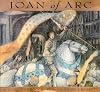
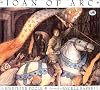
Joan of Arc
by Josephine Poole
On This Page
Description
A biography of the fifteenth-century peasant girl who led a French army to victory against the English, witnessed the crowning of King Charles VII, and was later burned at the stake for witchcraft.Tags
Recommendations






Member Reviews
Unlike the book I read previously of Joan of Arc's life by Ann Tompert, Poole's book read as a story book and moved in a much quicker pace. The author chose to not include the dates of events within the story but as timeline at the end of the book. I enjoyed this book more that the previous book I have read because the authors way of writing help build suspense. I already knew of what was to come in the story but the author's choice of words and punctuation made me want to keep reading.
An American Library Association notable children's book, the illustrations are magnificent! It tells to tale of Joan of Arc, a plain country woman who heard voices compelling her to go to battle against England who were seizing Orleans France, making the French King very vulnerable. The voices told her to free Orleans and accompany the King to Rheins where he would be crowned.
Listening to the voices would cost her life.
Listening to the voices would cost her life.
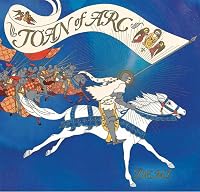
I absolutely love Joan of Arc. I love her story and how she is now seen as a hero to the French, but this story did not convey much of that. It is a great book for beginning readers who don't know the story of Joan, but it is only that...an introduction. The illustrations are beautiful and fit nicely with the tone of the book, and the end pages are maps of France, showcasing all the major cities in Joan's time, which I love. There is also a Chronology section at the end of the book which is a great tool for children who may read this book. There is no glossary, however, which I thought the author should have included. Some of the French words are hard to pronounce, and a glossary would have helped with that. Also, a lot of the show more terminology for battle gear may be difficult for younger kids to understand. I would have also liked an "About the Author" section, which was also excluded from the book. Despite this, it is a good book to have in elementary and/or middle school classrooms. show less
Joan of Arc by Josephine Poole. Library Section 9 A: Juvenile (K-5), Religion and Values.
This excellent storybook is the true story of Joan, a poor French country girl who heard Heaven speak to her. She heard voices for the first time when she was 13 and they thrilled and frightened her. To hear them was the most important thing in her world. Gradually, she was filled with the need to see to it that her King should have his kingdom. God told her to save Orleans, one of the most important cities in France, which was under British siege. Joan believed that since the voices from God told her to help free Orleans and take the King to Rheims, another French city to be crowned. If she did as God told her, nothing on earth would be strong show more enough to stop her.
She cut her hair short and dressed like a boy for safer travels. She learned to ride a war horse, use a lance, and wear armor. Soon she had raised an army and rode at its head as it attacked and routed the British. They called her a witch, but the French called her Joan the Maid, Daughter of God. The King was duly crowned at Rheims but then in another battle for the city of Compeigne (which her heavenly voices told her was not a battle God favored), she was taken prisoner by the British. While imprisoned, she was visited by St. Michael the archangel and his angels. This comforted her but when they left her she cried because she wanted to go with them to heaven but could not. The British tried her for heresy – pretending to hear heavenly voices, pretending to talk to saints, and even see them. The punishment for heresy was death. She warned them, “in truth, I am sent from God, and you are putting yourself in great danger.” The voices told her, “take all in good part, do not complain over thy martyrdom. By it thou shalt come at last to the Kingdom of Paradise.” Though she was burnt alive by fire, a sympathetic Englishman fashioned her a small wooden cross which she hid in her clothing. Her ashes were thrown into the nearby river. But, this book says, that is not the end. A saint is like a star. A star and a saint shine forever. Though we do not revere saints in the Lutheran church as do Catholics, the story of St. Joan is compelling. It helps our children understand that sometimes we too hear voices – in our hearts – to do something good for another person; to go where we are most needed. Why else do people risk their lives to work in the Peace Corps, the military, police or fire forces, or serve the homeless, abused, poor or ill among us? We can teach our children to listen for those nudges, those voices in our hearts that say, “Go, do this to better the world.” Abraham heard this same voice: “Go! To the land that I will show you.” Abraham was going totally on faith as was Joan.
This book is especially instructive for our daughters – that there are areas of life where others may tell them, even today, that they have no business. While our girls no longer have to cut their hair like a boy’s, ride a war horse, and wear armor, they have to prepare themselves for their life’s work just as boys do. It is so important to talk to our girls about what they want to do in the future, and to write out, to plot the steps needed to get there. If kids can envision a goal, a future, they will PLAN for it and be less apt to fall by the wayside. show less
This excellent storybook is the true story of Joan, a poor French country girl who heard Heaven speak to her. She heard voices for the first time when she was 13 and they thrilled and frightened her. To hear them was the most important thing in her world. Gradually, she was filled with the need to see to it that her King should have his kingdom. God told her to save Orleans, one of the most important cities in France, which was under British siege. Joan believed that since the voices from God told her to help free Orleans and take the King to Rheims, another French city to be crowned. If she did as God told her, nothing on earth would be strong show more enough to stop her.
She cut her hair short and dressed like a boy for safer travels. She learned to ride a war horse, use a lance, and wear armor. Soon she had raised an army and rode at its head as it attacked and routed the British. They called her a witch, but the French called her Joan the Maid, Daughter of God. The King was duly crowned at Rheims but then in another battle for the city of Compeigne (which her heavenly voices told her was not a battle God favored), she was taken prisoner by the British. While imprisoned, she was visited by St. Michael the archangel and his angels. This comforted her but when they left her she cried because she wanted to go with them to heaven but could not. The British tried her for heresy – pretending to hear heavenly voices, pretending to talk to saints, and even see them. The punishment for heresy was death. She warned them, “in truth, I am sent from God, and you are putting yourself in great danger.” The voices told her, “take all in good part, do not complain over thy martyrdom. By it thou shalt come at last to the Kingdom of Paradise.” Though she was burnt alive by fire, a sympathetic Englishman fashioned her a small wooden cross which she hid in her clothing. Her ashes were thrown into the nearby river. But, this book says, that is not the end. A saint is like a star. A star and a saint shine forever. Though we do not revere saints in the Lutheran church as do Catholics, the story of St. Joan is compelling. It helps our children understand that sometimes we too hear voices – in our hearts – to do something good for another person; to go where we are most needed. Why else do people risk their lives to work in the Peace Corps, the military, police or fire forces, or serve the homeless, abused, poor or ill among us? We can teach our children to listen for those nudges, those voices in our hearts that say, “Go, do this to better the world.” Abraham heard this same voice: “Go! To the land that I will show you.” Abraham was going totally on faith as was Joan.
This book is especially instructive for our daughters – that there are areas of life where others may tell them, even today, that they have no business. While our girls no longer have to cut their hair like a boy’s, ride a war horse, and wear armor, they have to prepare themselves for their life’s work just as boys do. It is so important to talk to our girls about what they want to do in the future, and to write out, to plot the steps needed to get there. If kids can envision a goal, a future, they will PLAN for it and be less apt to fall by the wayside. show less
This story is a great book for beginning readers who don't know the story of Joan of Arc. The illustrations go along great and keep you involved, like the maps at the end. I think some kids may lose interest because of some of the words. I really enjoyed the layout of this book, but I think this book needed more detail. Joan is a poor French country girl who heard Heaven speak to her. God told her to save New Orleans. She did things through God's love and fought for the city. She was burned at the stake for charges of heresy.
While Joan of Arc's story is mostly about her visions and connection with God, this biography did go much further into her surroundings. Joan of Arc's story is too complicated to sum into just her hearing voices. Although students would be encouraged to read more about the subject after reading this book, it will be because they are confused but not quite interested in Joan of Arc.
Poole has much better biographies in print.
Poole has much better biographies in print.
This is a complete biography about the life of Joan of Arc. It starts off with a brief history of her family and where she lived. It goes on to talk about when she first heard voices talking to her that told her to help the French king against the English. Next, it describes how she had to change her appearance so she could travel safely with the French army. The story tells about the battles that she was in and how some were defeated. In the end, she was captured by the English and tried. The French king that she helped made a secrete truce with the English that involved her. Consequently, she was burned at the stake for charges of heresy.
I thought that the author did a good job of telling about the life of Joan of Arc. It was not in show more depth as could be, but for a picture book it touched on the important events nicely. The illustrations were very detailed and did a good job at supplementing the text and bringing it to life. At the end of the book was a time line of the events from Joan's life. This would be a great book for upper-elementary students.
The students can write their own biography about Joan of Arc using what they thought were key points from the story. The teacher could read some of the student's biographies aloud to demonstrate how one subject's life can be told from different viewpoints by what the author thought was most important or wanted to emphasize. The students could also have a class discussion about the differences and similarities Joan faced in the 1400's to present day. This could help show how history repeats itself and how some things can be changed to not repeat itself. show less
I thought that the author did a good job of telling about the life of Joan of Arc. It was not in show more depth as could be, but for a picture book it touched on the important events nicely. The illustrations were very detailed and did a good job at supplementing the text and bringing it to life. At the end of the book was a time line of the events from Joan's life. This would be a great book for upper-elementary students.
The students can write their own biography about Joan of Arc using what they thought were key points from the story. The teacher could read some of the student's biographies aloud to demonstrate how one subject's life can be told from different viewpoints by what the author thought was most important or wanted to emphasize. The students could also have a class discussion about the differences and similarities Joan faced in the 1400's to present day. This could help show how history repeats itself and how some things can be changed to not repeat itself. show less
Members
- Recently Added By
Lists

The Story of the World: History for the Classical Child: Activity Book Two
415 works; 2 members
Author Information

26 Works 937 Members
Some Editions
Awards and Honors
Common Knowledge
- People/Characters
- Jeanne d'Arc; Charles VII, King of France
- Important places
- Orléans, Loiret, Centre-Val de Loire, France; Reims, Marne, Grand-Est, France; Rouen, Seine-Maritime, Normandy, France; France
- Important events
- Hundred Years' War (1337 | 1453); Siege of Orléans (1428-10-12 | 1429-05-08); Coronation of Charles VII of France (1429-07-17); Execution of Joan of Arc (1431-05-30)
Classifications
Statistics
- Members
- 326
- Popularity
- 97,179
- Reviews
- 21
- Rating
- (3.79)
- Languages
- Danish, English, French
- Media
- Paper, Ebook
- ISBNs
- 13
- ASINs
- 1