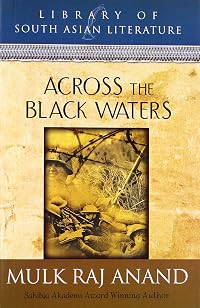
ACROSS THE BLACK WATERS
by Mulk Raj Anand
On This Page
Tags
Recommendations




































Member Reviews
This is an excellent novel that gives an account of the Indian soldiers who served during the First World War, we see them arrive in Marseille, experiencing Europe for the first time, before moving north to the trenches in Flanders. Mulk Raj Anand was in the same generation of writers as Virginia Woolf and T. S. Eliot, and his prose style and approach to wartime politics put him alongside the best of the early twentieth century novelists. This is an essential First World War one novel and should be read alongside the more canonical war literature. The novel is the middle part of a trilogy (although you wouldn't know it from this edition) but can be read as a standalone book quite easily.
While the novel is excellent, the modern edition show more published by Shalimar Books to coincide with centenary of the Great War is very poor. There are glaring typographical errors on nearly every page, from sentences cut in half to spaces inserted within words, all of which is garnished with random punctuation and spelling mistakes. These mistakes are so consistent that it is hard not to come to the conclusion that no one proof read the book before it was sent to the printers. It makes reading the novel very difficult. show less
While the novel is excellent, the modern edition show more published by Shalimar Books to coincide with centenary of the Great War is very poor. There are glaring typographical errors on nearly every page, from sentences cut in half to spaces inserted within words, all of which is garnished with random punctuation and spelling mistakes. These mistakes are so consistent that it is hard not to come to the conclusion that no one proof read the book before it was sent to the printers. It makes reading the novel very difficult. show less
Across the Black Waters has a certain simplicity and humbleness. Its strength lies in reminding the world the important part the Indians in the imperial army played on the battle fields of France in World War I. Mr. Anand has presented the reader with empathetic views of these troops involved with trench warfare and their imperial overlords in a knowing comprehending way. The stamp of authenticity of this novel is pronounced.
Quotes: (pages 178 & 179) “They rushed forward into a trench, hurtling after each other and almost choking the narrow passageway, because Owen Sahib and the other officers wouldn't move. The men behind shouted and raved, and the blast and concussion of exploding shells created panic. Someone pushed Lalu from show more behind, and he felt trapped, confused and angry.
When the advance guard began to move Lalu pushed and shoved. Somehow, in a moment, he had become chock-full of anger and impatience, and the fear in him was smothered. He felt like a monster who would annihilate everything on his way.”
(page 235) “The girl had moved him. But 'there were no she-asses in the Emperor's household.' Reclining back to the abandon of a moment, he chased the phantom of her presence in the moonshine of the Sahib's heaven like one of the damned in the netherworlds, who had forfeited their dignity and pride of manhood, who had been dragged through the blood-soaked and murky waters of several hells to rest for a little before he was sent to taste the air and water of fresher hells. Abjectly grateful for the smaller mercies of life, he sought to crush the luxury of desire and went about like the dehumanized toy of destiny, which was the unknown will of the Sakar. show less
Quotes: (pages 178 & 179) “They rushed forward into a trench, hurtling after each other and almost choking the narrow passageway, because Owen Sahib and the other officers wouldn't move. The men behind shouted and raved, and the blast and concussion of exploding shells created panic. Someone pushed Lalu from show more behind, and he felt trapped, confused and angry.
When the advance guard began to move Lalu pushed and shoved. Somehow, in a moment, he had become chock-full of anger and impatience, and the fear in him was smothered. He felt like a monster who would annihilate everything on his way.”
(page 235) “The girl had moved him. But 'there were no she-asses in the Emperor's household.' Reclining back to the abandon of a moment, he chased the phantom of her presence in the moonshine of the Sahib's heaven like one of the damned in the netherworlds, who had forfeited their dignity and pride of manhood, who had been dragged through the blood-soaked and murky waters of several hells to rest for a little before he was sent to taste the air and water of fresher hells. Abjectly grateful for the smaller mercies of life, he sought to crush the luxury of desire and went about like the dehumanized toy of destiny, which was the unknown will of the Sakar. show less
I came upon this book when I read another book called "If I Die Here, Who Will Remember Me?". That book, by Vedica Kant, is a brief history - with lots of photographs - of the Indian soldiers who lived and died in World War I. I had said then, that it is a book that is well worth reading because it chronicles the history of these little known soldiers.
Mulk Raj Anand's book is also based on the events of World War I, and it follows the lives of a fictional battalion as they cross the "Black Waters" into France. It speaks of the incessant sound of warfare; the more liberal attitudes of the French to Indians, as compared to the British, who instilled a sense of inferiority in Indians; the petty attitude of the Indian NCOS and a bit more. show more
It follows, largely, Lal Singh into battle, until his final capture by the Germans. His fate is left for us to imagine.
It's a very good book. It's a very good book indeed. There is a sense of pathos, anger, and sadness in the book. Why did we have to send people to fight the war of another nation? show less
Mulk Raj Anand's book is also based on the events of World War I, and it follows the lives of a fictional battalion as they cross the "Black Waters" into France. It speaks of the incessant sound of warfare; the more liberal attitudes of the French to Indians, as compared to the British, who instilled a sense of inferiority in Indians; the petty attitude of the Indian NCOS and a bit more. show more
It follows, largely, Lal Singh into battle, until his final capture by the Germans. His fate is left for us to imagine.
It's a very good book. It's a very good book indeed. There is a sense of pathos, anger, and sadness in the book. Why did we have to send people to fight the war of another nation? show less
Members
- Recently Added By
Author Information

95+ Works 1,377 Members
Classifications
Statistics
- Members
- 24
- Popularity
- 1,113,835
- Reviews
- 3
- Rating
- (3.83)
- Languages
- English
- Media
- Paper
- ISBNs
- 5
- ASINs
- 2