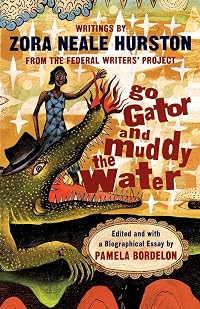
Go Gator and Muddy the Water: Writings From the Federal Writers' Project
by Zora Neale Hurston
On This Page
Description
Stories on the manners and mores of African-Americans in 1930s Florida. They were written when the author was employed by the federal government to transcribe the oral history and to collect data on the customs of black people. At the time, few of her stories made it into print.Tags
Recommendations
















Member Reviews
The book is a collection of writings that Hurston did while working in Florida for the Federal Writers' Project. Perhaps one of the bset features of the book is that the entire first half is a biographical essay on Hurston's time working for the FWP. Pamela Bordelon, the edited of the book and author of the essay, came upon Hurston's writing by accident when she was looking to write a book about Floridian folklore. When she came across the FWP papers she noticed that the majority of the stories and interviews were in a familiar hand and written in a manner that she recognized to be Hurston's writing. After confirming that it was Hurston's notes and essays, she went to Hurston's niece and the two worked together to write an essay about show more Hurston's time working for the Federal Writer's Project.
The second half of the book are a sampling of Hurston's writings from the FWP. This collection only includes folklore and tales from Florida and the West Indies. However, Hurston does not limit herself to merely the stories but also includes songs and art. Each folktale is preceeded an essay by Hurston explaining the history of the folktale and the importance of it in this specific culture. Preceeding Hurston's essay, is a short paragraph written by Bordelon explaining the biographical period in which Hurston wrote each of these essays.
In regards to folktales, the stories in this collection are rare and most people have probably not heard of them. That is to say, they are not Cinderella or Beauty in the Beast. Instead, they are much more "gritty" folktales that take place on inhumane plantations or in southern prisons. All of the tales are laden with superstitions that run the gamut from enormous animals to the hazards of not exhibiting proper behavior. Also included, are variations of certain tales such as "Uncle Monday" and "Daddy Mention". This is a great asset because the reader can see how folktales have grown and been shaped over time as well as understand how each region has its own variation that caters to its own beliefs and superstitions.
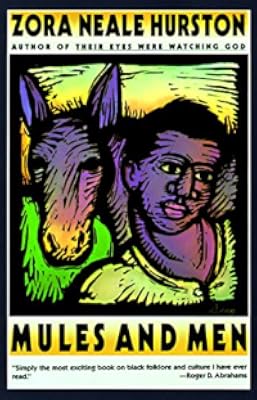
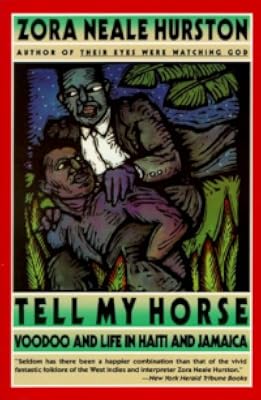
Overall, I thought that this was a fantastic book (certainly one that I will be asking for for Christmas)! At times the text seemed to be light on the folktales and heavy on the essays. Such as the chapter on the "Citrus Industry" and the essay on "Turpentine". However, I did not find these essays to be a hindrance to the overall book. Instead, I thought that they added a context that the average reader would be lacking had the essays not been provided. As previously stated, there was also a large range of mediums that were included in this collection. Bordelon included Hurston's essays and stories as well as transcripts from interviews and even lyrics to traditional songs. This helped to spice up the book a great deal and showed the importance of folktales and how it permeated almost all art forms. Still, clocking in at 200 pages (with 20 of those being footnotes and an index) this book is an incredibly compact collection. Fortunately, Hurston has a few books on folklore and the FWP. If you enjoyed this book, be sure to read Mules and Men as well as Tell My Horse. Both of these books are about the religion of Hoodoo and Voodoo and the folklore and superstitions that go along with that religion. The only issue that readers may encounter is that, unlike Go Gator and Muddy the Water, both of these works are written in dialect and therefore may take some more time to understand.
www.iamliteraryaddicted.blogspot.com show less
The second half of the book are a sampling of Hurston's writings from the FWP. This collection only includes folklore and tales from Florida and the West Indies. However, Hurston does not limit herself to merely the stories but also includes songs and art. Each folktale is preceeded an essay by Hurston explaining the history of the folktale and the importance of it in this specific culture. Preceeding Hurston's essay, is a short paragraph written by Bordelon explaining the biographical period in which Hurston wrote each of these essays.
In regards to folktales, the stories in this collection are rare and most people have probably not heard of them. That is to say, they are not Cinderella or Beauty in the Beast. Instead, they are much more "gritty" folktales that take place on inhumane plantations or in southern prisons. All of the tales are laden with superstitions that run the gamut from enormous animals to the hazards of not exhibiting proper behavior. Also included, are variations of certain tales such as "Uncle Monday" and "Daddy Mention". This is a great asset because the reader can see how folktales have grown and been shaped over time as well as understand how each region has its own variation that caters to its own beliefs and superstitions.
Overall, I thought that this was a fantastic book (certainly one that I will be asking for for Christmas)! At times the text seemed to be light on the folktales and heavy on the essays. Such as the chapter on the "Citrus Industry" and the essay on "Turpentine". However, I did not find these essays to be a hindrance to the overall book. Instead, I thought that they added a context that the average reader would be lacking had the essays not been provided. As previously stated, there was also a large range of mediums that were included in this collection. Bordelon included Hurston's essays and stories as well as transcripts from interviews and even lyrics to traditional songs. This helped to spice up the book a great deal and showed the importance of folktales and how it permeated almost all art forms. Still, clocking in at 200 pages (with 20 of those being footnotes and an index) this book is an incredibly compact collection. Fortunately, Hurston has a few books on folklore and the FWP. If you enjoyed this book, be sure to read Mules and Men as well as Tell My Horse. Both of these books are about the religion of Hoodoo and Voodoo and the folklore and superstitions that go along with that religion. The only issue that readers may encounter is that, unlike Go Gator and Muddy the Water, both of these works are written in dialect and therefore may take some more time to understand.
www.iamliteraryaddicted.blogspot.com show less
Ratings
Members
- Recently Added By
Author Information

112+ Works 34,716 Members
Zora Neale Hurston was born in 1901 in Eatonville, Fla. She left home at the age of 17, finished high school in Baltimore, and went on to study at Howard University, Barnard College, and Columbia University before becoming one of the most prolific writers in the Harlem Renaissance. Her works included novels, essays, plays, and studies in folklore show more and anthropology. Her most productive years were the 1930s and early 1940s. It was during those years that she wrote her autobiography Dust Tracks on a Road, worked with the Federal Writers Project in Florida, received a Guggenheim fellowship, and wrote four novels. She is most remembered for her novel Their Eyes Were Watching God, published in 1937. In 2018, her previously unpublished work, Barracoon: The Story of the Last Black Cargo, was published. She died penniless and in obscurity in 1960 and was buried in an unmarked grave. In 1973, her grave was rediscovered and marked and her novels and autobiography have since been reprinted. (Bowker Author Biography) show less
All Editions
Classifications
Statistics
- Members
- 102
- Popularity
- 316,684
- Reviews
- 1
- Rating
- (4.00)
- Languages
- English
- Media
- Paper
- ISBNs
- 4