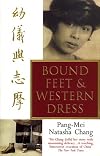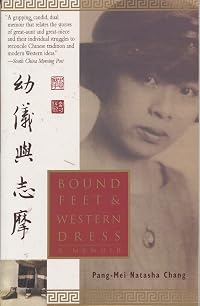
Bound Feet & Western Dress: A Memoir
by Pang-Mei Natasha Chang
On This Page
Description
As a first-generation Chinese-American dutifully majoring in Chinese studies, Pang-Mei Natasha Chang stumbled across the name of her great-aunt Chang Yu-i in a history book. To Pang-Mei's astonishment, her eighty-three-year-old aunt, best known in the family for her retiring ways and masculine manner, had once been married to Hsu Chih-mo, China's preeminent modern poet, had run the Shanghai Women's Savings Bank during the 1930s, and had suffered the anguish of enduring what is considered show more China's first Western-style divorce. Could this same woman, whom Pang-Mei regarded as part respected elder and part unsophisticated immigrant, be the same romantic heroine from her textbooks? Over the next few years, Pang-Mei spent long afternoons with Yu-i drawing forth her story - an unforgettable saga of a woman, born in Shanghai at the turn of the century to a highly respected, well-to-do family, who continually defied the expectations of her class and culture. "In China, a woman is nothing," began Yu-i over tea and dumplings. "This is the first lesson I want to give so that you will understand." Growing up in the perilous years between the fall of the last Emperor and the Communist Revolution, Yu-i led a life marked by a series of rebellions that changed the course of her life, including the first and most lasting: her refusal to have her feet bound. And through Yu-i's stories, Pang-Mei comes to understand something of her own ambivalences regarding her Chinese heritage and the ever-present tug between familial duty and individual desire. show lessTags
Recommendations



Member Reviews
A gorgeous and compelling memoir. Pang-Mei Natasha Chang tells the story of her great aunt, Chang Yu-i, and the story of early twentieth century China, including interesting information related to the customs, traditions and mores of the old Chinese culture. Yu-i was one of the first Chinese woman to go through a modern divorce. She was young, poorly educated, with two children, one of whom tragically died shortly after her divorce. Yu-i transforms from a poorly educated, highly dependent woman into a self-reliant, educated, and successful woman who eventually becomes the vice-president of the Shanghai Woman's Savings Bank and helps ensure its survival, when Japan invaded Shanghai. When her great niece finds her name in books while show more studying Far East Culture at Harvard University, she is intrigued by her family history and decides to interview her. This book is the product of those interviews, a poignant and bitter story and a fascinating family history. show less
Written by her great-niece, this is the story of Yu-i, a woman caught between East and West, between being a traditional Chinese wife and an educated Western woman.
Pang-Mei Natasha Chang, the author, discovers that her great-aunt was a famous woman in China whilst she is studying. She spends time with her aunt to find out her story, from her birth into a respected Chinese family, through her marriage to and divorce from a celebrated poet, to her move to the US in the '70s.
What makes this so readable is the sympathetic writing style, and conflicting and sometimes contradictory memories of her great-aunt, making this more human and less of a history lesson. The contradictions arise from Yu-i trying to walk the line between East and West. show more The first girl in her family not to have bound feet, after protests by her brother, she wanted to be educated, but her duty to her parents, and then her in-laws, prevents her continuing.
A second thread in the book is Chang's own dilemma, a first-generation Chinese-America. She also feels like she is lost inbetween the two cultures, and as her great-aunt's story unfolds, she looks hard at her own life.
There are many biographies and memoirs of Chinese women on the market, but what makes this different is it's often contradictory nature and the comparisons drawn with the present. show less
Pang-Mei Natasha Chang, the author, discovers that her great-aunt was a famous woman in China whilst she is studying. She spends time with her aunt to find out her story, from her birth into a respected Chinese family, through her marriage to and divorce from a celebrated poet, to her move to the US in the '70s.
What makes this so readable is the sympathetic writing style, and conflicting and sometimes contradictory memories of her great-aunt, making this more human and less of a history lesson. The contradictions arise from Yu-i trying to walk the line between East and West. show more The first girl in her family not to have bound feet, after protests by her brother, she wanted to be educated, but her duty to her parents, and then her in-laws, prevents her continuing.
A second thread in the book is Chang's own dilemma, a first-generation Chinese-America. She also feels like she is lost inbetween the two cultures, and as her great-aunt's story unfolds, she looks hard at her own life.
There are many biographies and memoirs of Chinese women on the market, but what makes this different is it's often contradictory nature and the comparisons drawn with the present. show less
This memoir deals with the life of a prominent Chinese woman who emigrated to the United States in the early 20th Century after having been the first woman to be subject to a "modern divorce." As told by her great niece, the story is that of an admirable individual, striving to bridge the immense changes taking place in her society and adapt herself in turbulent times. The author provides an interesting commentary that contrasts her own, still unsettling, experience as an American of Chinese descent.
rabck from the convention; While the author, a Chinese-American, was studying Chinese history in college she noticed her family name & her great-aunt's name in some of the texts. When she interviewed her aunt, she found that she really was famous. The books spans Yu-i's life from birth in 1900 through 1931, during which quite a change occurred in China, embracing western ways while still continuing in some of the old ones too. She was the first modern divorcee in China, which was quite a scandal at the time. The book includes photos of the Chang family that the author obtained from Yu-i's family, as well as translations of her first husband's poems, which he was famous for.
Bought at ChaterHouse Booktrader in Shanghai for 115RMB.
Finished reading 08/10/07.
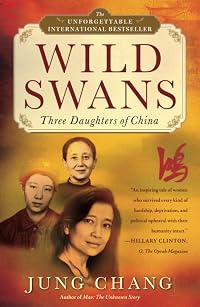
Interesting, but somehow seemed a little skimpy. One thing that struck me was how different the description of foot binding was between this book and Wild Swans. I guess the actual method varied throughout the country.
Finished reading 08/10/07.
Interesting, but somehow seemed a little skimpy. One thing that struck me was how different the description of foot binding was between this book and Wild Swans. I guess the actual method varied throughout the country.
Told through the eyes of the niece, story of Chang Yu-i, who refused to have her feet bound as a child, later married Hsu Chih-mo, famed Chinese modern poet, ran Shanghai Women's Savings Bank in the 1930s, and first Western divorcee in China.
This is another one I need to reread...
Members
- Recently Added By
Lists

Biographies: Women
112 works; 1 member
Author Information

3 Works 499 Members
Awards and Honors
Awards
Distinctions
Series
Belongs to Publisher Series
dtv (30763)
Common Knowledge
- Canonical title*
- Grüner Tee und Coca-Cola
- Original title
- Bound feet and Western dress
- Original publication date
- 1996
- People/Characters*
- Chang Yu-i
- Important places
- China
- First words*
- Prolog: Der chinesische Schrankkoffer aus geschnitztem Mahagoniholz steht noch immer im Wohnzimmer meiner Eltern in Connecticut, in dem Haus, in dem ich aufwuchs.
Ich bin die Schwester deines Grossvaters, Chang Yu-i, und bevor ich dir meine Geschichte erzähle, möchte ich, dass du dir eines merkst: In China ist eine Frau nichts wert. - Last words*
- (Click to show. Warning: May contain spoilers.)Vielleicht habe ich ihn von allen Frauen in seinem Leben am meisten geliebt.
(Click to show. Warning: May contain spoilers.)Epilog: Dann legte ich die Kleider eins neben das andere in die Truhe und schloss leise den Deckel über den Erinnerungsstücken meiner Familie. - Original language*
- Amerikanisch
*Some information comes from Common Knowledge in other languages. Click "Edit" for more information.
Classifications
- Genres
- Biography & Memoir, Nonfiction, History
- DDC/MDS
- 305.420951 — Society, government, & culture Social sciences, sociology & anthropology Social group - Age, Gender, Ethnicity Women Social role and status of women Standard subdivisions History, geographic treatment, biography
- LCC
- HQ1767 .C434 — Social sciences The family. Marriage, Women and Sexuality The Family. Marriage. Women Women. Feminism
- BISAC
Statistics
- Members
- 496
- Popularity
- 60,784
- Reviews
- 10
- Rating
- (3.61)
- Languages
- 5 — Chinese, Danish, Dutch, English, German
- Media
- Paper, Audiobook, Ebook
- ISBNs
- 16
- ASINs
- 4