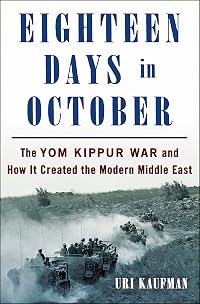
Eighteen Days in October: The Yom Kippur War and How It Created the Modern Middle East
by Uri Kaufman
On This Page
Description
""[Kaufman] tells the story brilliantly. Anyone interested in the Middle East or military history will appreciate Kaufman's work." --Senator Joseph I. Lieberman "A stimulating and insightful...will no doubt find a permanent place on the Arab-Israeli bookshelf." --Michael Oren, New York Times bestselling author of Six Days of War October 2023 marks the 50th anniversary of the Yom Kippur War, a conflict that shaped the modern Middle East. The War was a trauma for Israel, a dangerous superpower show more showdown, and, following the oil embargo, a pivotal reordering of the global economic order. The Jewish State came shockingly close to defeat. A panicky cabinet meeting debated the use of nuclear weapons. After the war, Prime Minister Golda Meir resigned in disgrace, and a 9/11-style commission investigated the "debacle." But, argues Uri Kaufman, from the perspective of a half century, the War can be seen as a pivotal victory for Israel. After nearly being routed, the Israeli Defense Force clawed its way back to threaten Cairo and Damascus. In the war's aftermath both sides had to accept unwelcome truths: Israel could no longer take military superiority for granted--but the Arabs could no longer hope to wipe Israel off the map. A straight line leads from the battlefields of 1973 to the Camp David Accords of 1978 and all the treaties since. Like Michael Oren's Six Days of War, this is the definitive account of a critical moment in history"-- show lessTags
Recommendations




























Member Reviews
****.5
Military history is not one of my preferred genres, but the utter failure of Israel's security forces to prevent the Oct 7 attack demonstrates that even 50 years later the lessons of the Yom Kippur War weren't truly taken to heart. This book was published just before that, to coincide with the 50th anniversary of the previous debacle, which must be revisited in order to fully understand the current situation.
The book starts in the euphoria in the wake of Israel's stunning victory in the 1967 Six Day War, which Kaufman attributes to luck as much as to sound strategy. But the good times are short lived, as the oft-ignored War of Attrition quickly began and lasted until 1970, with Israel scrambling to procure sufficient weaponry to show more combat the tons of materiel pouring in from the Soviet Union to Egypt.
It then introduces the major players, and traces the origins of the "conceptia", the disastrously flawed notion held by the echelons of Israel's military-political-intelligence apparatus that the Arabs wouldn't dare attack again without warning. But rather than dwell on that, the book quickly pivots to a lengthy play-by-play account of the war. Which is revealed to be a muddled mess with costly mistakes all around, and almost as much infighting as actual fighting.
A bit more interesting are the recently declassified documents that shed light on the behind-the-scenes diplomacy and politics, both internal discussions as well as secret negotiations. The actions of the Nixon administration and the response of the Soviets are particularly alarming, and show how easy it is for a local conflict to quickly escalate out of control into a much larger global problem.
The book concludes with a look at the aftermath of the war, including the results of Israel's Agranat Commission of Inquiry, which the author thinks misattributed a lot of the blame. In his view, despite the failure to fully prepare and the heavy losses the war was ultimately a major victory for Israel, and not the dismal failure as perceived by Israelis ever since. In this reckoning, prime ministers Levi Eshkol (1967) and Golda Meir (1973) come out looking good, with Meir in particular emerging as tough, calm, collected, and not at all at fault. The situations of defense minister Moshe Dayan and general Ariel Sharon are more complex, both are shown to have made some truly terrible decisions, but they also demonstrated the audacious leadership that ultimately won the war for Israel.
The book definitely changed the way I view the war, and there are some clear lessons to be learned. Not just about the war itself or even its lead-up, but the reckoning afterwards. Drawing the right conclusions and learning the right lessons are at least as important as the fighting itself, which is often haphazard and plagued by elements out of the control of the decision makers. Let's hope that Israel does a better job this time around.
Audiobook: As I'm used to by now, the narrator is unable to utter most of the Hebrew (and presumably Arabic) words and names without either mangling the pronunciation, sounding like he's being tortured, or both. show less
Military history is not one of my preferred genres, but the utter failure of Israel's security forces to prevent the Oct 7 attack demonstrates that even 50 years later the lessons of the Yom Kippur War weren't truly taken to heart. This book was published just before that, to coincide with the 50th anniversary of the previous debacle, which must be revisited in order to fully understand the current situation.
The book starts in the euphoria in the wake of Israel's stunning victory in the 1967 Six Day War, which Kaufman attributes to luck as much as to sound strategy. But the good times are short lived, as the oft-ignored War of Attrition quickly began and lasted until 1970, with Israel scrambling to procure sufficient weaponry to show more combat the tons of materiel pouring in from the Soviet Union to Egypt.
It then introduces the major players, and traces the origins of the "conceptia", the disastrously flawed notion held by the echelons of Israel's military-political-intelligence apparatus that the Arabs wouldn't dare attack again without warning. But rather than dwell on that, the book quickly pivots to a lengthy play-by-play account of the war. Which is revealed to be a muddled mess with costly mistakes all around, and almost as much infighting as actual fighting.
A bit more interesting are the recently declassified documents that shed light on the behind-the-scenes diplomacy and politics, both internal discussions as well as secret negotiations. The actions of the Nixon administration and the response of the Soviets are particularly alarming, and show how easy it is for a local conflict to quickly escalate out of control into a much larger global problem.
The book concludes with a look at the aftermath of the war, including the results of Israel's Agranat Commission of Inquiry, which the author thinks misattributed a lot of the blame. In his view, despite the failure to fully prepare and the heavy losses the war was ultimately a major victory for Israel, and not the dismal failure as perceived by Israelis ever since. In this reckoning, prime ministers Levi Eshkol (1967) and Golda Meir (1973) come out looking good, with Meir in particular emerging as tough, calm, collected, and not at all at fault. The situations of defense minister Moshe Dayan and general Ariel Sharon are more complex, both are shown to have made some truly terrible decisions, but they also demonstrated the audacious leadership that ultimately won the war for Israel.
The book definitely changed the way I view the war, and there are some clear lessons to be learned. Not just about the war itself or even its lead-up, but the reckoning afterwards. Drawing the right conclusions and learning the right lessons are at least as important as the fighting itself, which is often haphazard and plagued by elements out of the control of the decision makers. Let's hope that Israel does a better job this time around.
Audiobook: As I'm used to by now, the narrator is unable to utter most of the Hebrew (and presumably Arabic) words and names without either mangling the pronunciation, sounding like he's being tortured, or both. show less
Does everything a good history should do. Portraying the common soldier on the battlefields to the Generals and the politicians making the decisions. The narrator managed to be entertaining on what can be a dark subject.
Ratings
Members
- Recently Added By
Lists

Judaism & Israel
104 works; 2 members
Author Information
2 Works 88 Members
Common Knowledge
- Important places
- Israel; Egypt
- Important events
- Yom Kippur War
Classifications
- Genres
- History, Nonfiction, General Nonfiction
- DDC/MDS
- 956.048 — History & geography History of Asia Middle East Asia: Turkey, Iraq, Syria, Lebanon, Israel, Jordan Middle East 1945-1980; 20th Century
- LCC
- DS128.1 .K44 — History of Europe, Asia, Africa and Oceania Asia History of Asia Israel (Palestine). The Jews History
- BISAC
Statistics
- Members
- 85
- Popularity
- 375,749
- Reviews
- 2
- Rating
- (4.06)
- Languages
- English
- Media
- Paper, Audiobook, Ebook
- ISBNs
- 4
- ASINs
- 2