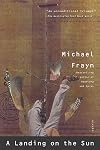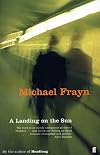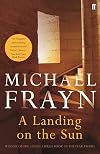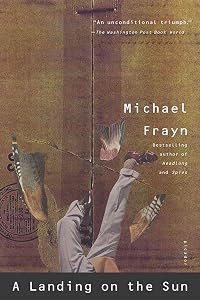
A Landing on the Sun
by Michael Frayn
On This Page
Description
A backlist fiction masterpiece from the author of Spies and Skios.Tags
Recommendations























Member Reviews
I resolved to read ‘A Landing on the Sun’ on the basis of Frayn’s masterfully hilarious satire on academia, [b:The Tin Men|511252|The Tin Men|Michael Frayn|https://images.gr-assets.com/books/1422640766s/511252.jpg|45248136]. Although equally astutely observed, this book is entirely lacking in hilarity. It is very limited in scope yet incredibly detailed, like a miniature painted for a locket. The narrator is a civil servant named Jessel, who is asked to prepare a report on Stephen Summerchild, formerly also a civil servant, fifteen years deceased, and possessing some tangential connection to Jessel. At first I wondered if a conspiracy would emerge around Summerchild’s mysterious death, but it is not at all that sort of novel. It show more is a claustrophobic work that puts the reader in the head of Jessel, who puts himself in the head of Summerchild, both of whom lead highly confined lives.
Frayn captures the atmosphere and procedure of bureaucracy beautifully. He presents in a subtle and powerful fashion how mental illness and great depths of emotion lurk amongst the memoranda and assessments. As [b:The Utopia of Rules: On Technology, Stupidity, and the Secret Joys of Bureaucracy|22245334|The Utopia of Rules On Technology, Stupidity, and the Secret Joys of Bureaucracy|David Graeber|https://images.gr-assets.com/books/1417415465s/22245334.jpg|41620170] attests, bureaucracy is a form of interaction between people that avoids emotional labour. A series of processes are set in place such that no emotional considerations need be involved, whilst deviation from these is seen as inappropriate and taboo (unless someone involved is wealthy enough to buy themselves an exception, but that’s another story). Here, that theory is elegantly illustrated by a story of how two bureaucrats cannot truly embody a system that disallows them any emotions.
The narrative is cleverer than that, though. In addition to the uncomfortably personal nature of observing the two civil servants’ experiences, there is the work that Summerchild was engaged in: an enquiry into the Quality of Life. I’ve worked in the public sector on matters of quality of life and found the way in which this was approached incredibly effective. What is quality of life? Can it be reduced to kitchen appliances and the minutes of labour they save? Can quality of life be defined without reference to happiness? And then, what is happiness? Can it ever be defined? Can it be effectively operationalised for policy purposes, as it has become trendy to do in recent years? ‘A Landing on the Sun’ demonstrates that the answers to such questions can never be objective and independent, as civil servants are meant to be. Anyone’s answers will reveal a great deal about who they are and how they feel, more than they may wish to be known.
I can find no fault with the writing, pacing, and plotting of this novel, but will capriciously withhold the fifth star as it made me feel sad. Not in the way of books that allow you to revel in vicarious extremes of emotion without dealing with the practical implications, such as the sublime ecstasies of tragedy in [b:Les Misérables|24280|Les Misérables|Victor Hugo|https://images.gr-assets.com/books/1411852091s/24280.jpg|3208463]. Rather, ‘A Landing on the Sun’ provokes a calm sadness at the difficulty of finding and sustaining happiness in a mundane world. It is thus quite the opposite of escapist. show less
Frayn captures the atmosphere and procedure of bureaucracy beautifully. He presents in a subtle and powerful fashion how mental illness and great depths of emotion lurk amongst the memoranda and assessments. As [b:The Utopia of Rules: On Technology, Stupidity, and the Secret Joys of Bureaucracy|22245334|The Utopia of Rules On Technology, Stupidity, and the Secret Joys of Bureaucracy|David Graeber|https://images.gr-assets.com/books/1417415465s/22245334.jpg|41620170] attests, bureaucracy is a form of interaction between people that avoids emotional labour. A series of processes are set in place such that no emotional considerations need be involved, whilst deviation from these is seen as inappropriate and taboo (unless someone involved is wealthy enough to buy themselves an exception, but that’s another story). Here, that theory is elegantly illustrated by a story of how two bureaucrats cannot truly embody a system that disallows them any emotions.
The narrative is cleverer than that, though. In addition to the uncomfortably personal nature of observing the two civil servants’ experiences, there is the work that Summerchild was engaged in: an enquiry into the Quality of Life. I’ve worked in the public sector on matters of quality of life and found the way in which this was approached incredibly effective. What is quality of life? Can it be reduced to kitchen appliances and the minutes of labour they save? Can quality of life be defined without reference to happiness? And then, what is happiness? Can it ever be defined? Can it be effectively operationalised for policy purposes, as it has become trendy to do in recent years? ‘A Landing on the Sun’ demonstrates that the answers to such questions can never be objective and independent, as civil servants are meant to be. Anyone’s answers will reveal a great deal about who they are and how they feel, more than they may wish to be known.
I can find no fault with the writing, pacing, and plotting of this novel, but will capriciously withhold the fifth star as it made me feel sad. Not in the way of books that allow you to revel in vicarious extremes of emotion without dealing with the practical implications, such as the sublime ecstasies of tragedy in [b:Les Misérables|24280|Les Misérables|Victor Hugo|https://images.gr-assets.com/books/1411852091s/24280.jpg|3208463]. Rather, ‘A Landing on the Sun’ provokes a calm sadness at the difficulty of finding and sustaining happiness in a mundane world. It is thus quite the opposite of escapist. show less
I'm really not sure where to begin. It starts like a dry civil servant investigation procedural, I thought it might be in the vein of a Le Carré or a Graeme Greene. There are elements of both of these of course, but it evolves into something much more farcical and surreal in places. But, again not farcical in the way you might expect, or surreal in a surreal way. I can't categorise this novel at all, is it a study of happiness, is it satire? It's funny, sad, touching, philosophical, absurd, mundane, close, distant. I suspect it will be memorable long after reading.
I enjoyed it. It is different: it seems to start out as a spoof on bureaucrats and academics, but then transforms itself into something more poignant. Jessel is British bureaucrat charged with reviewing the files of a Stephen Summerchild who died 20 years earlier in a fall from an office window, to determine whether there were any security implications that need to "managed". Summerchild worked in a obscure section called the "Strategy Unit", which Jessel discovers was a think-tank set up by the returned Labour government in the early 70s, supposedly charged with thinking big thoughts about the Quality of Life. In fact, it turns out that the unit consisted solely of Jessel and a professor of philosophy from Oxford, Dr.Elizabeth Serafin. show more Serafin never really understands her mandate, and Summerchild sees his as fencing this outsider to ensure that the work of the Unit does not interfere with good governance by the bureaucrats. Jessel discovers and deduces all of this on the basis of some dusty files that he discovers, but more importantly through his discovery of a horde of cassette tapes on which Summerchild and Serafin had recorded their disquisitions into the meaning of happiness and joy and the quality of life. There are some good send-ups here of the academic, hair-splitting style, as well as a fine understanding by Frayn of the values and appropriate structure of a good government memo! Jessel, who knew Summerchild as a youngster and was infatuated with his daughter, unravels the story of how Serafin and Summerchild became lovers, working and then essentially living together in the small garret office that they had been given. The story bends over to the absurd, but traces the fine line of credibility when one thinks of the stereotypical eccentricity of English bureaucrats, and the very real possibility of people virtually dropping out of sight in a large bureaucracy.
As Jessel explores the story more deeply, he is at first appalled with Summerchild letting slip his professional approach and attitudes, but he comes to identify more and more with Summerchild, entering into his mind, understanding what he is thinking and where he is going with his thoughts and actions. There is a light irony throughout the story, but at the same time a growing intimacy with Summerchild and Serafin as we watch them moving towards the doom that we know is Summerchild's death. It is the old story, which Summerchild himself recognizes on looking back: a series of small steps, each one of which seemed reasonable and acceptable in and of itself, but which cumulatively lead to a situation that would have seemed absurd from the outset. show less
As Jessel explores the story more deeply, he is at first appalled with Summerchild letting slip his professional approach and attitudes, but he comes to identify more and more with Summerchild, entering into his mind, understanding what he is thinking and where he is going with his thoughts and actions. There is a light irony throughout the story, but at the same time a growing intimacy with Summerchild and Serafin as we watch them moving towards the doom that we know is Summerchild's death. It is the old story, which Summerchild himself recognizes on looking back: a series of small steps, each one of which seemed reasonable and acceptable in and of itself, but which cumulatively lead to a situation that would have seemed absurd from the outset. show less
When I read this book I could see nothing in it but the idea that you have been given this gift of life and you have to do the right thing by it. That to give up on finding love and happiness is to scorn this gift.
And yet...maybe the very opposite is true. Maybe what I should have seen is the idea that you should stay where you are, that the miserable life you know is better than the unknown dangers of the happiness and love you could choose to seek.
And yet...maybe it is simply thus: the best whodunnit ever.
There is a sex scene. Even though I've read the book twice, I forgot this until rereading it a third time today:
https://alittleteaalittlechat.wordpress.com/2018/07/01/a-landing-on-the-sun-by-m...
And yet...maybe the very opposite is true. Maybe what I should have seen is the idea that you should stay where you are, that the miserable life you know is better than the unknown dangers of the happiness and love you could choose to seek.
And yet...maybe it is simply thus: the best whodunnit ever.
There is a sex scene. Even though I've read the book twice, I forgot this until rereading it a third time today:
https://alittleteaalittlechat.wordpress.com/2018/07/01/a-landing-on-the-sun-by-m...
When I read this book I could see nothing in it but the idea that you have been given this gift of life and you have to do the right thing by it. That to give up on finding love and happiness is to scorn this gift.
And yet...maybe the very opposite is true. Maybe what I should have seen is the idea that you should stay where you are, that the miserable life you know is better than the unknown dangers of the happiness and love you could choose to seek.
And yet...maybe it is simply thus: the best whodunnit ever.
There is a sex scene. Even though I've read the book twice, I forgot this until rereading it a third time today:
https://alittleteaalittlechat.wordpress.com/2018/07/01/a-landing-on-the-sun-by-m...
And yet...maybe the very opposite is true. Maybe what I should have seen is the idea that you should stay where you are, that the miserable life you know is better than the unknown dangers of the happiness and love you could choose to seek.
And yet...maybe it is simply thus: the best whodunnit ever.
There is a sex scene. Even though I've read the book twice, I forgot this until rereading it a third time today:
https://alittleteaalittlechat.wordpress.com/2018/07/01/a-landing-on-the-sun-by-m...
This is a book that has stayed with me long after I first read it. There is a beauty to the prose, a gentleness. It is my favourite of Frayn's books.
I was a fan of Frayn's based on previous work of his I had encountered - the novel 'Headlong' and the play 'Copenhagen' so I was looking forward to reading 'A Landing on the Sun'.
What a disappointing book! I could handle the different attempts at conveying the narrative - transcripts of discussions 15 years past, official documents, tape recorded conversations, the narrator feeling that he is 'inhabited' by the people he is investigating - but the problem is, I didn't care. I didn't care about the narrator: a civil servant with a complicated domestic life. I didn't care about the characters he was investigating - a civil servant and a philosopher who worked together 15 years ago before the civil servant died in mysterious circumstance. show more This book felt very distanced and jumbled, not what I expected from Frayn at all. show less
What a disappointing book! I could handle the different attempts at conveying the narrative - transcripts of discussions 15 years past, official documents, tape recorded conversations, the narrator feeling that he is 'inhabited' by the people he is investigating - but the problem is, I didn't care. I didn't care about the narrator: a civil servant with a complicated domestic life. I didn't care about the characters he was investigating - a civil servant and a philosopher who worked together 15 years ago before the civil servant died in mysterious circumstance. show more This book felt very distanced and jumbled, not what I expected from Frayn at all. show less
Members
- Recently Added By
Author Information

86+ Works 9,663 Members
Michael Frayn is the author of the award-winning "Copenhagen" & twelve other plays, including "Noises Off". The most recent of his nine novels is "Headlong", a New York Times Editor's Choice & Booker Prize finalist. He lives in London. (Bowker Author Biography)
Some Editions
Awards and Honors
Awards
Common Knowledge
- Canonical title*
- Landing op de zon
- Original title
- A Landing On the Sun
- Alternate titles*
- Landing op de zon : roman
- Original publication date
- 1991 (Engels) (Engels); 1995 (Nederlands) (Nederlands)
- People/Characters*
- Brian Jessel
- Important places*
- Londen, Engeland, Verenigd Koninkrijk
- Related movies
- A Landing on the Sun (1994 | IMDb)
- Blurbers
- Burgess, Anthony
- Original language
- English UK
*Some information comes from Common Knowledge in other languages. Click "Edit" for more information.
Classifications
Statistics
- Members
- 266
- Popularity
- 121,503
- Reviews
- 10
- Rating
- (3.55)
- Languages
- Dutch, English, German
- Media
- Paper, Ebook
- ISBNs
- 12
- ASINs
- 1