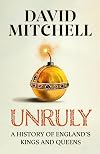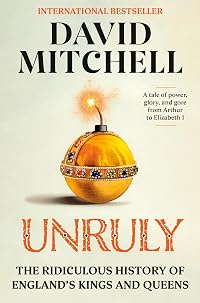
Unruly: The Ridiculous History of England's Kings and Queens
by David Mitchell
On This Page
Description
INSTANT #1 SUNDAY TIMES BESTSELLER • A rollicking history of England’s kings and queens from Arthur to Elizabeth I, a tale of power, glory, and excessive beheadings by award-winning British actor and comedian David Mitchell“Clever, amusing, gloriously bizarre and razor sharp. Mitchell [is] a funny man and a skilled historian.”?The Times
Think you know the kings and queens of England? Think again.
In Unruly, David Mitchell explores how early England’s monarchs, while acting as show more feared rulers firmly guiding their subjects’ destinies, were in reality a bunch of lucky bastards who were mostly as silly and weird in real life as they appear today in their portraits.
Taking us back to King Arthur (spoiler: he didn’t exist), Mitchell tells the founding story of post-Roman England up to the reign of Elizabeth I (spoiler: she dies). It’s a tale of narcissists, inadequate self-control, middle-management insurrection, uncivil wars, and a few Cnuts, as the English evolved from having their crops stolen by the thug with the largest armed gang to bowing and paying taxes to a divinely anointed king.
How this happened, who it happened to, and why the hell it matters are all questions that Mitchell answers with brilliance, wit, and the full erudition of a man who once studied history—and won’t let it off the hook for the mess it’s made.
A funny book that takes history seriously, Unruly is for anyone who has ever wondered how the British monarchy came to be—and who is to blame. show less
Tags
Recommendations













Member Reviews
I have always imagined that if I were from the UK (or any country where I was funding monarchs with my taxes) I would be a dedicated anti-royalist. As I have no skin in the game I am pretty neutral, but philosophically opposed to any system where merit is conflated with bloodlines. If you are interested in knowing a teeny tiny amount of information about several hundred years worth of English monarchs that will make you hate the system you will enjoy this fun summary. This is essentially the royal history equivalent of 88 Lines About 44 Women. Mitchell is smart, funny, and clearly knowledgable. His stand-up approach to delivery can get overwhelming so if you are going to listen to this you will want to spread it out over time. A 3.5 for me.
Most children have the common sense to take evasive action if told that something is going to be “funny and educational“. Sadly, as adults we seem to lose that ability…
This is a full-on narrative history of the rulers of England from Hengist & Horsa to Elizabeth I, told from the point of view of someone who earns his living being funny on British television. Since medieval monarchs were numerous and on the whole nasty, brutish and short, while their family relationships were insanely complicated but are unfortunately mostly essential to the proper understanding of what is going on, you can see that something is going to have to give if the book can earn the necessary cover blurbs indicating that it’s the funniest thing since show more 1066 and all that (spoiler alert: it isn’t).
What has to give in practice is the reader’s will to live. There are plenty of jokes inserted into the text, and a lot of liberal worthiness in which Mitchell has some quite sensible things to say about how we got the non-intuitive idea of government by hereditary monarchs. Any twenty-page stretch of the text, taken in isolation, is enjoyable and funny. But the thing goes on for over four hundred pages of sustained, dutiful funniness, all constructed on the same basic elements of anachronism and mild subversiveness. It’s like that engagingly ironic teacher who seems so cool when you have him for one lesson, but whom you want to murder after months and months of the same joke three periods a week…
An ideal book to give to someone who probably won‘t read it. show less
This is a full-on narrative history of the rulers of England from Hengist & Horsa to Elizabeth I, told from the point of view of someone who earns his living being funny on British television. Since medieval monarchs were numerous and on the whole nasty, brutish and short, while their family relationships were insanely complicated but are unfortunately mostly essential to the proper understanding of what is going on, you can see that something is going to have to give if the book can earn the necessary cover blurbs indicating that it’s the funniest thing since show more 1066 and all that (spoiler alert: it isn’t).
What has to give in practice is the reader’s will to live. There are plenty of jokes inserted into the text, and a lot of liberal worthiness in which Mitchell has some quite sensible things to say about how we got the non-intuitive idea of government by hereditary monarchs. Any twenty-page stretch of the text, taken in isolation, is enjoyable and funny. But the thing goes on for over four hundred pages of sustained, dutiful funniness, all constructed on the same basic elements of anachronism and mild subversiveness. It’s like that engagingly ironic teacher who seems so cool when you have him for one lesson, but whom you want to murder after months and months of the same joke three periods a week…
An ideal book to give to someone who probably won‘t read it. show less
A fascinating book, not quite the "Horrible Histories for grownups" as it's been tagged as the subject matter is rather depressingly more serious than that. Mitchell looks at the history of king and queen-dom rather than the history of individual kings and queens (though of course it is also that). He shows how the English monarchy evolved from the mythological King Arthur through the squabbling Saxon and Danish war-lords, the Norman invaders (who's hearts and interests were often more in France than England) and onwards to Elizabeth, the last of the Tudors. How the role of "King" (or "Queen" evolved from the toughest and wiliest leader to a hereditary office (with heredity often loosely claimed by the toughest and wiliest contender), show more an office held by God's appointed. Parallel is the development of what were to become our democratic institutions - initially put in place by other powerful men to counter the depredations of a weak or dangerous king rather than out of any altruistic notions of human rights... If I had any lingering feelings of British exceptionalism this book ensured they were well and truly dispensed with. An interesting read, with Mitchell's snide asides (which may date quite quickly) and hilarious captions to the illustrations leavening the somewhat depressing view of human nature the book provides. Recommended. show less
What’s the point of showing bland respect for all the ages? 'Oh, they’re all lovely, all the ages – let’s not be rude by labelling one of them “dark.” The rubble and leaky roofs that no one could remember how to repair are, in their way, just as spiffing as building the Parthenon and inventing democracy. Let’s say a big “well done” to all the people of history for being there at all. We won’t get all analytical and judgy. It’s patronizing to start telling people that, just because they all totally forgot how to do running water or dress stone and loads of people died, that’s not a lovely positive choice they’ve made.
Unruly is an utterly hilarious tour through the history of the rulers of the area that has come show more to be called England, starting with King Arthur (“Gandalf is fictional. King Arthur is a lie.”) and other Anglo-Saxon kings through Queen Elizabeth I.
This David Mitchell is apparently a British comedian, actor, and writer:
Not to be confused with this other David Mitchell, who is just an author, apparently still riding the coattails of some little book he wrote 20 years ago.
(That's a joke. I professed my desire to marry [b:Cloud Atlas|49628|Cloud Atlas|David Mitchell|https://i.gr-assets.com/images/S/compressed.photo.goodreads.com/books/1563042852l/49628._SX50_.jpg|1871423] in my review. I simply want to clarify that there are apparently two brilliant David Mitchells in the UK with varying degrees of humor and versatility.)
Anyway...about Unruly: David Mitchell (the funny one, although this is probably true for the unfunny DM, too) learned about the Kings & Queens in school, but decided to dig WAY deeper into their stories. But he's going at it from a comedian's perspective, which means it's highly irreverent and throws in lots of references from more recent history and his own life. I had very little background on the Ks & Qs (being American), but was able to follow along, learn a ton more about British history, and laugh/chuckle/guffaw along the way.
I don't know where the idea of Vikings having horns on their helmets came from, but it's a brilliant one. In every possible way, other than the literal truth, they totally had horns on their helmets. Horned helmets was absolutely their vibe and I feel we all have a right to that deeper artistic truth. They had limited technology and manufacturing helmets was pretty tricky for them, I imagine, so putting horns on them wouldn't have been workable, and wouldn't have increased the functionality of the helmets, but I swear they'd have given it a go if they'd thought of it. show less
Unruly is an utterly hilarious tour through the history of the rulers of the area that has come show more to be called England, starting with King Arthur (“Gandalf is fictional. King Arthur is a lie.”) and other Anglo-Saxon kings through Queen Elizabeth I.
This David Mitchell is apparently a British comedian, actor, and writer:
Not to be confused with this other David Mitchell, who is just an author, apparently still riding the coattails of some little book he wrote 20 years ago.
(That's a joke. I professed my desire to marry [b:Cloud Atlas|49628|Cloud Atlas|David Mitchell|https://i.gr-assets.com/images/S/compressed.photo.goodreads.com/books/1563042852l/49628._SX50_.jpg|1871423] in my review. I simply want to clarify that there are apparently two brilliant David Mitchells in the UK with varying degrees of humor and versatility.)
Anyway...about Unruly: David Mitchell (the funny one, although this is probably true for the unfunny DM, too) learned about the Kings & Queens in school, but decided to dig WAY deeper into their stories. But he's going at it from a comedian's perspective, which means it's highly irreverent and throws in lots of references from more recent history and his own life. I had very little background on the Ks & Qs (being American), but was able to follow along, learn a ton more about British history, and laugh/chuckle/guffaw along the way.
I don't know where the idea of Vikings having horns on their helmets came from, but it's a brilliant one. In every possible way, other than the literal truth, they totally had horns on their helmets. Horned helmets was absolutely their vibe and I feel we all have a right to that deeper artistic truth. They had limited technology and manufacturing helmets was pretty tricky for them, I imagine, so putting horns on them wouldn't have been workable, and wouldn't have increased the functionality of the helmets, but I swear they'd have given it a go if they'd thought of it. show less
Mitchell, who has a history degree from Cambridge, romps through English monarchs (with the odd mention of the Scots and Welsh, and rather more about the French) from the fictional King Arthur to Elizabeth I, last of the Tudors. There are maps, family trees, index, pictures, and diversions including a long rant about why Daniel Craig’s final James Bond film (No Time to Die) enraged him, and the damage caused by the related forces of nationalism, cronyism, and Brexit.
It achieves its aim to be “funny but not spoof, irreverent but not trivial”. There are similarities with Sellar and Yeatman’s classic, 1066 and All That: A Memorable History of England, and Terry Deary’s Horrible Histories (such as The Stormin' Normans and The show more Terrible Tudors).
I really enjoyed it - his commentary more than the factual details - but his style isn’t for everyone. This review gives you a feel of it.
It helps if you have a general knowledge of English history, but are fuzzy on the details, have no great reverence for the monarchy, don’t mind casual swearing, and like the snarky humour of David Mitchell of Mitchell & Webb and Peep Show (not the author of Cloud Atlas, though I like him too). It’s comprehensive, but explicitly skewed to his personal interests (those who wear sparkly metal hats) and peeves (Edward the Confessor, especially his underserved sainthood). It may not endure as long as Sellar and Yeatman’s book because of contemporary slang, jokes about things like artisanal cheese, and recent political trivia.
Image: Two portraits captioned thus, “These depictions of Alfred the Great and Aethelred the Unready were created hundreds of years apart and hundreds of years after the deaths of their subjects. They nevertheless provide an accurate guide to the two kings' relative levels of competence.”
English identity
The nature of Englishness is a topical, and often controversial, issue:
“What do we stand for really? Freedom and democracy? Tradition and hierarchy? Bad food and sarcasm? Traffic and disappointment? Ships and factories? Rain and jokes?”
Mitchell thinks:
“Monarchy is what England has instead of a sense of identity.”
He rails against Brexit, and the ideology that polarised the country and made it happen.
“The usual pattern of radical change spun as restoration of something ancient.”
The bit
I read this on trains to and through Germany, where we visited several towns in the Rhine-Hessen region, and immediately adopted Mitchell’s terminology, as we searched for each one's “bit”:
“When my wife and I are visiting a nice town or village for the first time, the question we always ask is ‘Where’s the bit?’... the main bit. The nice bit. The bit you’re supposed to go and walk round where the stuff is. The bit that, once seen, gives you the authority to say you’ve been to the place.”
Image: Cartoon “Map of Every European City”, by Itchy Feet (Source)
In the history of Anglo-Saxon England, apparently “the bit” is the mid to late eighth century.
Startling
The legacy of an awful history teacher (and my laziness in compensating), meant I learned some things that surprised me:
• After the Roman administration departed, Londinium was almost empty for nearly 200 years.
• The Bayeux tapestry is neither French (they commissioned English women), nor a tapestry (it’s embroidery). What most irks Mitchell is that the meaning of the word “tapestry” hasn’t evolved to include other items of embroidery, given it's the continent’s most famous item described as tapestry.
• The rules of succession were somewhat vague and flexible for long periods, and claimants used all sorts of arguments to seize the throne. Perhaps the most extraordinary was Henry I using porphyrogeniture. It means “born in the purple”, so that a son born after the father inherits has precedence over his older brothers. (Mitchell quotes Monty Python: “strange women lying in ponds”.)
• “Insistence on the legitimacy of birth didn’t fully kick in until the twelfth century.”
• The Domesday book records that in 1086, 10% of the population were slaves.
• Parliament was founded by a Frenchman (as most of the aristocracy were), Simon de Montfort, who Mitchell consistently refers to as SDM - except in the index.
• Castles were built and used for 300 years before arrow slits were invented.
• We talk about “The English Civil War”, as if there was only one, but however you define the term, it turns out, there were quite a few, plus, The Anarchy, which I’d never heard of.
• I hadn’t appreciated the scale of the Black Death (aka bubonic plague): over half the world’s population died in the space of a year:
“It’s probably the worst thing that has ever happened to humanity.”
That puts Covid, bad as it was, into perspective.
Image: Mitchell captions this “Henry I thinking sadly about the White Ship disaster. The expression on his face is the one tabloid photographers tell OAPs [seniors] to adopt to accompany articles about how they were tricked out of their life savings.”. (Early 14th-century depiction of Henry I and the sinking of the White Ship off Barfleur in Normandy in 1120, Source)
Quotes
Typical of Mitchell's style. If you're familiar with his radio or TV work, you'll read them in his voice. If you're not, consider getting the audiobook, read by him:
• “Gandalf is fictional. King Arthur is a lie.”
• “People found it much easier to believe in a rose-tinted view of the past than a utopian future. They still do: hence ‘Take Back Control’ and ‘Make America Great Again’.”
• “A big threat to our current civilization is the persistent post-Victorian assumption of progress.”
• “Violence is a constant, the religious views are just the accompanying spin.” And he includes the non-religious views of Communist autocracies.
• “In every possible way, other than the literal truth, they [Vikings] totally had horns on their helmets. Horned helmets was absolutely their vibe and I feel we all have a right to that deeper artistic truth.”
• “Slaughtering people… nowadays we’re really down on it, but they were really down with it (oh, the power of prepositions!).”
• “The fun thing for us about primogeniture is that the person who ends up as king can be hilariously unsuitable.”
• “William the Conqueror fathered his sons in reverse order of regal competence.”
• “Allowing good men to do nothing is the purpose of civilization.”
• Henry I was a good king because he was predictable. “It’s disappointing in a lover, but, in a feudal lord, it hits the spot.”
• “Castles are like the twelfth century’s asbestos. Seemed like such a great idea, got put in everywhere and then the lethal and resource-hungry consequences dragged on for decades.” It’s hard to force people out, so they become ungovernable.”
• “This [crusade] was the fashionable and righteous thing to be doing at the time - like going vegan is now, but with the opposite impact on the amount of blood that gets shed.”
• “In 2020, during the Covid pandemic, as part of the general internet-fuelled stupidity of our time, some lockdown refuseniks took to citing clause 61 of Magna Carta as a justification for ignoring lockdown rules… Clause 61… only gave twenty-five thirteenth-century barons the right to rebel against unjust laws… and it was… repudiated by all signatories and the pope within three months and never became law. So they were wrong twice… Of course, if two wrongs genuinely make a right, they have a point.”
• “John’s skull was kept by some monks in Dijon for reasons vaguely connected to Catholics being weird.”
• “This war [of the Roses] is reminiscent of the process of disentangling a very long string of Christmas lights. You sort out one bit and then there are just more twists, more tangles.”
• “His [Edward IV] major achievement was balancing the books, which he managed by various sensible economic measures such as not having a civil war and not trying to conquer France.”
What next?
This was published in 2023 and dedicated to his wife and daughter. They have since had another daughter, so I was thinking he might be planning another volume to dedicate to her. However, his closing thoughts make that seem unlikely, because he thinks monarchy fundamentally changed after Elizabeth I:
“An office accepted only because an unjust hierarchy is preferable to anarchy.”
And because Shakespeare has had more lasting impact than those subsequent monarchs.
“From King Arthur to William Shakespeare - a literary character to a literary genius… His brilliance makes them [kings] seem silly.”
Previously
Mitchell starred as the bard in the BBC historical sitcom, Upstart Crow, written by Ben Elton, which then became a West End stage play. I really enjoyed it: it seems a bit silly until you notice the many ways it cleverly satirises the plays.
See imdb and Wikipedia. show less
It achieves its aim to be “funny but not spoof, irreverent but not trivial”. There are similarities with Sellar and Yeatman’s classic, 1066 and All That: A Memorable History of England, and Terry Deary’s Horrible Histories (such as The Stormin' Normans and The show more Terrible Tudors).
I really enjoyed it - his commentary more than the factual details - but his style isn’t for everyone. This review gives you a feel of it.
It helps if you have a general knowledge of English history, but are fuzzy on the details, have no great reverence for the monarchy, don’t mind casual swearing, and like the snarky humour of David Mitchell of Mitchell & Webb and Peep Show (not the author of Cloud Atlas, though I like him too). It’s comprehensive, but explicitly skewed to his personal interests (those who wear sparkly metal hats) and peeves (Edward the Confessor, especially his underserved sainthood). It may not endure as long as Sellar and Yeatman’s book because of contemporary slang, jokes about things like artisanal cheese, and recent political trivia.
Image: Two portraits captioned thus, “These depictions of Alfred the Great and Aethelred the Unready were created hundreds of years apart and hundreds of years after the deaths of their subjects. They nevertheless provide an accurate guide to the two kings' relative levels of competence.”
English identity
The nature of Englishness is a topical, and often controversial, issue:
“What do we stand for really? Freedom and democracy? Tradition and hierarchy? Bad food and sarcasm? Traffic and disappointment? Ships and factories? Rain and jokes?”
Mitchell thinks:
“Monarchy is what England has instead of a sense of identity.”
He rails against Brexit, and the ideology that polarised the country and made it happen.
“The usual pattern of radical change spun as restoration of something ancient.”
The bit
I read this on trains to and through Germany, where we visited several towns in the Rhine-Hessen region, and immediately adopted Mitchell’s terminology, as we searched for each one's “bit”:
“When my wife and I are visiting a nice town or village for the first time, the question we always ask is ‘Where’s the bit?’... the main bit. The nice bit. The bit you’re supposed to go and walk round where the stuff is. The bit that, once seen, gives you the authority to say you’ve been to the place.”
Image: Cartoon “Map of Every European City”, by Itchy Feet (Source)
In the history of Anglo-Saxon England, apparently “the bit” is the mid to late eighth century.
Startling
The legacy of an awful history teacher (and my laziness in compensating), meant I learned some things that surprised me:
• After the Roman administration departed, Londinium was almost empty for nearly 200 years.
• The Bayeux tapestry is neither French (they commissioned English women), nor a tapestry (it’s embroidery). What most irks Mitchell is that the meaning of the word “tapestry” hasn’t evolved to include other items of embroidery, given it's the continent’s most famous item described as tapestry.
• The rules of succession were somewhat vague and flexible for long periods, and claimants used all sorts of arguments to seize the throne. Perhaps the most extraordinary was Henry I using porphyrogeniture. It means “born in the purple”, so that a son born after the father inherits has precedence over his older brothers. (Mitchell quotes Monty Python: “strange women lying in ponds”.)
• “Insistence on the legitimacy of birth didn’t fully kick in until the twelfth century.”
• The Domesday book records that in 1086, 10% of the population were slaves.
• Parliament was founded by a Frenchman (as most of the aristocracy were), Simon de Montfort, who Mitchell consistently refers to as SDM - except in the index.
• Castles were built and used for 300 years before arrow slits were invented.
• We talk about “The English Civil War”, as if there was only one, but however you define the term, it turns out, there were quite a few, plus, The Anarchy, which I’d never heard of.
• I hadn’t appreciated the scale of the Black Death (aka bubonic plague): over half the world’s population died in the space of a year:
“It’s probably the worst thing that has ever happened to humanity.”
That puts Covid, bad as it was, into perspective.
Image: Mitchell captions this “Henry I thinking sadly about the White Ship disaster. The expression on his face is the one tabloid photographers tell OAPs [seniors] to adopt to accompany articles about how they were tricked out of their life savings.”. (Early 14th-century depiction of Henry I and the sinking of the White Ship off Barfleur in Normandy in 1120, Source)
Quotes
Typical of Mitchell's style. If you're familiar with his radio or TV work, you'll read them in his voice. If you're not, consider getting the audiobook, read by him:
• “Gandalf is fictional. King Arthur is a lie.”
• “People found it much easier to believe in a rose-tinted view of the past than a utopian future. They still do: hence ‘Take Back Control’ and ‘Make America Great Again’.”
• “A big threat to our current civilization is the persistent post-Victorian assumption of progress.”
• “Violence is a constant, the religious views are just the accompanying spin.” And he includes the non-religious views of Communist autocracies.
• “In every possible way, other than the literal truth, they [Vikings] totally had horns on their helmets. Horned helmets was absolutely their vibe and I feel we all have a right to that deeper artistic truth.”
• “Slaughtering people… nowadays we’re really down on it, but they were really down with it (oh, the power of prepositions!).”
• “The fun thing for us about primogeniture is that the person who ends up as king can be hilariously unsuitable.”
• “William the Conqueror fathered his sons in reverse order of regal competence.”
• “Allowing good men to do nothing is the purpose of civilization.”
• Henry I was a good king because he was predictable. “It’s disappointing in a lover, but, in a feudal lord, it hits the spot.”
• “Castles are like the twelfth century’s asbestos. Seemed like such a great idea, got put in everywhere and then the lethal and resource-hungry consequences dragged on for decades.” It’s hard to force people out, so they become ungovernable.”
• “This [crusade] was the fashionable and righteous thing to be doing at the time - like going vegan is now, but with the opposite impact on the amount of blood that gets shed.”
• “In 2020, during the Covid pandemic, as part of the general internet-fuelled stupidity of our time, some lockdown refuseniks took to citing clause 61 of Magna Carta as a justification for ignoring lockdown rules… Clause 61… only gave twenty-five thirteenth-century barons the right to rebel against unjust laws… and it was… repudiated by all signatories and the pope within three months and never became law. So they were wrong twice… Of course, if two wrongs genuinely make a right, they have a point.”
• “John’s skull was kept by some monks in Dijon for reasons vaguely connected to Catholics being weird.”
• “This war [of the Roses] is reminiscent of the process of disentangling a very long string of Christmas lights. You sort out one bit and then there are just more twists, more tangles.”
• “His [Edward IV] major achievement was balancing the books, which he managed by various sensible economic measures such as not having a civil war and not trying to conquer France.”
What next?
This was published in 2023 and dedicated to his wife and daughter. They have since had another daughter, so I was thinking he might be planning another volume to dedicate to her. However, his closing thoughts make that seem unlikely, because he thinks monarchy fundamentally changed after Elizabeth I:
“An office accepted only because an unjust hierarchy is preferable to anarchy.”
And because Shakespeare has had more lasting impact than those subsequent monarchs.
“From King Arthur to William Shakespeare - a literary character to a literary genius… His brilliance makes them [kings] seem silly.”
Previously
Mitchell starred as the bard in the BBC historical sitcom, Upstart Crow, written by Ben Elton, which then became a West End stage play. I really enjoyed it: it seems a bit silly until you notice the many ways it cleverly satirises the plays.
See imdb and Wikipedia. show less
An excellent 101 starter guide to English history for someone from a country that skips from William of Normandy to George III. With this book, you get a good basic idea of the main "chapter headings" in post-legionary Britain along with the designated invaders, what happened when, and the big personalities, chaotic events, and developmental responses to these events in each "chapter." So if you aren't familiar with English or British history at the moment, but you'd like to familiarize yourself, this book is a great jumping-off point.
However, Mitchell really does lean a little too hard into the British habit of defeatist self-deprecation: if he thinks British history really is that horrible, he hasn't studied the history of nearly any show more other nation on Earth in any depth. He also has a tendency to think that everything good that the UK has ever done domestically was achieved by accident. For example, he seems to think that the rise of parliamentary power (i.e. democracy) was just a matter of a few kings having their arms twisted and would have happened eventually anyway. He should study Russian history to see what happened when the Duma tried to do that to Nicholas II. Monarchs don't always knuckle under to the more sensible outlook when forced to. In fact, most of the UK's history is composed of the country sliding even a bare few millimeters to the side of good sense in response to centuries of repeated stress-testing. Over 1,600 years, that adds up.
As a result, the book is too cynical and self-deprecating for my taste, and maybe that's inevitable as the author is British and cynical self-deprecation seems to be their favorite indoor sport after darts and drinking. But you can at least read this to get your bearings, and then you can open a Marc Morris book with some sense of the lay of the land. show less
However, Mitchell really does lean a little too hard into the British habit of defeatist self-deprecation: if he thinks British history really is that horrible, he hasn't studied the history of nearly any show more other nation on Earth in any depth. He also has a tendency to think that everything good that the UK has ever done domestically was achieved by accident. For example, he seems to think that the rise of parliamentary power (i.e. democracy) was just a matter of a few kings having their arms twisted and would have happened eventually anyway. He should study Russian history to see what happened when the Duma tried to do that to Nicholas II. Monarchs don't always knuckle under to the more sensible outlook when forced to. In fact, most of the UK's history is composed of the country sliding even a bare few millimeters to the side of good sense in response to centuries of repeated stress-testing. Over 1,600 years, that adds up.
As a result, the book is too cynical and self-deprecating for my taste, and maybe that's inevitable as the author is British and cynical self-deprecation seems to be their favorite indoor sport after darts and drinking. But you can at least read this to get your bearings, and then you can open a Marc Morris book with some sense of the lay of the land. show less
If Bill Bryson used cuss words and wrote a book about the British monarchy, this would be it. Funny, irreverent, and I afraid of finding the hilarity in a whole system that claims a gold hat makes you a ruler. The book flits between the facts of each monarch but doesn’t go too deep with any of them. Come for the history, stay for the humor.
Members
- Recently Added By
Lists

Books Read in 2024
4,623 works; 126 members

Books Read in 2025
4,091 works; 97 members

2024-2025 Ezra Klein Guest Recommendations
213 works; 6 members

Kindle Non-Fiction
221 works; 1 member
Author Information

24+ Works 2,018 Members
Awards and Honors
Awards
Notable Lists
Common Knowledge
- Alternate titles
- Unruly: The Ridiculous History of England's Kings and Queens; Unruly: A History of England's Kings and Queens
- Original publication date
- 2023-09-28
- Dedication
- To Victoria and Barbara
- Last words
- (Click to show. Warning: May contain spoilers.)We had but mistook them all this while.
Classifications
- Genres
- History, General Nonfiction, Nonfiction
- DDC/MDS
- 941.0099 — History & geography History of Europe British Isles Historical periods of British Isles Geographic treatment, biography Collected persons
- LCC
- DA28.1 .M58 — History of Europe, Asia, Africa and Oceania Great Britain History of Great Britain England History General
- BISAC
Statistics
- Members
- 946
- Popularity
- 27,921
- Reviews
- 38
- Rating
- (3.86)
- Languages
- English
- Media
- Paper, Audiobook, Ebook
- ISBNs
- 14
- ASINs
- 6