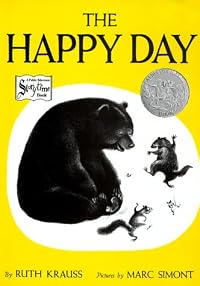
The Happy Day
by Ruth Krauss
On This Page
Description
In the middle of winter, different forest animals awake and run sniffing through the trees, to discover a single flower growing in the snow.Tags
Recommendations









Member Reviews
Krauss gets kids. This is short, simple and lively. The animal characters are sufficiently authentic to please the scientist in me, but at the same time have personalities that a human child can identify with. This book definitely should stay in print, imo.
This is a cute book which creates a feeling of excitement the first time you read it. However, it wasn't a huge hit with us because we live where there's no winter -- we have flowers here all year long -- so it's hard to relate to the excitement.
This is another book what was great. I enjoyed watching all the animals com out of winter hibernation for the big reveal at the end of the book.
“The Happy Day” is a picture book about an event in late winter. The snow is falling and the animals are sleeping. The animals are all the species that would hibernate in the winter. The story tells how each of the types of animals opens their eyes, sniff, and begin to run. They finally stop, laugh and dance. They are “happy” because they have discovered a flower growing in the snow.
Achromatic illustrations fill the pages with details of the animals’ winter habitats. These pictures earned the book the 1950 Caldecott Honor Book award. The story starts slow and peaceful with the animals sleeping. As you read you suddenly are rushing to the discovery with the words “They sniff. They run. They run. They sniff.” The built up show more anticipation ends with a simple discovery that makes you smile. The story offers a message of how we can open our eyes and find so much joy in one simple thing.
In the classroom the book could be used in a science class to assist in a discussion about hibernation. The animals used in the book are easily recognized and shown in the appropriate habitats. Another use of the book as a learning tool could be as an introduction to an art project. Students could be given drawing pencils and shown how to shade the black to gray color. They could then be asked to draw a picture about an event that pertains to a topic the class is studying. show less
Achromatic illustrations fill the pages with details of the animals’ winter habitats. These pictures earned the book the 1950 Caldecott Honor Book award. The story starts slow and peaceful with the animals sleeping. As you read you suddenly are rushing to the discovery with the words “They sniff. They run. They run. They sniff.” The built up show more anticipation ends with a simple discovery that makes you smile. The story offers a message of how we can open our eyes and find so much joy in one simple thing.
In the classroom the book could be used in a science class to assist in a discussion about hibernation. The animals used in the book are easily recognized and shown in the appropriate habitats. Another use of the book as a learning tool could be as an introduction to an art project. Students could be given drawing pencils and shown how to shade the black to gray color. They could then be asked to draw a picture about an event that pertains to a topic the class is studying. show less
A cute easy reader, perfect for beginning readers. The black and white images are simple and add a bit of interest to the book as you and your child try to count the animals. A repeating story that begs to be read again and again.
I'm so torn.
On the one hand, this is a simply-written, repetitive book about the real start of spring - a flower in the snow - and how all the animals react to that.
On the other hand, the artwork is a little uninspiring, and I'm not certain black-and-white is the color scheme to go with here.
Definitely read before you buy.
On the one hand, this is a simply-written, repetitive book about the real start of spring - a flower in the snow - and how all the animals react to that.
On the other hand, the artwork is a little uninspiring, and I'm not certain black-and-white is the color scheme to go with here.
Definitely read before you buy.
This is another book what was great. I enjoyed watching all the animals com out of winter hibernation for the big reveal at the end of the book
Members
- Recently Added By
Lists

Caldecott Honor Books
296 works; 23 members

Books Read in 2023
5,547 works; 145 members
Author Information

51+ Works 11,874 Members
Ruth Krauss was born on July 25, 1901 in Baltimore, Maryland. She attended the Peabody Institute of Music. She received a Bachelor of Arts degree from the Parsons School of Fine and Applied Art and studied anthropology at Columbia University. In 1941, she married David Johnson Leisk, who wrote and illustrated children's books as Crockett Johnson. show more They occasionally worked together. Her first book, A Good Man and His Good Wife, was published in 1944. She was credited as being one of the first authors to use minimal text, concentrating on precise language and working closely with an illustrator. She wrote more than 30 children's books during her lifetime including The Carrot Seed, I Can Fly, and A Hole Is to Dig: A First Book of First Definitions. She received the Caldecott Medal for The Happy Day in 1950 and A Very Special House in 1954. She also wrote verse plays and poetry for adults. She died on July 10, 1993 at the age of 91. (Bowker Author Biography) show less
All Editions
Awards and Honors
Common Knowledge
- Canonical title
- The Happy Day
- Original publication date
- 1949
- First words
- Snow is falling.
- Last words
- (Click to show. Warning: May contain spoilers.)They cry, "Oh! A flower is growing in the snow."
- Original language
- English
Classifications
- Genres
- Children's Books, Picture Books
- DDC/MDS
- 398.369 — Society, Government, and Culture Customs, etiquette & folklore Folklore & Folktales Real phenomena as subjects of folklore Scientific themes Animals
- LCC
- PZ10.3 .K87 .H — Language and Literature Fiction and juvenile belles lettres Fiction and juvenile belles lettres Juvenile belles lettres
- BISAC
Statistics
- Members
- 1,535
- Popularity
- 14,885
- Reviews
- 15
- Rating
- (3.44)
- Languages
- 5 — English, French, Japanese, Korean, Spanish
- Media
- Paper
- ISBNs
- 19
- ASINs
- 9