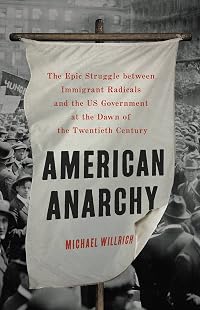
American Anarchy: The Epic Struggle between Immigrant Radicals and the US Government at the Dawn of the Twentieth Century
by Michael Willrich
On This Page
Description
"From the Gilded Age to the first Red Scare of 1919-1920, the American anarchist movement clashed with some of the nation's most powerful institutions and individuals. Anarchists never comprised more than a small minority the labor movement. Their vision of a world without states, borders, laws, organized religion, or private property proved far too radical for even the most open-minded liberals of their day--particularly when some anarchists advocated terrorist violence. By the turn of the show more twentieth century, in the face of this challenge to American values and political traditions, American leaders chose to suspend those very values to destroy the anarchist movement. They vilified anarchism as an "alien" contagion, launched an unprecedented buildup of government surveillance, called for draconian restrictions on free speech, and used immigration laws to expel non-citizen anarchists from the nation. This decades-long "war on anarchy" in turn inspired the emergence of the modern civil liberties movement, grounded in Constitutional freedoms of speech and due process. Seeking to defend anarchist thinkers who denounced the liberal idea of the rule of law, this movement breathed new life into the Bill of Rights and spurred debates about the proper limits of government power that continue today. In American Anarchy, award-winning historian Michael Willrich weaves the gripping tale of these anarchists, their allies, and their enemies, showing how they together transformed the United States. Willrich vividly recaptures the radical political world of early twentieth-century New York City--the nation's chief port of arrival for new immigrants and its preeminent financial and industrial center. New York was home to the infamous Russian-Jewish anarchists Emma Goldman and Alexander Berkman and their social network of Eastern European and Italian immigrant radicals, who championed industrial democracy, demanded reproductive freedom for women, and fought for free speech. From the start, their alien status and spectacles of protest made the anarchists targets for government officials. But when anarchists took a stand against the First World War and celebrated the Russian Revolution, the war against anarchy took on a new ferocity. To fight back, Goldman, Berkman, and their colleagues called on lawyers like the young Harry Weinberger, a night-school-educated attorney from the Lower East Side who found his calling defending radicals in criminal trials, Ellis Island deportation hearings, and before the U.S. Supreme Court, and whose work laid the groundwork for the American Civil Liberties Union. By taking the anarchists seriously as flawed but principled political actors, American Anarchy unlocks one of the great puzzles of modern U.S. history, revealing how a powerful national government and a robust conception of individual liberty emerged at the very same moment in the early twentieth century. Clear-eyed, prodigiously researched, and vividly written, it is a deeply resonant story of young radicals who would stop at nothing to change the world, and a powerful democracy willing to suspend its most fundamental freedoms for the illusion of security"-- show lessTags
Recommendations






Member Reviews
American Anarchy by Michael Willrich is a fascinating look at the radical movements at the turn of the 20th century, the legal battles they waged, and the ways in which both have helped to shape how we view civil rights to this day.
Even having taught sections on this period, including many of the people and events, I learned a lot about the details of the legal arguments as well as a little more nuance to how some of the anarchists of the time viewed their realistic goals.
For those primarily interested in history, this is an excellent look at the period and how the government could emphasize the very rights they thoroughly undermined. Sound like current events? Well, many of the legal approaches developed during this time to try to show more counter government overreach, and just plain un-American abuses masquerading as national security, have become part of both civil rights policy as well as foundational concepts for our current struggles against the powers that be, especially those that tried (and failed) to illegally maintain power.
Those with an interest in radical movements will gain both a wonderful historical perspective as well as see how such movements can succeed and fail, often concurrently when they have a scattershot approach. This also highlights how, in any movement, there will be nuanced differences between how the activists themselves understand their ideology. Action first? More philosophical with well-considered (or, arguably, over-considered) action taken? Violent or nonviolent? Is there a time to switch from one to another? What intermediate goals can and should be targeted? Or do you believe total and complete change, for the positive, can happen instantaneously? Is that even remotely realistic?
Highly recommended for readers of history, civil liberty movements, and legal history. Written in a very accessible manner, you don't need to be an expert in any field to get a lot out of this book.
Reviewed from a copy made available by the publisher via NetGalley. show less
Even having taught sections on this period, including many of the people and events, I learned a lot about the details of the legal arguments as well as a little more nuance to how some of the anarchists of the time viewed their realistic goals.
For those primarily interested in history, this is an excellent look at the period and how the government could emphasize the very rights they thoroughly undermined. Sound like current events? Well, many of the legal approaches developed during this time to try to show more counter government overreach, and just plain un-American abuses masquerading as national security, have become part of both civil rights policy as well as foundational concepts for our current struggles against the powers that be, especially those that tried (and failed) to illegally maintain power.
Those with an interest in radical movements will gain both a wonderful historical perspective as well as see how such movements can succeed and fail, often concurrently when they have a scattershot approach. This also highlights how, in any movement, there will be nuanced differences between how the activists themselves understand their ideology. Action first? More philosophical with well-considered (or, arguably, over-considered) action taken? Violent or nonviolent? Is there a time to switch from one to another? What intermediate goals can and should be targeted? Or do you believe total and complete change, for the positive, can happen instantaneously? Is that even remotely realistic?
Highly recommended for readers of history, civil liberty movements, and legal history. Written in a very accessible manner, you don't need to be an expert in any field to get a lot out of this book.
Reviewed from a copy made available by the publisher via NetGalley. show less
This is a great study about a totally neglected area of American History. Most people today are not very familiar with the high water mark of American Anarchism between late 1800 to the early 1900's. The focal point here are the movement's leaders Emma Goldman and Alexander Berkmann along with their defense attorney Harry Weinberger who defends them against the government for their public statements both in oral and written form. There is much more here in this conflict over free speech in our country.
Ratings
Members
- Recently Added By
Lists

Favorite Books 2024
25 works; 1 member

Book Riot Read Harder 2026
80 works; 1 member
Author Information

3+ Works 421 Members
Awards and Honors
Awards
Classifications
Statistics
- Members
- 61
- Popularity
- 505,514
- Reviews
- 2
- Rating
- (4.67)
- Languages
- English
- Media
- Paper, Ebook
- ISBNs
- 2