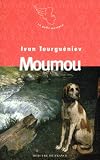
Mumu
by Ivan Turgenev
On This Page
Description
A journey into the depth of Russian countryside where intimate connection with nature comes as a natural way of life. Meet Kassyan, who can communicate directly with birds and other forest creatures. Discover mysterious sweet-voiced oracle bird, The Gamayune living among trees with leaves that fall not, neither in autumn nor in winter, and apples grow of gold, on silver branches, and every man lives in uprightness and content.Tags
Recommendations






























Member Reviews
I would like to preface my review by noting that I had previously snagged another audiobook adaptation of Russian literature also narrated by Max Bohlinger, the former was the Short Stories of Anton Chekhov.
For many years, I have been an ardent audiophile particularly of classic Russian and Victorian literature. As such, I anticipated the arrival of the first audiobook which was quite a disappointment to me. However, I wanted to give Mumu a chance yet the narration was a let down as well. It saddens me that such an egregious project leaves something to be desired. Like some of my fellow reviewers, the tone and cadence of the narrator distracted my concentration. On the other hand, the premise of Mumu is captivating - the sad show more circumstances of a deaf serf who suffers at the hands of his infuriating and calculating mistress leading to further isolation and alienation.
Though listening to the audiobook was challenging, I'm looking forward to reading Mumu in book format. show less
For many years, I have been an ardent audiophile particularly of classic Russian and Victorian literature. As such, I anticipated the arrival of the first audiobook which was quite a disappointment to me. However, I wanted to give Mumu a chance yet the narration was a let down as well. It saddens me that such an egregious project leaves something to be desired. Like some of my fellow reviewers, the tone and cadence of the narrator distracted my concentration. On the other hand, the premise of Mumu is captivating - the sad show more circumstances of a deaf serf who suffers at the hands of his infuriating and calculating mistress leading to further isolation and alienation.
Though listening to the audiobook was challenging, I'm looking forward to reading Mumu in book format. show less
 This review was written for LibraryThing Early Reviewers.
This is my first audiobook ever and it has been a good experience hearing this amusing story by Turgenev. Amusing, but interesting also because one can learn again about the terrible class-differences in the 19th century and how they affected life even in such way that the lady of the house not only could decide that a servant was going to marry, she could even chose the partner also, all dependening on her mood. What a miserable life...
She doesn't know or care about the souls of her servants, she only knows her own moods. The dog Mumu is a symbol of the loyalty of the servant towards the lady. And the servants are no more than a dog to her, something you can command and something fun or useful but if you start to hate it, you can show more drown it. In this story there is no love that overrules the classdifferences.
Only the servants love the dog (they can relate to its position). They have no means to change their situation of dependence. But the central, deaf (symbolic too) figure who saved the dog as a puppy and who loves it more than anything else, has the power to leave after he drowns it on the lady's command. By doing this he has drowned his faithfulness to her also and he breaks the rules.
I can imagine that it is fun for the English listener that the reader has a Russian accent but I had to get used to this and to his nasal voice. show less
She doesn't know or care about the souls of her servants, she only knows her own moods. The dog Mumu is a symbol of the loyalty of the servant towards the lady. And the servants are no more than a dog to her, something you can command and something fun or useful but if you start to hate it, you can show more drown it. In this story there is no love that overrules the classdifferences.
Only the servants love the dog (they can relate to its position). They have no means to change their situation of dependence. But the central, deaf (symbolic too) figure who saved the dog as a puppy and who loves it more than anything else, has the power to leave after he drowns it on the lady's command. By doing this he has drowned his faithfulness to her also and he breaks the rules.
I can imagine that it is fun for the English listener that the reader has a Russian accent but I had to get used to this and to his nasal voice. show less
This review was written for LibraryThing Early Reviewers.This is unlistenable (and if that's not a word, it should be).
Although I applaud a small company producing an audiobook of a classic Russian short story, the translation, reading and packaging all appear to have been prepared by non-native English speakers. The packaging has several glaring typos, and within the first minute of the audio recording, there's a major error in English tense ("she was living" used in an otherwise past tense clause instead of "she lived"). The reading itself is performed by someone with a heavy Russian accent who appears to have limited experience with English pronunciation and word/syllable emphasis. As a result, this makes it tricky to understand the reading on top of the awkward translation.
Sadly, I show more cannot recommend this production. show less
Although I applaud a small company producing an audiobook of a classic Russian short story, the translation, reading and packaging all appear to have been prepared by non-native English speakers. The packaging has several glaring typos, and within the first minute of the audio recording, there's a major error in English tense ("she was living" used in an otherwise past tense clause instead of "she lived"). The reading itself is performed by someone with a heavy Russian accent who appears to have limited experience with English pronunciation and word/syllable emphasis. As a result, this makes it tricky to understand the reading on top of the awkward translation.
Sadly, I show more cannot recommend this production. show less
This review was written for LibraryThing Early Reviewers.Having read Turgenev's works in the original Russian, I can acknowledge that Constance Garnett does an acceptable job with Mumu, although her language occasionally feels stilted or, worse, laughably anachronistic. My biggest complaint about this new audio release of Turgenev's 19th century classic is the use of a narrator who has a Russian accent. As listeners, we already perceive Turgenev's language through the filter of the translation, so being forced to contend with the additional filter of the narrator's accent serves only to emphasize our distance from the original. Frankly, the narrator's accent makes this audiobook come across as gimmicky for an English-speaking audience, preventing the listener from getting lost in the story show more itself, which is a great disservice to Turgenev's mastery as an author. show less
This review was written for LibraryThing Early Reviewers.A poignant story of a deaf-mute peasant who gets a job on an estate in Moscow. Wonderful storytelling and great portrayal of the main character. Even though it's only a short story, there is a wealth of social issues presented in it that plagued life in Russia at the time.
Read in English, but with a very distinct Russian accent by Max Bollinger.
Read in English, but with a very distinct Russian accent by Max Bollinger.
This review was written for LibraryThing Early Reviewers.Deeply intense story of Mumu, the dog and deaf mute Gerasim, whom one might suppose a serf transplanted from a country estate near Moscow where "he did the work of four men" to duties as courtyard porter of the Moscow's house of a recluse elderly female landowner, whom one might suppose a member of the Aristocracy. All is intimist and social critic tschekovian in tone, never overt. Gerasim is Russia, lost in a city in his peasant blouse among the "German coats" worn by domesticity and visitors to the town house.
With great empathy for the human condition and his characters, Turgenev depicts a courtyard kept meticulously clean of weeds, dust and drunkards by Gerasim. After loosing a potential wife to a shoemaker through a marriage of show more convenience arranged by the landowner, Gerasim reports all his affection on his dog Mumu.
When Mumu rejects the unwanted attention of the insomniac and paranoiac old lady secluded in her second floor apartments, disaster strikes prompting Gerasim's return to his village and the eternal values of mother Russia, its land and its people. This audio book is beautifully presented. The narrator convincing and sincere in conveying the gentleness of Gerasim and yet his inalterable strenghth opposed to the cruelty and stupidity of the other members of the household. A short story but great in emotion and meaning that makes you want to read his other books. What a successful introduction to a great writer. show less
With great empathy for the human condition and his characters, Turgenev depicts a courtyard kept meticulously clean of weeds, dust and drunkards by Gerasim. After loosing a potential wife to a shoemaker through a marriage of show more convenience arranged by the landowner, Gerasim reports all his affection on his dog Mumu.
When Mumu rejects the unwanted attention of the insomniac and paranoiac old lady secluded in her second floor apartments, disaster strikes prompting Gerasim's return to his village and the eternal values of mother Russia, its land and its people. This audio book is beautifully presented. The narrator convincing and sincere in conveying the gentleness of Gerasim and yet his inalterable strenghth opposed to the cruelty and stupidity of the other members of the household. A short story but great in emotion and meaning that makes you want to read his other books. What a successful introduction to a great writer. show less
This review was written for LibraryThing Early Reviewers.Mumu is a empathic story that criticizes the social structure of feudal Russia of the 19th century. This subtle tale takes place on the estate of a selfish and thoughtless old widow who treats her serfs as animals and treats her animals worse. The Mumu of the title is a little dog who belongs to a Gerasim, a deaf-mute serf who works on the estate.
I have never read Turgenev before, and this story makes me interested to try more of him.
As for the audiobook, I found that the narrator had an oddly computerized sounding voice--it was as if I was listening to this on my GPS and I'd set the accent as Russian-British. However, within a few minutes of listening, the distraction disappeared and I didn't notice it anymore. However, I had to listen show more to the book in 20 minute periods, so each time I started I noticed this. This was a minor distraction.
Recommended for: people who are new to 19th Russian literature but want to give it a try. Also, people looking for short audiobooks.
NOT recommended for: people who get upset about sad animal stories. I'm not one of those people, but this story was more than a little troubling. show less
I have never read Turgenev before, and this story makes me interested to try more of him.
As for the audiobook, I found that the narrator had an oddly computerized sounding voice--it was as if I was listening to this on my GPS and I'd set the accent as Russian-British. However, within a few minutes of listening, the distraction disappeared and I didn't notice it anymore. However, I had to listen show more to the book in 20 minute periods, so each time I started I noticed this. This was a minor distraction.
Recommended for: people who are new to 19th Russian literature but want to give it a try. Also, people looking for short audiobooks.
NOT recommended for: people who get upset about sad animal stories. I'm not one of those people, but this story was more than a little troubling. show less
This review was written for LibraryThing Early Reviewers.Members
- Recently Added By
Published Reviews
ThingScore 100
Gerasim is a deaf mute servant in the household of a cantankerous old widow outside Moscow. He finds comfort in his isolated life of arduous work in his beloved dog, Mimi, but the widow orders the animal’s destruction. A harrowing short story published in 1854, its vivid portrayal of callous cruelty towards serfs is believed to have influenced opinion in favour of the abolition of serfdom show more seven years later. The narration is Russian accented English communicates all of Turgenev’s favour. show less
added by PDSA
Lists

Worst books read in 2011
36 works; 20 members
Author Information

610+ Works 24,386 Members
Ivan Turgenev, 1818 - 1883 Novelist, poet and playwright, Ivan Turgenev, was born to a wealthy family in Oryol in the Ukraine region of Russia. He attended St. Petersburg University (1834-37) and Berlin University (1838-41), completing his master's exam at St. Petersburg. His career at the Russian Civil Service began in 1841. He worded for the show more Ministry of Interior from 1843-1845. In the 1840's, Turgenev began writing poetry, criticism, and short stories under Nikolay Gogol's influence. "A Sportsman's Sketches" (1852) were short pieces written from the point of view of a nobleman who learns to appreciate the wisdom of the peasants who live on his family's estate. This brought him a month of detention and eighteen months of house arrest. From 1853-62, he wrote stories and novellas, which include the titles "Rudin" (1856), "Dvorianskoe Gnedo" (1859), "Nakanune" (1860) and "Ottsy I Deti" (1862). Turgenev left Russia, in 1856, because of the hostile reaction to his work titled "Fathers and Sons" (1862). Turgenev finally settled in Paris. He became a corresponding member of the Imperial Academy of Sciences in 1860 and Doctor of Civil Law at Oxford University in 1879. His last published work, "Poems in Prose," was a collection of meditations and anecdotes. On September 3, 1883, Turgenev died in Bougival, near Paris. (Bowker Author Biography) show less
Some Editions
Awards and Honors
Series
Belongs to Publisher Series
Work Relationships
Is contained in
Has the adaptation
Common Knowledge
- Canonical title
- Mumu
- Original title
- Муму
- Original publication date
- 1852
- People/Characters
- Gerasim; Tat'jana; Mumu
- Important places
- Moscow, Russia
- First words*
- In one of the outlying streets of Moscow, in a gray house with white columns and a balcony, warped all askew, there was once living a lady, a widow, surrounded by a numerous household of serfs.
- Last words*
- (Click to show. Warning: May contain spoilers.)Such is the fame of the dumb man's Titanic strength.
*Some information comes from Common Knowledge in other languages. Click "Edit" for more information.
Classifications
- Genres
- Fiction and Literature, General Fiction
- DDC/MDS
- 891.733 — Literature & rhetoric Asian Literature East Indo-European and Celtic literatures Russian and East Slavic languages Russian fiction 1800–1917
- LCC
- PG3420 .M8 — Language and Literature Slavic languages and literatures. Baltic languages. Albanian language Slavic. Baltic. Albanian Russian literature Individual authors and works 1800-1870 Turgenev
- BISAC
Statistics
- Members
- 173
- Popularity
- 188,677
- Reviews
- 33
- Rating
- (3.53)
- Languages
- 10 — Chinese, Dutch, English, Estonian, French, German, Greek, Lithuanian, Russian, Swedish
- Media
- Paper, Audiobook, Ebook
- ISBNs
- 30
- ASINs
- 11