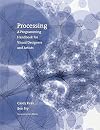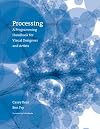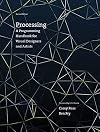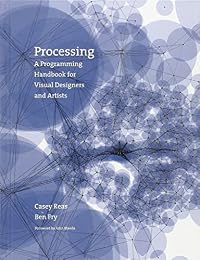
Processing: A Programming Handbook for Visual Designers and Artists
by Casey Reas (Author), Ben Fry (Author)
On This Page
Description
The visual arts are rapidly changing as media moves into the web, mobile devices, and architecture. When designers and artists learn the basics of writing software, they develop a new form of literacy that enables them to create new media for the present, and to imagine future media that are beyond the capacities of current software tools. This book introduces this new literacy by teaching computer programming within the context of the visual arts. It offers a comprehensive reference and show more text for Processing (www.processing.org), an open-source programming language that can be used by students, artists, designers, architects, researchers, and anyone who wants to program images, animation, and interactivity. Written by Processing's cofounders, the book offers a definitive reference for students and professionals. Tutorial chapters make up the bulk of the book; advanced professional projects from such domains as animation, performance, and installation are discussed in interviews with their creators.This second edition has been thoroughly updated. It is the first book to offer in-depth coverage of Processing 2.0 and 3.0, and all examples have been updated for the new syntax. Every chapter has been revised, and new chapters introduce new ways to work with data and geometry. New "synthesis" chapters offer discussion and worked examples of such topics as sketching with code, modularity, and algorithms. New interviews have been added that cover a wider range of projects. "Extension" chapters are now offered online so they can be updated to keep pace with technological developments in such fields as computer vision and electronics.InterviewsSUE.C, Larry Cuba, Mark Hansen, Lynn Hershman Leeson, Jurg Lehni, LettError, Golan Levin and Zachary Lieberman, Benjamin Maus, Manfred Mohr, Ash Nehru, Josh On, Bob Sabiston, Jennifer Steinkamp, Jared Tarbell, Steph Thirion, Robert Winter. show lessTags
Recommendations



Member Recommendations
Member Reviews
Good introduction to graphic programming, clearly aimed at first-time programmers with plenty of basic 'ok, this is a variable, this is a loop, etc'. The book's stated aim is to introduce artists to the idea of programming as art- I'm a bit skeptical on whether or not they've made it accessible to the average non-programmer. But, then, I stopped being able to judge whether material is techically accessible to laypeople years ago, so your mileage may vary.
Useful for the experienced programmer with little graphics experience (me!), provided you skim/skip the basic programming constructs sections. Also easily adaptable to other language implementations of Processing if you hate Java: I used the examples with little trouble in ruby-processing.
Useful for the experienced programmer with little graphics experience (me!), provided you skim/skip the basic programming constructs sections. Also easily adaptable to other language implementations of Processing if you hate Java: I used the examples with little trouble in ruby-processing.
Ratings
Members
- Recently Added By
Author Information

Some Editions
Common Knowledge
- Original publication date
- 2007
- Dedication
- For the ACG
- First words
- This book was written as an introduction to the ideas of computer programming within the context of the visual arts.
- Blurbers
- Antonelli, Paola; Burns, Red; Lupton, Ellen; Mitchell, William J.; Paul, Christiane; Sauter, Joachim
Classifications
- Genres
- Technology, Nonfiction, Art & Design, General Nonfiction
- DDC/MDS
- 005.1 — Computer science, information & general works Computer science, knowledge & systems Artificial Intelligence/Virtual Reality Software development
- LCC
- QA76.6 .R4138 — Science Mathematics Mathematics Instruments and machines Calculating machines Electronic computers. Computer science
- BISAC
Statistics
- Members
- 383
- Popularity
- 81,375
- Reviews
- 1
- Rating
- (4.34)
- Languages
- English
- Media
- Paper, Ebook
- ISBNs
- 7
- ASINs
- 3