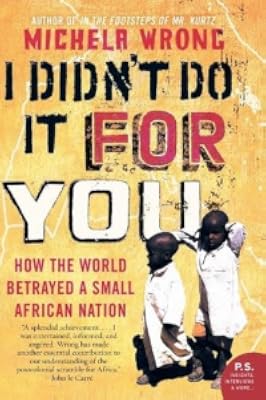
I Didn't Do It for You: How the World Betrayed a Small African Nation
by Michela Wrong
On This Page
Description
"Scarred by decades of conflict and occupation, the craggy African nation of Eritrea has weathered the world's longest-running guerrilla war. The dogged determination that secured victory against Ethiopia, its giant neighbor, is woven into the national psyche, the product of a series of cynical foreign interventions. Fascist Italy wanted Eritrea as the springboard for a new, racially pure Roman empire, Britain sold off its industry for scrap, the United States needed a base for its show more state-of-the-art spy station, and the Soviet Union used it as a pawn in a proxy war." "Michael Wrong reveals the breathtaking abuses this tiny nation has suffered and tells the story of colonialism itself. Along the way, we meet a formidable African emperor, a pigheaded English suffragette, and a guerilla fighter who taught himself French cuisine in the bush."--Jacket. show lessTags
Recommendations
Member Reviews
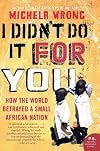
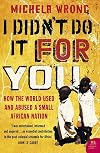
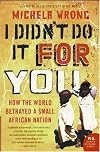
One day, several months ago, I wandered for the first time into the small African history section of my local used bookstore and ended up buying "I Didn't Do It For You", mostly because the attractively designed cover caught my eye. Even if I bought it for shallow reasons, I'm so glad I did--this was a fantastic, eye-opening read.
Wrong details the odyssey of Eritrea, the youngest country in Africa, and the subtitle of the book is depressingly accurate. Eritrea was basically invented by the Italians in the late 19th century so that they could have their own colonial empire, carved out of the northern bit of Ethiopia and the southern bit of Egypt. The country was subsequently ransacked by the British during WWII, illegally annexed by show more Ethiopia while the UN looked the other way (no surprise there), ignored by the entire Western world as it fought an ultimately successful 30-year-long guerilla war for independence (with first the U.S., then the Soviet Union, then Israel supplying Ethiopia with billions of dollars worth of military equipment and training), only to stumble back into war with Ethiopia after only six years of peace and prosperity as the poster-child for a possible African renaissance. The book was written in 2004 and I immediately looked up Eritrea's Wikipedia article to see what had happened in the last four years, only to find that, among other indictments, Eritrea is currently ranked dead last on Reporters Without Borders' Worldwide Press Freedom Index. Despite the horrible effect that the Eritrean government (ironically composed of some of the very freedom fighters who liberated the country in the first place) has had in the last 10 years, Wrong still holds out hope that the dogged pride and determination of the Eritreans will help the country bounce back. It was a nice note to end on, and the book itself is incredibly interesting and well-written, but the emotional effect of reading it can be summed-up by one of Wrong's own comments: "And you were left in a sulky gray fug of ambiguity, sure of only one thing: everyone had behaved badly, everyone was to blame." show less
Wrong details the odyssey of Eritrea, the youngest country in Africa, and the subtitle of the book is depressingly accurate. Eritrea was basically invented by the Italians in the late 19th century so that they could have their own colonial empire, carved out of the northern bit of Ethiopia and the southern bit of Egypt. The country was subsequently ransacked by the British during WWII, illegally annexed by show more Ethiopia while the UN looked the other way (no surprise there), ignored by the entire Western world as it fought an ultimately successful 30-year-long guerilla war for independence (with first the U.S., then the Soviet Union, then Israel supplying Ethiopia with billions of dollars worth of military equipment and training), only to stumble back into war with Ethiopia after only six years of peace and prosperity as the poster-child for a possible African renaissance. The book was written in 2004 and I immediately looked up Eritrea's Wikipedia article to see what had happened in the last four years, only to find that, among other indictments, Eritrea is currently ranked dead last on Reporters Without Borders' Worldwide Press Freedom Index. Despite the horrible effect that the Eritrean government (ironically composed of some of the very freedom fighters who liberated the country in the first place) has had in the last 10 years, Wrong still holds out hope that the dogged pride and determination of the Eritreans will help the country bounce back. It was a nice note to end on, and the book itself is incredibly interesting and well-written, but the emotional effect of reading it can be summed-up by one of Wrong's own comments: "And you were left in a sulky gray fug of ambiguity, sure of only one thing: everyone had behaved badly, everyone was to blame." show less
Excellent. Reads smoothly, but also very thought-provoking about what drives foreign policy and how productive/effective this is in the long term.
A fascinating piece of journalism and history: a reporter who really gets to know the country, and talks with representative figures along the way. Except for an overlong section on American troops stationed in Eritrea during the Cold War, the book was consistently interesting, and engagingly written.
Wrong has a gift for explaining the history and circumstances of African countries in a readable, accessible way. I couldn't put this down.
I am referenced multiple times, so I think this is a GREAT BOOK!
Ratings
Members
- Recently Added By
Lists

Non-Fiction Worth Reading
1,016 works; 262 members

Tour of Africa
54 works; 2 members
Author Information

6 Works 1,345 Members
Michela Wrong has worked as a foreign correspondent for Reuters, the BBC, and the Financial Times. She has writen about Africa for Slate.com and is a frequent commentator on African affairs in the media. Her first book. In the Footsteps of Mr. Kurtz, won the James Stern Silver Pen Award for Nonfiction. She lives in London.
Awards and Honors
Awards
Common Knowledge
- Original publication date
- 2005
- Important places
- Africa; Asmara, Eritrea; Egypt; Eritrea; Ethiopia
- Important events
- World War II (1939 | 1945)
- Dedication
- To Elena and Silvia Harty, as promised
- First words
- It was well past midnight, and in Cairo airport’s transit lounge it was clear most passengers had already entered the trance-like state of passivity that accompanies long-distance travel.
- Last words
- (Click to show. Warning: May contain spoilers.)He searched again for the right words, and found them. 'Our history makes us close. We have an affinity. Do not push us away.'
Classifications
Statistics
- Members
- 324
- Popularity
- 98,234
- Reviews
- 5
- Rating
- (4.09)
- Languages
- English, Spanish
- Media
- Paper, Ebook
- ISBNs
- 6
- ASINs
- 4