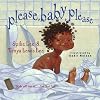
Please, Baby, Please
by Spike Lee, Tonya Lewis Lee
On This Page
Description
A toddler's antics keep his mother busy as she tries to feed him, watch him on the playground, give him a bath, and put him to bed.Tags
Recommendations







Member Reviews
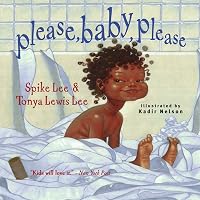
I love, love, love this! As the hours of the day pass, Baby's mother begs her to behave. Kadir Nelson's illustrations perfectly capture the independence of this little girl, as she follows her own path through the day, not going to sleep, eating her peas, or sitting still in the bath.
I read this book and I hear Spike Lee in my head. This is a very good thing for a celebrity author. So often celebrity authors sound like they’ve been ghost written. This does not sound that way. Between the repetitiveness and the change up of the “please baby please” line the other thing that is done well is the simple concepts. The illustrator does a masterful job illustrating the words that show different points in a very busy toddlers day. The illustrations are amazing. I love how the illustrator did the curly hair. I just really liked everything about this book. I think it’s well done. I think it’s entertaining. I think it’s memorable and I think it goes way beyond the celebrity in the author.
I really enjoyed Spike Lee’s story “Please Baby Please” for multiple reasons, from the engaging, well-paced writing, and the illustrations, to the realistic characters. In the story the author takes us through a day with an active toddler, and her seemingly overwhelmed parents. The story is told chronologically (from morning to night) and is written in a very well paced and engaging style. Lee uses short, simple sentences, and repeats the phrase “please, baby please”, as the toddlers parents attempt to get her to cooperate throughout the day. This element adds to the realistic nature of the story. The illustrations also add to the story because the images reflect real situations that occur with toddlers from getting cheerios show more all over them, to writing on the walls, and the bubbly, wet mess that comes with bath time. The characters are extremely believable because they behave in a way that is true to real life, from the hyper toddler, to the tired parents pleading with the child for cooperation. This is a wonderful story that brings to the forefront the struggles that comes with parenting a young child. The big idea is that although raising a toddler has its challenges, the love between the child and parents makes it all worthwhile. show less
Please, Baby, Please is an adorable book. However, I had issues with the rhyme scheme of the book because the author would switch up the phrase. The illustrations are great and I believe every parent can relate to the story of an active toddler.
This is an adorable book that would make a sweet gift for a new parent, or a parent of a toddler.
The illustrations are phenomenal, and the font appearance is fun, but I can't quite figure out the rhyme scheme or rhythm, so I actually find the story itself a little frustrating-- it doesn't just naturally flow.
BUT EVERY SINGLE CHILD who I've read this with has LOVED it! And actually, the mismatched rhyme scheme made the kids actually have to read the words rather than merely memorize the word sequence!
The mischievous character is very engaging, the artwork is incredibly well done, and it's a great representation of non-white characters.
The illustrations are phenomenal, and the font appearance is fun, but I can't quite figure out the rhyme scheme or rhythm, so I actually find the story itself a little frustrating-- it doesn't just naturally flow.
BUT EVERY SINGLE CHILD who I've read this with has LOVED it! And actually, the mismatched rhyme scheme made the kids actually have to read the words rather than merely memorize the word sequence!
The mischievous character is very engaging, the artwork is incredibly well done, and it's a great representation of non-white characters.
This book tells the story of raising a child and all that comes with it. Throughout the story, the parents are constantly pleading with thei daughter to do a certain task. For example, she plays on her mother’s tummy, up way past her bedtime (the clock radio shows 3:01 a.m.) her mother pleads, “Go back to bed, baby, please, baby, please.” When she dumps the contents of her breakfast, “Not on your HEAD, baby baby baby, please!” Each page features an impish grin and impossibly beautiful eyes peeking out from under a tangle of perky curls. A tiny clock records the time of day at the beginning of the line of text. Vivid illustrations of this African-American family full of love and patience for their strong-willed daughter will show more evoke laughter as the parents attempt, with mixed results, to guide their charmer’s behavior. Sure enough, the closing line turns the tables as the little girl asks for a kiss, “. . . Mama, Mama, Mama, please.” The big picture is that kids are not easy to raise. It takes patience, love, and hard work to raise a toddler. These parents show that at times, children are not all sweet and cuddly. show less
Picture this: Mom and Dad are in bed and their baby girl crawls in and wants up. "Go back to bed, baby, PLEASE baby, PLEASE!" What parent hasn't experienced the 3:00 in the morning “can’t go to sleep playtime, a bowl of cereal dumped all of the head, crayon drawings all over the wall, the screaming friend who won't give back the ball, eating sand at the playground, and of course giving you a dandelion. Every scene mimics every parent's adventure in parenthood. This could turn into a series illustrating all of the frustrating elements of families lives as the child goes to preschool, then to elementary school, middle school, and finally high school. Nelson uses such delightful expressions on the children's faces that you know you show more could never stay mad at them for long. The pages are filled to the edge with realistic pictures in bright, brilliant colors. Children will love turning page after page because they will certainly identify with nearly every scene depicted. As a teacher I appreciate being able to promote a book including a black family doing every day normal routines in a familiar setting. It’s about normal families. I’m glad race didn’t matter. Highly recommended. Ages 2-5. show less
Members
- Recently Added By
Lists

Children's picture books with kids of color
129 works; 15 members

Children's Books About Babies & Toddlers
69 works; 3 members
Author Information

65+ Works 3,988 Members
Directing, writing, and starring in his own films, as did Charlie Chaplin and Orson Welles before him, Lee has arguably had almost as profound an influence on American filmmaking as his predecessors, although in very different ways. In his own words, he is good at "marketing," and what he has marketed is a highly politicized African American show more cinema that is also commercially viable. Many critics credit Lee with paving the way for a new wave of mass-market yet socially conscious filmmakers, including John Singleton, Charles Lane, and Carl Franklin. The eldest of six children, Lee was educated first at Morehouse College and then at New York University's film school. His first feature release, She's Gotta Have It (1986), won the Prix de Jeunesse at Cannes and was both critically acclaimed and commercially successful in the United States. Lee went on to make School Daze (1988) and Do the Right Thing (1989), a technically sophisticated film that addressed racism in a complex and controversial fashion. The film constructs a narrative that leaves it to the viewer to decide whether its protagonist, Mookie, has done the right thing when he responds to the death of one of his friends at the hands of the police by throwing a trash can through the window of his employer, who had called the police in the first place. Because a riot ensues, many (white) critics argued that the film celebrated violence, and the press suggested that it would incite black spectators to riot (it did not). Other critics suggested that Mookie actually defuses a riot, by directing the community's anger toward property and away from the police. Two years later, Lee tackled the subject of interracial relationships in another hotly debated film, Jungle Fever (1991), which some saw as preachy and sexist and others praised as bold and complex. However, his most recent and ambitious film, Malcolm X (1992), has been almost universally acclaimed. Lee has published a companion text for each film that includes biographies of all of the principals, essays on such topics as guerilla filmmaking, production stills, details of salaries and finances, excerpts from his journal or production notes, and the script. These materials demystify production, advertise the talents of the people who work for him, and promote his political positions, particularly his commitment to black entrepreneurship and cultural self-expression. (Bowker Author Biography) show less
4 Works 1,858 Members
All Editions
Awards and Honors
Common Knowledge
- Original publication date
- 2001
Classifications
Statistics
- Members
- 722
- Popularity
- 39,468
- Reviews
- 45
- Rating
- (4.08)
- Languages
- English
- Media
- Paper
- ISBNs
- 9
- UPCs
- 1
- ASINs
- 2