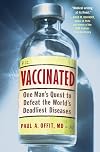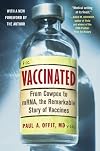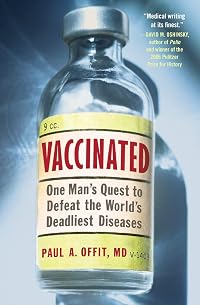
Vaccinated: One Man's Quest to Defeat the World's Deadlist Diseases
by Paul A. Offit
On This Page
Description
Vaccines save millions of lives every year, and one man, Maurice Hilleman, was responsible for nine of the big fourteen. Paul Offit recounts his story and the story of vaccinesMaurice Hilleman discovered nine vaccines that practically every child gets, rendering formerly dread diseases—including often devastating ones such as mumps and rubella—practically forgotten. Paul A. Offit, a vaccine researcher himself, befriended Hilleman and, during the great man's last months, interviewed him show more extensively about his life and career.
Offit makes an eloquent and compelling case for Hilleman's importance, arguing that, like Jonas Salk, his name should be known to everyone. But Vaccinated is also enriched and enlivened by a look at vaccines in the context of modern medical science and history, ranging across the globe and throughout time to take in a fascinating cast of hundreds, providing a vital contribution to the continuing debate over the value of vaccines.
. show less
Tags
Recommendations
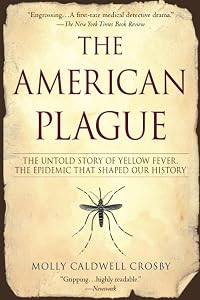
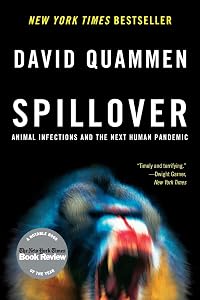
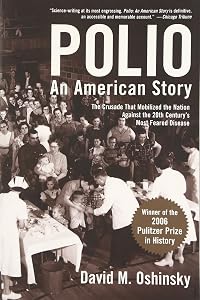
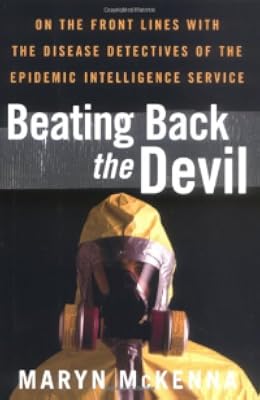









Member Reviews
Paul Offit's "Vaccinated" is an engaging look at the history and development of the vaccines invented or improved by Maurice Hilleman. It is broad in scope, including elements of history, biography, science, and bioethics, but Offit's narrative is neither overly simplistic nor too technical to be hard to understand for the lay reader. Offit is also unapologetic about the anti-vaccination hypocrisy and disinformation campaigns promulgated by the conserative religious right--a refreshing bit of fresh air in this country's current repressive conservative climate.
He does lose major points, however, for including several unnecessary movie product placements in his text, including a page-long summary of the D-movie flop "Anaconda" (including show more extended quotations!), the effect of which is rather patronizing. Nevertheless, "Vaccinated" gives a good overview of the history of vaccines, Maurice Hilleman, and his many important contributions to the health and well-being of people the world over, which have been vastly overlooked. show less
He does lose major points, however, for including several unnecessary movie product placements in his text, including a page-long summary of the D-movie flop "Anaconda" (including show more extended quotations!), the effect of which is rather patronizing. Nevertheless, "Vaccinated" gives a good overview of the history of vaccines, Maurice Hilleman, and his many important contributions to the health and well-being of people the world over, which have been vastly overlooked. show less
While Vaccinated is mostly intended to be a biography of Maurice Hilleman, it also functions as a nice, quick little overview of the history of vaccinations. Like Mr. Hilleman, vaccines just don't get the credit they deserve. If a vaccine does everything it's supposed to, protect a person from a deadly disease and potentially save their life, no one ever notices. You get a shot, you might come into contact with the disease, you never know. It sort of lulls people, especially when it comes to diseases that have been mostly eradicated in the distant past thanks to the vaccines. People forget.
Vaccinated reminds us.
It also tells the story of the aforementioned Maurice Hilleman, a man who dedicated much of his life to the war against the show more microbes. You might not have ever heard of him, many haven't, but his contributions are tremendous. With dozens of vaccines under his belt, he has saved a lot of lives. His story isn't perfect, he was human, his practices were not always ethical, but he got the job done and helped make the world a safer place. So did a lot of other scientists who most of us have never heard of.
Maybe the author was a little bias, the book feeling like it had an agenda; to put a positive spin on some of the more controversial aspects of scientific research. Maybe he was a bit too opinionated for his own good, and maybe some of his arguments were a little holey. And yes, maybe he tinkered with quotes in a slightly annoying way. But ultimately it was worth it. Like the temporary sting of a vaccination shot, I suppose, a minor irritation but ultimately for the best. Plus, you don't have to like the doctor that administers it.
I liked the book. It was a nice and leisurely, and for such a quick and light read it had a lot of information packed inside it. Recommended for those interested in the topic. show less
Vaccinated reminds us.
It also tells the story of the aforementioned Maurice Hilleman, a man who dedicated much of his life to the war against the show more microbes. You might not have ever heard of him, many haven't, but his contributions are tremendous. With dozens of vaccines under his belt, he has saved a lot of lives. His story isn't perfect, he was human, his practices were not always ethical, but he got the job done and helped make the world a safer place. So did a lot of other scientists who most of us have never heard of.
Maybe the author was a little bias, the book feeling like it had an agenda; to put a positive spin on some of the more controversial aspects of scientific research. Maybe he was a bit too opinionated for his own good, and maybe some of his arguments were a little holey. And yes, maybe he tinkered with quotes in a slightly annoying way. But ultimately it was worth it. Like the temporary sting of a vaccination shot, I suppose, a minor irritation but ultimately for the best. Plus, you don't have to like the doctor that administers it.
I liked the book. It was a nice and leisurely, and for such a quick and light read it had a lot of information packed inside it. Recommended for those interested in the topic. show less
Good stuff. I'm quite partial to medical history, but it'd been a while since I read any. This is a good one, easily accessible, interesting and super relevant. Although it's organized around the work of Maurice Hilleman it really isn't a biography (thank goodness). Offit simply uses him as a pivot by which he accesses the history and development of vaccines preceding and concurrent with Hilleman's career. It was completely fascinating reading how vaccines grew from the cringe-worthy practice of arm-to-arm vaccination (when the inoculated fluids of one person were introduced directly in the next person to be vaccinated) to the crazy space-age sort of vaccines we've got today where scientists can cleave apart viruses isolating the show more particles that cause immunity from the dangerous bits with little threat of outside contamination. That's pretty new, they stumbled onto the mechanism to do that in the 80's.
Most of it is about some pretty down and dirty, nose to grindstone type of techniques. Reading about them made vaccines understandable in a way that they never were before. Simply put before I read this book I had only the vaguest idea of how vaccines worked and where they came from. Scientists did it! With magic! Ha. No really, after years and years of hearing about vaccines being made from weakened or dead diseases I get it now. Now I know how they weakened diseases. They forced them to evolve. Stick it in a chicken egg. Force generation upon generation to acclimate to life in a chicken egg until it's not so good at life in a person, but still enough like the original disease that the body can learn to make antibodies from it.
Offit presents how various vaccines were developed and it's fascinating how much the ingredients list sounds like witchcraft. Really. The rabies vaccine was first made in rabbit spines. Offit also does a good job of looking at the political and corporate involvement in vaccine production, both positive and negative. It's all very human. Hilleman was kinda a hardass, but you had to respect how completely committed he was to developing the best vaccine for the people. It's a shame that egos, fear-mongering and bottomlines can do so much damage to such important work. show less
Most of it is about some pretty down and dirty, nose to grindstone type of techniques. Reading about them made vaccines understandable in a way that they never were before. Simply put before I read this book I had only the vaguest idea of how vaccines worked and where they came from. Scientists did it! With magic! Ha. No really, after years and years of hearing about vaccines being made from weakened or dead diseases I get it now. Now I know how they weakened diseases. They forced them to evolve. Stick it in a chicken egg. Force generation upon generation to acclimate to life in a chicken egg until it's not so good at life in a person, but still enough like the original disease that the body can learn to make antibodies from it.
Offit presents how various vaccines were developed and it's fascinating how much the ingredients list sounds like witchcraft. Really. The rabies vaccine was first made in rabbit spines. Offit also does a good job of looking at the political and corporate involvement in vaccine production, both positive and negative. It's all very human. Hilleman was kinda a hardass, but you had to respect how completely committed he was to developing the best vaccine for the people. It's a shame that egos, fear-mongering and bottomlines can do so much damage to such important work. show less
Dr. Maurice Hilleman: singlehandedly pushed through a vaccine that mitigated the influenza epidemic of 1957; developed vaccines against mumps, rubella, measles, Japanese encephalitis virus, hepatitis A and B, pneumonia, and Haemophilus influenzae type b. Most of his vaccines are still in use to this day. He never won the Nobel Prize for his work, and to this day few people know his name, let alone his accomplishments.
Dr. Offit uses Hilleman's work to organize the book and take readers through the history of biological research and humanity's relationship with disease. He also examines myths that have dogged Hillman's work: that fetuses were killed to provide material, that the hep B vaccine contained HIV, that the MMR vaccine causes show more autism, that ethyl mercury (formerly contained in vaccines) causes autism. And he reminds his readers just how necessary vaccines are. I recommend this book to everyone, regardless of scientific background. A lay person could read this just as easily as a microbiologist--and should. Knowledge is power! show less
Dr. Offit uses Hilleman's work to organize the book and take readers through the history of biological research and humanity's relationship with disease. He also examines myths that have dogged Hillman's work: that fetuses were killed to provide material, that the hep B vaccine contained HIV, that the MMR vaccine causes show more autism, that ethyl mercury (formerly contained in vaccines) causes autism. And he reminds his readers just how necessary vaccines are. I recommend this book to everyone, regardless of scientific background. A lay person could read this just as easily as a microbiologist--and should. Knowledge is power! show less
A combination biography, history of vaccinations, this book covers the development of the vaccinations that control many common diseases that were once mass killers and now are controlled, at least in the western world. It is not as far ranging as some other histories of vaccinations, since it touches mostly on the 20th century as it covers the contributions of one man, Maurice Hillemann, with side trips to other major contributors. It is less biography than history, as it spends little time on his personal life, and most of its time on the subject of the vaccines. This is a feature, not a bug, as the story of his vaccine crusade appears to be the bulk of his story for a man who worked so many hours that he had little personal life, show more apparently. The author also discusses the former tendency to test techniques on children in hospitals for the mentally retarded, and while recognizing the ethical difficulties with this, also discusses the whys and wherefores of doing the testing where they did, and it was not for hatred of the mentally less gifted; it was because this was the population most at risk. The final chapters discuss the various political and social movements that are troubling vaccinations at this time. A lucid, readable book. show less
Really enjoyed it. More of a carreer overview than a biography, but it gives a real sense of the man behund the scientist.
As a mix of biography and science history, Vaccinated: One Man's Quest to Defeat the World's Deadliest Diseases is an intriguing account of the development of vaccines centered around the one man who gave the world a chance to fight against some of the most devastating diseases. Maurice Hilleman grew up in the farming communities in Montana and later became one of the lead researchers for the pharmaceutical giant Merck who developed vaccines for measles, mumps, rubella, hepatitis B, and others...(more)
Members
- Recently Added By
Lists

Top Five Books of 2024
795 works; 264 members
Author Information

15 Works 1,939 Members
Paul A. Offit, MD, is the director of the Vaccine Education Center at the Children's Hospital of Philadelphia, as well as the Maurice R. Hilleman Professor of Vaccinology and Professor of Pediatrics at the University of Pennsylvania School of Medicine. A national expert on vaccines and coinventor of the rotavirus vaccine, Dr. Offit is a recipient show more of many awards, including a Research Career Development Award from the National Institutes of Health. Dr. Offit was elected to the Institute of Medicine of the National Academies and is a member of the FDA's Vaccine Advisory Committee. show less
Awards and Honors
Common Knowledge
- Canonical title
- Vaccinated: One Man's Quest to Defeat the World's Deadlist Diseases
- Original publication date
- 2007
- People/Characters
- Maurice Hilleman
- Epigraph
- "And now," cried Max, "let the wild rumpus star."
-Maurice Sendak, Where the Wild Things Are - Dedication
- For Bonnie,
who made dreams come true,
And for our children, Will and Emily,
the two meteros striking through our lives - First words
- Scientists aren't famous.
- Blurbers
- Oshinsky, David; Engel, Jonathan
Classifications
Statistics
- Members
- 312
- Popularity
- 102,194
- Reviews
- 8
- Rating
- (3.93)
- Languages
- Chinese, English
- Media
- Paper, Audiobook, Ebook
- ISBNs
- 10
- ASINs
- 8