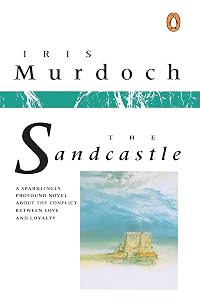
The Sandcastle
by Iris Murdoch 
On This Page
Description
A sparklingly profound novel about the conflict between love and loyalty The quiet life of schoolmaster Bill Mor and his wife Nan is disturbed when a young woman, Rain Carter, arrives at the school to paint the portrait of the headmaster. Mor, hoping to enter politics, becomes aware of new desires. A complex battle develops, involving love, guilt, magic, art, and political ambition. Mor's teenage children and their mother fight discreetly and ruthlessly against the invader. The Head, himself show more disenchanted, advises Mor to seize the girl and run. The final decision rests with Rain. Can a "great love" be purchased at too high a price? show lessTags
Recommendations















Member Recommendations
Member Reviews
Is it that I am 'getting' Iris Murdoch, or is it that I am (accidentally) choosing novels that I like better? It hardly matters, but I found this one hard to put down. It's hot, early summer and a young woman, already known as an accomplished painter, comes to do the portrait of the lately retired headmaster of St. Bride's, Demoyte. Bill Mor, a schoolmaster (and clearly one of the good ones) is among the first invited to meet her and they have an odd an intense encounter at Demoyte's house, Brayling Close, - which is as always to be found in an IM novel - a remarkable and beautiful house. They fall madly in love - for Mor a world of possibility is opened, a world he never imagined. He has always been dominated by his wife, a strong show more shrewd woman, and he sees now that he could break out.... so will he? He has two children that he misunderstands, a good friend that he doesn't know as well as he thinks he does, in fact Mor lives in a kind of fog, that lifts under the influence of the young painter (interestingly named Rain Carter). Everything comes to a head in the last quarter of the book and for me it was vivid and unputdownable. I'm rating it highly as I feel that every aspect of what goes into a good novel is at a high level, theme, character, momentum - there is also that hint of mystery - done with a very light hand here. The 'question' under consideration is when is love, especially 'being in love' not enough? Another question is what 'face' do we present to the world? Our real one or the one we wish it was? Yet another, can we read, in our own action or inaction, our true wishes, our true natures? I should also add that there was a good deal of humor - the boys at the school are lovingly described, as are the master ept and inept alike, the new headmaster is a worthy man but cheap and clumsy and this leads to farce upon occasion. I laughed out loud several times and chuckled many others. ***** show less
A splendid early Iris Murdoch novel, with a deceptively simple plot about a married man falling in love with a clever young woman, providing scope for a lot of interesting speculation about the nature of relationships between people, the purpose of representation in art, the proper role of education, and of course the difficulty of building sandcastles on Mediterranean beaches. In between, there's a lot of ironic deflation of pretensions, some French farce, and a sinister gypsy who keeps turning up for no obvious reason.
While it seems likely that the "other woman" was modelled on herself, Murdoch perversely tells the story mostly from the husband's POV, and even more oddly chooses the very masculine world of a boys' boarding school as show more the setting for her story. There's even a cricket match scene: whilst her young heroine may feel obliged to apologise for turning up for a tour of the school in trousers, Murdoch is making no apologies here for trampling all over the privileged territory of British male writers. Perhaps not exactly the first blast of the trumpet against the monstrous regiment of Angry Young Men, but certainly a bit of bucket and spade work to assist the action of the incoming tide... show less
While it seems likely that the "other woman" was modelled on herself, Murdoch perversely tells the story mostly from the husband's POV, and even more oddly chooses the very masculine world of a boys' boarding school as show more the setting for her story. There's even a cricket match scene: whilst her young heroine may feel obliged to apologise for turning up for a tour of the school in trousers, Murdoch is making no apologies here for trampling all over the privileged territory of British male writers. Perhaps not exactly the first blast of the trumpet against the monstrous regiment of Angry Young Men, but certainly a bit of bucket and spade work to assist the action of the incoming tide... show less
After all, he thought, I can be guided by this. Let me only make clear what I gain, and what I destroy.
My very first Murdoch exceeded all my expectations. I frankly hardly know where to start, or even what I want to say. Funny, suspenseful, a loud, relentless hymn of creation and destruction. Rarely does one see such brilliant harmony between plot, character development, and hard work on developing the underlying themes. (The word "themes", naturally, said in Stephen Fry's voice)
There are so many things, subtle and not so subtle, that contribute to the way the story is put together perfectly...it feels like an extremely human, emotional text and an arcane treatise on wishing impossible things, both at the same time. In this way the book show more is much like a painting itself.
I thought of the plot as a bit of a landslide - the worlds of adults, of children, the private and the public, rolling, sliding towards the point of no return, colliding, changing.
Perhaps it is rather that we feel our own face, as a three-dimensional mass, from within - and when we try in a painting to realize what another person's face is, we come back to the experience of our own.
Art and its creation (the debate on how to paint a face) are juxtaposed with the forces that make and break the life of the individual (how to treat other people, love, religion, scruples). Rain is to leave after she finishes the portrait - so decisions are to be made on both counts. Just like the commissioned portrait must be finished, so must the protagonists decide how they are to leave the stage and how much they are prepared to leave behind.
Beautiful, descriptive, thrilling - a stroke of genius. show less
My very first Murdoch exceeded all my expectations. I frankly hardly know where to start, or even what I want to say. Funny, suspenseful, a loud, relentless hymn of creation and destruction. Rarely does one see such brilliant harmony between plot, character development, and hard work on developing the underlying themes. (The word "themes", naturally, said in Stephen Fry's voice)
There are so many things, subtle and not so subtle, that contribute to the way the story is put together perfectly...it feels like an extremely human, emotional text and an arcane treatise on wishing impossible things, both at the same time. In this way the book show more is much like a painting itself.
I thought of the plot as a bit of a landslide - the worlds of adults, of children, the private and the public, rolling, sliding towards the point of no return, colliding, changing.
Perhaps it is rather that we feel our own face, as a three-dimensional mass, from within - and when we try in a painting to realize what another person's face is, we come back to the experience of our own.
Art and its creation (the debate on how to paint a face) are juxtaposed with the forces that make and break the life of the individual (how to treat other people, love, religion, scruples). Rain is to leave after she finishes the portrait - so decisions are to be made on both counts. Just like the commissioned portrait must be finished, so must the protagonists decide how they are to leave the stage and how much they are prepared to leave behind.
Beautiful, descriptive, thrilling - a stroke of genius. show less
Continuing my attempt to read all the Murdoch novels in chronological order, this is her 3rd book. It is more local and domestic than the previous two, but still has elements of magic. It is set in a school and is really just the cliched tale of a teacher falling in love with a young artist. But it's told so well, I love the characters, the situations and the balance between seriousness and farce.
An uncomplicated plot with a manageable number of characters, this novel would rate as a good introduction to Murdoch's novels. Bill Mor, a school-teacher with family falls for a young woman, named Rain Carter, who has arrived at the school to paint a portrait of a retired headmaster. Bill is driven near mad as he is torn between familial ties and an overwhelming infatuation with Rain. A clever well written book.
Iris Murdoch is jutifiably notable as a skilled and illuminating author. However, this is quite possibly the most tediously unimaginative novel I have ever read. The love story is cliché after cliché & the characters disappear in a welter of drifting intellectual analysis of what is real love & interpretation thereof via the meaning of art! I cannot say more (or less) without losing my cool at just how epically dull a story Murdoch contrived with this pitiful offering!
As for the numerous literati that have lauded this tome: their failure to grasp there is nothing intense or original in the content or context of this novel exposes a brand of literary snobbery that should long since have been abandoned.
As for the numerous literati that have lauded this tome: their failure to grasp there is nothing intense or original in the content or context of this novel exposes a brand of literary snobbery that should long since have been abandoned.
Darkly witty and with Murdoch's driven prose, this story reflects embedded southern Englishness - the protagonist is an English schoolteacher who cannot escape his own destiny due to his own cowardice or self-restrictions. An easy, quick and enjoyable read.
Members
- Recently Added By
Lists


Llibres que he llegit el 2023
38 works; 1 member
Talk Discussions
Past Discussions
The Sandcastle in Iris Murdoch readers (January 2015)
Author Information

99+ Works 29,277 Members
Iris Murdoch was one of the twentieth century's most prominent novelists, winner of the Booker Prize for The Sea. She died in 1999. (Publisher Provided) Iris Murdoch was born in Dublin, Ireland on July 15, 1919. She was educated at Badminton School in Bristol and Oxford University, where she read classics, ancient history, and philosophy. After show more several government jobs, she returned to academic life, studying philosophy at Newnham College, Cambridge. In 1948, she became a fellow and tutor at St. Anne's College, Oxford. She also taught at the Royal College of Art in London. A professional philosopher, she began writing novels as a hobby, but quickly established herself as a genuine literary talent. She wrote over 25 novels during her lifetime including Under the Net, A Severed Head, The Unicorn, and Of the Nice and the Good. She won several awards including the James Tait Black Memorial Prize for The Black Prince in 1973 and the Booker Prize for The Sea, The Sea in 1978. She died on February 8, 1999 at the age of 79. (Bowker Author Biography) show less
Iris Murdoch has a Legacy Library. Legacy libraries are the personal libraries of famous readers, entered by LibraryThing members from the Legacy Libraries group.
Some Editions
Awards and Honors
Notable Lists
Series
Belongs to Publisher Series
Work Relationships
Common Knowledge
- Canonical title
- The Sandcastle
- Original title
- The Sandcastle
- Original publication date
- 1957
- Epigraph*
- /
- Dedication
- To John Bayley
- First words
- 'Five hundred guineas!' said Mor's wife. 'Well
I never!' - Quotations
- Demoyte's book were all behind glass, so that the room was full of reflections. Demoyte was a connoisseur of books. Mor, who was not, had long ago been barred from the library. Mor liked to tear a book apart as he read it, br... (show all)eaking the back, thumbing and turning down the pages, commenting and underlining. He liked to have his books close to him, upon a table, upon the floor, at least upon open shelves. Seeing the so near and so destroyed, he could feel that they were now almost inside his head. Demoyte's books seemed a different kind of entity. Yet he liked to see them too, elegant, stiff and spotless, gilded and calved, books to be gently held in the hand and admired, and which recalled to mind the fact of which Mor was usually oblivious that a book is a thing and not just a collection of thoughts.
- Last words*
- (Click to show. Warning: May contain spoilers.)[...]
Felicity était assise toure seule au milieu de l'escalier. Elle pouvait entendre , provenant de la cuisine, les bruits de vaisselle et les sifflements du gaz et, provenant du premier étage, le bruit calme des voix de son père et de Donald en train de parler de la chambre. Tout était en ordre, maintenant. Alors pourquoi avait-elle envie de pleurer ? Elle foiuilla dans ses poches à la recherche d'un mouchoir. Ses yeux étaient plein de larmes qui se mirent bientôt à couler sur son visage. Elle étouffa un petit sanglot dans son mouchoir. Tout allait bien maintenant. Tout allait bien. Tout allait bien. - Original language
- English
*Some information comes from Common Knowledge in other languages. Click "Edit" for more information.
Classifications
Statistics
- Members
- 759
- Popularity
- 37,002
- Reviews
- 11
- Rating
- (3.71)
- Languages
- 11 — Catalan, Danish, Dutch, English, Estonian, French, German, Norwegian (Bokmål), Norwegian, Russian, Spanish
- Media
- Paper, Audiobook, Ebook
- ISBNs
- 26
- ASINs
- 28