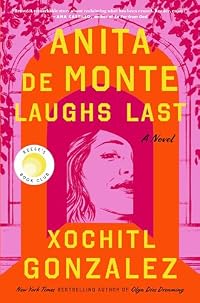
Anita de Monte Laughs Last
by Xochitl Gonzalez
On This Page
Description
"Who gets to leave a legacy? 1985. Anita de Monte, a rising star in the art world, is found dead in New York City; her tragic death is the talk of the town. Until it isn't. By 1998 Anita's name has been all but forgotten - certainly by the time Raquel, a third-year art history student is preparing her final thesis. On College Hill, surrounded by progeny of film producers, C-Suite executives, and international art-dealers, most of whom float through life knowing that their futures are show more secured, Raquel feels herself an outsider. Students of color, like Raquel, are the minority there, and the pressure to work twice as hard for the same opportunities is no secret. But when Raquel becomes romantically involved with a well-connected older art student, she finds herself unexpectedly rising up the social ranks. As she attempts to straddle both worlds, she stumbles upon Anita's story, raising questions about the dynamics of her own relationship, which eerily mirrors that of the forgotten artist. Moving back and forth through time and told from the perspectives of both women, Anita de Monte Laughs Last, is a propulsive, witty examination of power, love, and art, daring to ask who gets to be remembered and who is left behind in the rarefied world of the elite"-- show lessTags
Recommendations










Member Reviews
Anita de Monte Laughs Last is a multi-pov book following Anita de Monte and her husband Jack after Jack murders Anita and Raquel as she completes her undergraduate degree doing research on Jack. Little bits of ghosts and vengeance are interspersed with the bulk of the novel, breaking up the more serious topics of racism and classism in the art world. While I know many people did not like the ghosts and vengeance parts of the story, I actually quite enjoyed them.
Based quite directly off of Ana Mendieta, a real-life Cuban artist who was killed in the same way by her husband, Anita de Monte discusses her hardships enduring domestic violence, racism within the art world, and her up-and-coming art career. I was disappointed that the only show more mention of Ana Mendieta we ever got was a first-name in the dedication and that apparently, Mendieta's family was never contacted in the making of this book. Off the top of my head, I can think of at least two places in the novel itself (excluding a potential dedication, afterword, or acknowledgments) in which she could have easily directly named Ana Mendieta. However, I am choosing to not let that affect my rating of the book, as this is something many White authors get away with, and Gonzalez seems to be getting much more pushback on this than a White author would have.
Maybe I am only seeing the parallels because I read this so soon after reading Seven Husbands of Evelyn Hugo by Taylor Jenkins Reid (a book I hated, by the way), but Anita de Monte Laughs Last is everything Seven Husbands DREAMED of being. While it may not be nearly as chronically readable, it has the same idea of investigative journalism with the character Raquel, but it actually dives into the characters much more thoroughly and allows us to learn who these people actually are. It also is much more thorough in its discussion of the systematic oppression and exploitation of women of color in the art world, which added the needed depth to this novel.
I loved this book through the whole thing, and cried my way through the last 50 or so pages. show less
Based quite directly off of Ana Mendieta, a real-life Cuban artist who was killed in the same way by her husband, Anita de Monte discusses her hardships enduring domestic violence, racism within the art world, and her up-and-coming art career. I was disappointed that the only show more mention of Ana Mendieta we ever got was a first-name in the dedication and that apparently, Mendieta's family was never contacted in the making of this book. Off the top of my head, I can think of at least two places in the novel itself (excluding a potential dedication, afterword, or acknowledgments) in which she could have easily directly named Ana Mendieta. However, I am choosing to not let that affect my rating of the book, as this is something many White authors get away with, and Gonzalez seems to be getting much more pushback on this than a White author would have.
Maybe I am only seeing the parallels because I read this so soon after reading Seven Husbands of Evelyn Hugo by Taylor Jenkins Reid (a book I hated, by the way), but Anita de Monte Laughs Last is everything Seven Husbands DREAMED of being. While it may not be nearly as chronically readable, it has the same idea of investigative journalism with the character Raquel, but it actually dives into the characters much more thoroughly and allows us to learn who these people actually are. It also is much more thorough in its discussion of the systematic oppression and exploitation of women of color in the art world, which added the needed depth to this novel.
I loved this book through the whole thing, and cried my way through the last 50 or so pages. show less
Here, Xochitl Gonzalez takes the true story of Ana Mendieta, the Cuban-American artist who was allegedly pushed from the 34th floor apartment by her husband, the artist Carl Andre, in 1985 and changes the names and some details and creates a vivid reimagining of the artist's life and adds a supernatural element. Next to this story, which has been the subject of some controversy, sits another story, this time set a decade later, about an art history student who is working on her thesis when she discovers Anita de Monte's work. Raquel is Nuyorican, a fish out of water on the well-heeled grounds of Brown University, falling in love with an art major and figuring out how her blue collar roots fit into her new world.
Usually, a novel using show more two time lines, means that one of the storylines will be far more interesting than the other. Gonzalez manages to make Raquel's story as fascinating as Anita's. We know how Anita's story ends, for the most part, but Raquel's story has the element of surprise. Gonzalez's writing is assured and she keeps both stories moving along in tandem so that they enhance each other. While the ending denied Raquel the opportunity to choose her own path forward and leaned towards the supernatural in a way that took away from both women's stories, I still found this to be an extraordinary book. show less
Usually, a novel using show more two time lines, means that one of the storylines will be far more interesting than the other. Gonzalez manages to make Raquel's story as fascinating as Anita's. We know how Anita's story ends, for the most part, but Raquel's story has the element of surprise. Gonzalez's writing is assured and she keeps both stories moving along in tandem so that they enhance each other. While the ending denied Raquel the opportunity to choose her own path forward and leaned towards the supernatural in a way that took away from both women's stories, I still found this to be an extraordinary book. show less
I was enticed to read this book because of its connection to Ana Mendieta and Carl Andre. Unfortunately, I found it disappointing. I think the author had an interesting concept and she did her research. It was reasonably well-written. On the other hand, it felt at times very trite and somewhat stereotyped —particularly when she tried to wax eloquent on the issues of domestic violence, body dysmorphia, gender and cultural biases in the art world writ large, and socioeconomic and white privilege.
Xochitl Gonzalez delivers a powerful novel about art, race, class, and feminism with her latest book, Anita de Monte Laughs Last. In the 1980s, Anita de Monte is making a name for herself in the art world when she falls for the famous sculptor, Jack Martin, and slowly begins to lose herself. 15 years later, Raquel is studying art history at Brown and writing her thesis about Martin when she begins to see there might be another story there. Gonzalez goes back and forth between the two eras and the two Latina women’s voices as they struggle with similar challenges. Readers who enjoy strong female characters and don’t mind a hint of magical realism will definitely want to read this imaginative spin on the New York art world and who show more gets the power. show less
We begin in 1985, on the night that Anita de Monte will die. She's a rising star in the art world, but people are beginning to wonder how much longer she can continue being "rising" without doing something that lives up to her early promise. That growing disappointment is only strengthened when she's compared to her husband, Jack Martin, one of the world's most respected sculptors. (Anita's story is inspired by the life and death of Cuban-American artist Ana Mendieta.)
In 1998, Raquel Toro is an art history student at Brown. Her thesis advisor specializes in the work of Jack Martin, and Raquel is trying to find a new angle on Martin for her honors thesis. It's not that she's particularly interested in his work, but she doesn't have show more anything else that she feels strongly about, and surely Professor Temple's connections and resources that will help her come up with something interesting.
Gonzalez jumps back and forth between these two women, drawing increasingly ham-fisted parallels between them, most obviously in their romantic lives. Both are involved with white men who seem to think of them mostly as beautiful, exotic accessories, and who treat them in ways that at least border on the abusive.
This isn't bad writing; Gonzalez's prose flows gracefully; her characters are, though somewhat stereotypical, fairly vivid creations; and it's easy enough to keep turning the pages from chapter to chapter. But ultimately, the story doesn't add up to much, and while I'm certainly not going to argue that racism isn't a thing, Gonzalez comes awfully close to reducing the problem to "POC good, white people bad." And I really disliked the supernatural twist that dominates the second half of the novel, which comes out of nowhere and drastically changes the tone.
Didn't hate the book, didn't love it. A resounding meh. show less
In 1998, Raquel Toro is an art history student at Brown. Her thesis advisor specializes in the work of Jack Martin, and Raquel is trying to find a new angle on Martin for her honors thesis. It's not that she's particularly interested in his work, but she doesn't have show more anything else that she feels strongly about, and surely Professor Temple's connections and resources that will help her come up with something interesting.
Gonzalez jumps back and forth between these two women, drawing increasingly ham-fisted parallels between them, most obviously in their romantic lives. Both are involved with white men who seem to think of them mostly as beautiful, exotic accessories, and who treat them in ways that at least border on the abusive.
This isn't bad writing; Gonzalez's prose flows gracefully; her characters are, though somewhat stereotypical, fairly vivid creations; and it's easy enough to keep turning the pages from chapter to chapter. But ultimately, the story doesn't add up to much, and while I'm certainly not going to argue that racism isn't a thing, Gonzalez comes awfully close to reducing the problem to "POC good, white people bad." And I really disliked the supernatural twist that dominates the second half of the novel, which comes out of nowhere and drastically changes the tone.
Didn't hate the book, didn't love it. A resounding meh. show less
Slow start but I fell in love with these two feisty courageous women from different decades half way through the book. This is a book about gender politics, misogyny, art and self discovery of two Latina women artists. The two white male protagonists are sincerely confident of their mathematical precise art while they silently and painfully, through their actions, ridicule the more emotional art of their partners. Characters are Jack and Anita de Montez in the 1980’s and in the late 1990’s and Nick, the wealthy guy propped up by his snotty mother of NYC and the Hamptons, and Raquel.
I was disappointed to learn that the story is based on a true story of Ana Mendieta, who was given no recognition by the author or publisher.
I was disappointed to learn that the story is based on a true story of Ana Mendieta, who was given no recognition by the author or publisher.
I listened to this novel as an audiobook and it was the best adaptation of a book I've ever listened to. If Oscar's can be given to audiobook readers than the actress reading Anita deserves a dozen Oscar's. FAST FAST FAST!
Riveting and entertaining as well as so truly representing what keeps people staying in toxic entanglement.
Riveting and entertaining as well as so truly representing what keeps people staying in toxic entanglement.
Members
- Recently Added By
Lists

Library ebooks and electronic audio books
52 works; 1 member

Books Read in 2024
4,623 works; 126 members

May Books
5 works; 1 member

2025 Notable Books for Adults
26 works; 1 member

Reese Witherspoon Book Club
100 works; 3 members

Reese's Book Club
122 works; 2 members

Books Read in 2025
4,090 works; 97 members
Author Information

3+ Works 2,036 Members
Some Editions
Awards and Honors
Common Knowledge
- Canonical title
- Anita de Monte Laughs Last
- People/Characters
- Anita de Monte; Jack Martin; Raquel Toro; Nick Fitzsimmons; Professor John Temple
- Epigraph
- Why, indeed, should one not include artists who
embody very different sensibilities from that of the
European and the mainstream? There is, in principle, no
reason to exlude them whatsoever. However, I have
de... (show all)cided to limit this edition to Western art ... I have
taken a stand about what art I think is most significant
that not all readers will agree with, since it favors
universality over ethnocentricity.
—Anthony F. Janson
From the Preface of the Fifth Edition of
History of Art, Volume II
H. N. Abrams, 1994 - Dedication
- In memory of Ana
And all the women who endured solitude
never knowing the rest of us were out there - First words
- If it weren't for what happened later, everyone would have forgotten that night entirely.
- Quotations
- The only thing that made Raquel more uncomfortable than being with Professor Temple in his office was being with Professor Temple in any setting that was not the classroom.
To matter to another human being is the basis of having a life.
Here's what I'd already discovered in Cuba: nearly everything that seemed impossible—making salacious art, speaking your mind, owning Miami Sound Machine records—had a work-around. For a price, of course.
For some, the distance between deciding and doing is a wide gulf. - Last words
- (Click to show. Warning: May contain spoilers.)And sometimes, when I am feeling particularly grateful and tender for her helping bring my babies back—energy!—well, sometimes I fly past her apartment in New York and bring her a little mouse.
Classifications
Statistics
- Members
- 620
- Popularity
- 46,825
- Reviews
- 12
- Rating
- (3.99)
- Languages
- English
- Media
- Paper, Audiobook, Ebook
- ISBNs
- 13
- ASINs
- 4