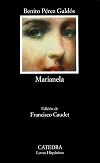
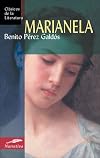
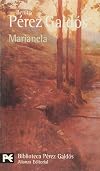
Marianela
by Benito Pérez-Galdós
On This Page
Description
Marianela, a poor orphan who has been disfigured in an accident, develops a special relationship with Pablo, a handsome blind man. When Pablo recovers his eyesight, Marianela's fragile world is shattered. This annotated edition includes information on Galdos and his time. Text copyright 2004 Lectorum Publications, Inc.Tags
Recommendations


















Member Reviews
Marianela" (1878) pertenece a lo que Galdós llamó "Novelas de la Primera época" (que comprenden obras como "Doña Perfecta" y "Gloria"). Partiendo de un caso extraído de un tratado de Psicología (la recuperación de la visión en un ciego congénito), Galdós creó una de sus novelas más famosas. La vida trágica de la muchacha Nela, fea y deforme, enamorada del ciego Pablo a quien sirve de lazarillo, es el hilo conductor sobre el que se entrelazan tres temas: la ceguera y su posible cura, la relación sentimental y la situación socioeconómica. La maestría del escritor canario se demuestra en la articulación narrativa de las oposiciones principales: belleza física y belleza moral; industria y agricultura, el hoy y el ayer; show more cultura y naturaleza. La relación del ciego con su lazarillo ha quedado como una de las más bellas surgidas de la pluma de Galdós. show less
La opresión colmada de ironía que nos imponen nuestras concepciones heredadas. No me quiero imaginar lo que hubiera sido este libro si Kafka lo hubiese terminado.
El libro es muy bueno, me gusta mucho el como se describen a los personajes.
Spanish Reader
Pérez Galdós solo necesita unas pocas páginas para crear un conflicto que engancha, invita a reflexionar y produce sentimientos de toda índole al mismo tiempo. La historia de la pobre Marianela, cuyo potencial y bondad nunca llegan a ser reconocidos por aspectos superficiales como su pobreza y su físico, removerá más de una conciencia.
El autor logra involucrar al lector gracias a una cuidada creación de personajes: no solo Marianela destaca por su realismo, sino que cada uno de los secundarios que la acompañan podrían pasar por personas de nuestro día a día.
El autor logra involucrar al lector gracias a una cuidada creación de personajes: no solo Marianela destaca por su realismo, sino que cada uno de los secundarios que la acompañan podrían pasar por personas de nuestro día a día.
May 27, 2025Spanish
Members
- Recently Added By
Author Information

608+ Works 9,565 Members
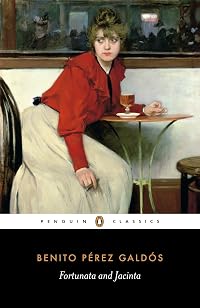
Perez Galdos was Spain's outstanding nineteenth-century novelist. At a time when most Spanish novelists were limited by their regional backgrounds, Galdos possessed the intellect and vision to embrace the Spanish people as a nation. In 1873 he began the Episodios nacionales (National Episodes), a 46--volume series of historical novels in which he show more was concerned less with details and facts of history than with their impact on the lives of ordinary people. His works are sometimes divided into two periods: novels of the first period and contemporary Spanish novels. His early novels, Dona Perfecta (1876), Gloria (1877), Marianela (1878), and The Family of Leon Roch (1879), may be characterized as realistic with touches of romanticism. The novels are united by common characters and themes in the manner of Balzac's Human Comedy. Dona Perfecta is a denunciation of intolerance. Marianela explores the irony and tragedy of the destruction of love by scientific progress. Fortunata and Jacinta (1886-87), a four-volume masterpiece of the second period, contrasts two women - Jacinta, wife of the wealthy middle-class Juanito Santa Cruz, and Fortunata, his mistress. Both are admirable characters, but it is Fortunata who bears a son, demonstrating the vitality of the lower classes. The character of Maxi reveals Galdos's interest in mental illness and his naturalistic strain. Born and educated in the Canary Islands, Perez Galdos studied law briefly and spent most of his adult life in Madrid. His study of lower-class Spanish life and his attempts to improve it led him to the advocacy of more equal distribution of wealth and outspoken opposition to the Catholic church. While always popular with the people, he fared less well in literary circles. In 1889 he sought admission to the Royal Academy, an honor he was refused until 1897, and the Nobel Prize went to a contemporary, Jose Echegaray, a writer of considerably less talent. Galdos died poor and blind. Although the government refused him a state funeral, the entire Spanish nation mourned him. English translations of his novels now out of print are The Disinherited Lady (1881), Miau (1888), Compassion (1897), and Tristana. (Bowker Author Biography) show less
Some Editions
Series
Belongs to Publisher Series
Work Relationships
Has the adaptation
Has as a student's study guide
Common Knowledge
- Original title
- Marianela
- Original publication date
- 1878 (original Spanish) (original Spanish)
- People/Characters*
- Marianela (Nela); Pablo
- Important places*
- Spanje
- Related movies*
- Marianela (1940 | IMDb); Marianela (1955 | IMDb); Marianela (1972 | IMDb); Marianela (1976 | IMDb); Marianela (1961 | IMDb); Marianela (1993 | IMDb) (show all 7); Marianela (1964 | IMDb)
- Original language*
- Español
*Some information comes from Common Knowledge in other languages. Click "Edit" for more information.
Classifications
Statistics
- Members
- 728
- Popularity
- 38,808
- Reviews
- 15
- Rating
- (3.64)
- Languages
- 7 — Dutch, English, French, German, Italian, Spanish, Swedish
- Media
- Paper, Audiobook, Ebook
- ISBNs
- 125
- ASINs
- 20