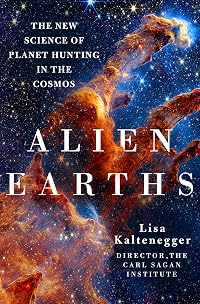
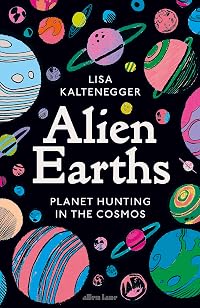
Alien Earths: The New Science of Planet Hunting in the Cosmos
by Dr. Lisa Kaltenegger
On This Page
Description
"Riveting and timely, a look at the research that is transforming our understanding of the cosmos in the quest to discover whether we are alone. For thousands of years, humans have wondered whether we're alone in the cosmos. Now, for the first time, we have the technology to investigate. But once you look for life elsewhere, you realize it is not so simple. How do you find it over cosmic distances? What actually is life? As founding director of Cornell University's Carl Sagan Institute, show more astrophysicist Lisa Kaltenegger has built a team of tenacious scientists from many disciplines to create a specialized toolkit to find life on faraway worlds. In Alien Earths, she demonstrates how we can use our homeworld as a Rosetta Stone, creatively analyzing Earth's history and its astonishing biosphere to inform this search. With infectious enthusiasm, she takes us on an eye-opening journey to the most unusual exoplanets that have shaken our worldview - planets covered in oceans of lava, lonely wanderers lost in space, and others with more than one sun in their sky! And the best contenders for Alien Earths. We also see the imagined worlds of science fiction and how close they come to reality. With the James Webb Space Telescope and Dr. Kaltenegger's pioneering work, she shows that we live in an incredible new epoch of exploration. As our witty and knowledgeable tour guide, Dr. Kaltenegger shows how we discover not merely new continents, like the explorers of old, but whole new worlds circling other stars and how we could spot life there. Worlds from where aliens may even be gazing back at us. What if we're not alone?"-- show lessTags
Recommendations









Member Reviews
Alien Earths by Lisa Kaltenegger is an informative and very accessible introduction to the current state of the search for exoplanets and life in the universe.
Like every science book written for a broad general readership there is a frame which allows for the relatively jargon-free explanations. In this case much of the frame consists of the author's experience as a student, professor, and researcher. This lets her inform us without lecturing to us, since she is telling us how these topics are addressed in a classroom or research situation.
Even with several courses (mostly MOOCs with just a couple very long ago IRL courses) under my belt I found the refresher course elements engaging and the new information exciting. This is not, nor show more is it intended to be, exhaustive or comprehensive, but it offers any reader with an interest a solid understanding of what approaches, both new and old, go into the search for life elsewhere in the universe.
The big takeaway from the book is the fact that this search has to be interdisciplinary and not only looking outward. Understanding how our planet changed over time is essential to understanding what we might see when we look at distant planets. Might it be progressing toward an atmosphere like ours? Might it already be past where we are? And what are the factors that contribute to these scenarios? If you think this is or even should be just another book about astrophysics, you're both mistaken and completely missed the point of the book.
Highly recommended for readers wanting to know where we stand in this area. As long as you're not overly (and disingenuously) concerned with a few grammar errors (especially in an advanced review copy, for goodness sake) or have your insecurities triggered by mention of major universities, you will find a lot to enjoy here.
Reviewed from a copy made available by the publisher via NetGalley. show less
Like every science book written for a broad general readership there is a frame which allows for the relatively jargon-free explanations. In this case much of the frame consists of the author's experience as a student, professor, and researcher. This lets her inform us without lecturing to us, since she is telling us how these topics are addressed in a classroom or research situation.
Even with several courses (mostly MOOCs with just a couple very long ago IRL courses) under my belt I found the refresher course elements engaging and the new information exciting. This is not, nor show more is it intended to be, exhaustive or comprehensive, but it offers any reader with an interest a solid understanding of what approaches, both new and old, go into the search for life elsewhere in the universe.
The big takeaway from the book is the fact that this search has to be interdisciplinary and not only looking outward. Understanding how our planet changed over time is essential to understanding what we might see when we look at distant planets. Might it be progressing toward an atmosphere like ours? Might it already be past where we are? And what are the factors that contribute to these scenarios? If you think this is or even should be just another book about astrophysics, you're both mistaken and completely missed the point of the book.
Highly recommended for readers wanting to know where we stand in this area. As long as you're not overly (and disingenuously) concerned with a few grammar errors (especially in an advanced review copy, for goodness sake) or have your insecurities triggered by mention of major universities, you will find a lot to enjoy here.
Reviewed from a copy made available by the publisher via NetGalley. show less
I remember being about nine years old and sitting with the son of family friends, discussing if there was life in outer space somewhere. We were both sure there was. Sixty some years later, science has yet to pin down a definitive answer to the question, but I don’t expect to be visited by War of the World type Martians or the giant robot from The Day the Earth Stood Still. What can we expect? And would alien life be recognizable to us any more than we could recognize it?
My world began as a small town, but it grew to encompass the whole globe, then reached into the cosmos, with new planets to explore in whatever way possible.
from Alien Earths by D.r Lisa Kaltenegger
Alien Earths shares Dr. Lisa Kaltenegger’s quest to discover life in show more the cosmos. She asks important questions. What is life? What is a habitable world? How does one look for life in the cosmos? She explains the concepts with illustrations geared to the non-scientist.
The author also addresses the difficult environment female scientists face their entire life, counselors and educators and peers entrenched in the belief that women are incapable of making a career in the natural sciences.
Are we alone in the universe? ANd if not, how do we find other life-forms? To me, these are two of the most intriguing questions in science.
from Alien Worlds by Dr. Lisa Kaltenegger
Descriptions of alien worlds and the mysteries of life and the universe spur the imagination. We are taken across the known universe as she imagines the environments of other planets.
“If someone has found us already,” she ends, considering how we have impacted our planet for the worse, “I wonder what they think of us.”
Thanks to the publisher for a free book. show less
My world began as a small town, but it grew to encompass the whole globe, then reached into the cosmos, with new planets to explore in whatever way possible.
from Alien Earths by D.r Lisa Kaltenegger
Alien Earths shares Dr. Lisa Kaltenegger’s quest to discover life in show more the cosmos. She asks important questions. What is life? What is a habitable world? How does one look for life in the cosmos? She explains the concepts with illustrations geared to the non-scientist.
The author also addresses the difficult environment female scientists face their entire life, counselors and educators and peers entrenched in the belief that women are incapable of making a career in the natural sciences.
Are we alone in the universe? ANd if not, how do we find other life-forms? To me, these are two of the most intriguing questions in science.
from Alien Worlds by Dr. Lisa Kaltenegger
Descriptions of alien worlds and the mysteries of life and the universe spur the imagination. We are taken across the known universe as she imagines the environments of other planets.
“If someone has found us already,” she ends, considering how we have impacted our planet for the worse, “I wonder what they think of us.”
Thanks to the publisher for a free book. show less
Sought out after American Scientist review. A fitting effort from the director of the Carl Sagan Institute at Cornell.
A review of the current state of astrobiology, complete with a question I hadn't really considered - yes, we have to figure out _how_ to detect alien words with an _n_ of one to compare them to - but our Earth has certainly changed over its journey, from w billion years of no free oxygen to two billion years of being oxygen rich! The timeline matters greatly.
The author's anecdotes liven the journey and make for an enjoyable distraction.
A review of the current state of astrobiology, complete with a question I hadn't really considered - yes, we have to figure out _how_ to detect alien words with an _n_ of one to compare them to - but our Earth has certainly changed over its journey, from w billion years of no free oxygen to two billion years of being oxygen rich! The timeline matters greatly.
The author's anecdotes liven the journey and make for an enjoyable distraction.
It’s one big mystery: life on other planets. Lisa Kaltenegger gives us a fascinating and comprehensible look at unexpected discoveries in the universe. For anyone that thinks this is a “stuffy and rigid” subject, she will prove you wrong with all sorts of ways astronomers are exploring new planets with advanced technology.
She explained how Earth has changed from a billion years ago. Kaltenegger makes comparisons that are simple to understand. Who would have ever thought about raisin bread and the big bang explosion? She said at first the raisins are close together. Then when dough rises, the raisins spread out just like the stars in the universe. This made me smile.
This book engages readers to learn and understand more about show more Earth, Jupiter, Saturn, the Moon and Sun along with other surrounding planets outside of our solar system. She answers questions like: What is the meaning of tardigrades on the moon? How does one search for life in the cosmos? What is the significance of posters at an international collaboration with scientists? Why is it impossible for humans to live on almost all other planets?
Kaltenegger talks about her work as the Director at the Carl Sagan Institute at Cornell. She says it wasn’t easy as a female to advance with this type of career. However, at 46 years old, her accomplishments are impressive. She hopes that someday there will be a way of space traveling safely to areas where we can only dream about now.
This is an easy-to-read, interesting book. The only thing missing is the visual look at what she’s describing which is why she has a big following at live presentations. I love her comments about science fiction books and movies. While there hasn’t been proof yet of other types of life, she notes that with 200 billion stars in our galaxy, it’s just a matter of time when it happens.
My thanks to St. Martin’s Press and NetGalley for providing me with an advanced copy of this book with an expected release date of April 16, 2024. show less
She explained how Earth has changed from a billion years ago. Kaltenegger makes comparisons that are simple to understand. Who would have ever thought about raisin bread and the big bang explosion? She said at first the raisins are close together. Then when dough rises, the raisins spread out just like the stars in the universe. This made me smile.
This book engages readers to learn and understand more about show more Earth, Jupiter, Saturn, the Moon and Sun along with other surrounding planets outside of our solar system. She answers questions like: What is the meaning of tardigrades on the moon? How does one search for life in the cosmos? What is the significance of posters at an international collaboration with scientists? Why is it impossible for humans to live on almost all other planets?
Kaltenegger talks about her work as the Director at the Carl Sagan Institute at Cornell. She says it wasn’t easy as a female to advance with this type of career. However, at 46 years old, her accomplishments are impressive. She hopes that someday there will be a way of space traveling safely to areas where we can only dream about now.
This is an easy-to-read, interesting book. The only thing missing is the visual look at what she’s describing which is why she has a big following at live presentations. I love her comments about science fiction books and movies. While there hasn’t been proof yet of other types of life, she notes that with 200 billion stars in our galaxy, it’s just a matter of time when it happens.
My thanks to St. Martin’s Press and NetGalley for providing me with an advanced copy of this book with an expected release date of April 16, 2024. show less
I am enjoying this accessible, concise read, but I have to say that I knew most of the cosmological stuff going in, and I had to be patient to get to the meat of what the title references. The sub-title is more accurate, as the fact is that we just don't know much.
Meanwhile, I did learn a few things:
"Hotter, less dense material [inside the Earth] rises, and cooler, denser material sinks... generating the electric dynamo that powers Earth's magnetic field."
"The Moon formed around 15,000 miles from Earth's surface, about twice the distance from L.A. to Sydney. But today, the Moon is about 15 times farther away... "
"All proteins in living organisms are built from the same 22 amino acids, although there are more than 500 other show more possibilities.... If life were to evolve somewhere else, would other recipes also work?"
[a:Andy Weir|6540057|Andy Weir|https://images.gr-assets.com/authors/1382592903p2/6540057.jpg] "knowingly fudged" ... "In Mars's thin atmosphere, even a giant storm's 100 mile an hour winds would feel like a gentle breeze."
Also, I think I want to read [b:The Demon-Haunted World: Science as a Candle in the Dark|17349|The Demon-Haunted World Science as a Candle in the Dark|Carl Sagan|https://i.gr-assets.com/images/S/compressed.photo.goodreads.com/books/1553691804l/17349._SX50_.jpg|252618]. The author is a huge fan of Sagan, and I was too, but I didn't read his books back when I should have.
I'm glad that the author explicitly states, "Whatever you evolve for, that is your normal." Even so-called 'extremophiles' are happy where they are, and would, if they could, pity us for the conditions that we have to cope with.
Speaking of coping with adverse conditions, there is some narrative and some personal history in this book, and the author has had to deal with some sexist senior scientists. Yes, still. Fortunately, she also has advice:
"In situations like this, I cling to a German proverb [insufficiently translated as] 'Don't get upset; instead, wonder why.'... While it might be counterintuitive, this practice causes me to focus on other people's motivations, to question how people arrive at their view of the world. Switching my perspective helps me to get not too frustrated.... [But] how many brilliant ideas and discoveries have already been lost because gifted young women had to use most of their energy to fight to be even allowed to do research? ...
"People from all backgrounds, cultures, and genders are needed, in the hope that in pooling our different perspectives we will broaden the scope of our thinking and expertise sufficiently to make the breakthroughs we need." (italics mine)
(Of course that applies in all fields. Not just astronomy, not just science & engineering like the problems of coping with or mitigating climate change (for example), but basic problems of civilization such as not letting crazy people have access to machine-guns so they can kill people at a political rally.
Brian May, of the rock band Queen, holds a Ph.D. in astronomy and cofounded Starmus.
Speaking of diversity of perspectives, Kaltenegger's team at Cornell has representatives from 15 different departments, including music and the performing arts.
Kepler-64 b is a planet that circles a double-star system, which in turn orbits another pair of stars. Space may be nearly empty in some respects, but it's not tidy!
Tau Ceti and 40 Eridani, included in [b:Project Hail Mary|54493401|Project Hail Mary|Andy Weir|https://i.gr-assets.com/images/S/compressed.photo.goodreads.com/books/1597695864l/54493401._SY75_.jpg|79106958], are "interesting real host stars with known exoplanets." Tau Ceti in particular has intrigued SF writers since at least the 1950s, as it's only 12 light years away. The author spends a few pages talking about other SF connections to known space.
And finally, almost worth reading the whole book for, a revelation. Where is everybody? Well, the mystery can partly be explained by the fact that signals take time to travel. We on Earth have only been possibly interesting to 'aliens' for maybe about a century. So, any aliens who are scanning the skies but more than 100 light years away from us won't know that we've already become interesting. I mean, I knew that, and probably you did, too, but I never connected the pieces of the puzzle before.
Overall, the progression, the pace, of the book ranges from interesting to fascinating and back again. But unfortunately I'm left feeling so dissatisfied that I'm not glad that I read it, and can't quite recommend it. We just don't know enough yet, and must remember to keep funding STEM and making sure to encourage people from all backgrounds to use their abilities fully. show less
Meanwhile, I did learn a few things:
"Hotter, less dense material [inside the Earth] rises, and cooler, denser material sinks... generating the electric dynamo that powers Earth's magnetic field."
"The Moon formed around 15,000 miles from Earth's surface, about twice the distance from L.A. to Sydney. But today, the Moon is about 15 times farther away... "
"All proteins in living organisms are built from the same 22 amino acids, although there are more than 500 other show more possibilities.... If life were to evolve somewhere else, would other recipes also work?"
[a:Andy Weir|6540057|Andy Weir|https://images.gr-assets.com/authors/1382592903p2/6540057.jpg] "knowingly fudged" ... "In Mars's thin atmosphere, even a giant storm's 100 mile an hour winds would feel like a gentle breeze."
Also, I think I want to read [b:The Demon-Haunted World: Science as a Candle in the Dark|17349|The Demon-Haunted World Science as a Candle in the Dark|Carl Sagan|https://i.gr-assets.com/images/S/compressed.photo.goodreads.com/books/1553691804l/17349._SX50_.jpg|252618]. The author is a huge fan of Sagan, and I was too, but I didn't read his books back when I should have.
I'm glad that the author explicitly states, "Whatever you evolve for, that is your normal." Even so-called 'extremophiles' are happy where they are, and would, if they could, pity us for the conditions that we have to cope with.
Speaking of coping with adverse conditions, there is some narrative and some personal history in this book, and the author has had to deal with some sexist senior scientists. Yes, still. Fortunately, she also has advice:
"In situations like this, I cling to a German proverb [insufficiently translated as] 'Don't get upset; instead, wonder why.'... While it might be counterintuitive, this practice causes me to focus on other people's motivations, to question how people arrive at their view of the world. Switching my perspective helps me to get not too frustrated.... [But] how many brilliant ideas and discoveries have already been lost because gifted young women had to use most of their energy to fight to be even allowed to do research? ...
"People from all backgrounds, cultures, and genders are needed, in the hope that in pooling our different perspectives we will broaden the scope of our thinking and expertise sufficiently to make the breakthroughs we need." (italics mine)
(Of course that applies in all fields. Not just astronomy, not just science & engineering like the problems of coping with or mitigating climate change (for example), but basic problems of civilization such as not letting crazy people have access to machine-guns so they can kill people at a political rally.
Brian May, of the rock band Queen, holds a Ph.D. in astronomy and cofounded Starmus.
Speaking of diversity of perspectives, Kaltenegger's team at Cornell has representatives from 15 different departments, including music and the performing arts.
Kepler-64 b is a planet that circles a double-star system, which in turn orbits another pair of stars. Space may be nearly empty in some respects, but it's not tidy!
Tau Ceti and 40 Eridani, included in [b:Project Hail Mary|54493401|Project Hail Mary|Andy Weir|https://i.gr-assets.com/images/S/compressed.photo.goodreads.com/books/1597695864l/54493401._SY75_.jpg|79106958], are "interesting real host stars with known exoplanets." Tau Ceti in particular has intrigued SF writers since at least the 1950s, as it's only 12 light years away. The author spends a few pages talking about other SF connections to known space.
And finally, almost worth reading the whole book for, a revelation. Where is everybody? Well, the mystery can partly be explained by the fact that signals take time to travel. We on Earth have only been possibly interesting to 'aliens' for maybe about a century. So, any aliens who are scanning the skies but more than 100 light years away from us won't know that we've already become interesting. I mean, I knew that, and probably you did, too, but I never connected the pieces of the puzzle before.
Overall, the progression, the pace, of the book ranges from interesting to fascinating and back again. But unfortunately I'm left feeling so dissatisfied that I'm not glad that I read it, and can't quite recommend it. We just don't know enough yet, and must remember to keep funding STEM and making sure to encourage people from all backgrounds to use their abilities fully. show less
An interesting read that does a good job of explaining the cosmos in relatable terms. If you're someone interested in space (and you must be because you're reading this), you may enjoy it. She also references a Monty Python song, so there's that too. I give it 4 earth's rotations out of 5 earth's rotations (at 900 miles an hour).
A bit basic, but provides an excellent introduction to the topic for younger readers or people who are just getting interested in exoplanets.
Members
- Recently Added By
Lists

Science: Astronomy
62 works; 2 members

Books Read in 2024
4,727 works; 128 members
Author Information

2 Works 120 Members
Awards and Honors
Distinctions
Common Knowledge
- Original language
- English
Classifications
Statistics
- Members
- 117
- Popularity
- 279,006
- Reviews
- 9
- Rating
- (3.81)
- Languages
- English
- Media
- Paper, Audiobook, Ebook
- ISBNs
- 3
- ASINs
- 1