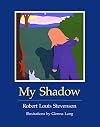
My Shadow
by Robert Louis Stevenson
On This Page
Description
An illustrated version of the poem in which a child describes her relationship with her shadow.Tags
Recommendations
Member Reviews
This was a fun poem and the mouse illustrations certainly lend to that, but I wasn't particularly moved by the book as a whole. It's a nice book, and it could be a lot of fun to share it with the right audience of children, but it wasn't particularly memorable.
I loved this book! It was a super cute, short poem. The author focused on rhyming, so it kind of had a little tune to it. I really liked this book because it actually made sense. The rhymes were perfect, and the way the shadow is shown, it is relevant to people. I can relate to this book because shadows are so silly and this book really shows what shadows are.
This book illustrates Robert Louis Stevenson's poem, My Shadow. The illustrations bring the words to life. They depict children from all over the world doing activies while acompanied by their shadow. The AABB repitition gives the book a sing song feel and would be great to teach kids some fluency patterns for this type of poem. The words on each page are limited and the illustrations will expand the meaning of the text.. It could be a great read aloud when teaching about a light or shaodows, as well as perspective taking. The reader personifies their shadow. There are some higher level vocabulary words that could be good examples of how to use context clues to figure out unknown words. Te book is rich in text and the illustrations are show more beautiful. I would use this book with children up to sixth grade. show less
This is a very cute book that would be great for a younger audience. The illustrations were awesome. This book is about a young boy who refers to a shadow almost as if they are a person, coming out during the day but lazy and sleeps at night. You could use this to talk about shadows and how they are made and when the sun sets were a shadow goes.
This picture-book edition of Stevenson's poem is a good introduction to classic poetry for young readers.
This poem talks about a shadow that is with someone everyday except when the sun was not up. He says he walks, sleeps, and plays with him. The shadow is lazy, a coward, and is different sizes everyday.
My reaction is this poem is really cute and innocent. The thought is from a perspective of someone that does not know or understand what a shadow is. This poem also rhymes.
This book could be good around ground hog day. There is a lot of talk about whether more winter or spring will arive. This poem could also create a project to go outside when it is sunny then when there is no sun to see what the poem is saying when his shadow supposively goes to sleep
My reaction is this poem is really cute and innocent. The thought is from a perspective of someone that does not know or understand what a shadow is. This poem also rhymes.
This book could be good around ground hog day. There is a lot of talk about whether more winter or spring will arive. This poem could also create a project to go outside when it is sunny then when there is no sun to see what the poem is saying when his shadow supposively goes to sleep
My Shadow by Robert Louis Stevenson
Summary:
This poem tells about a kid describing his shadow. He doesn’t know it his shadow; he just makes fun of it. Throughout the poem he says a lot of different and interesting things about his shadow.
Personal Reaction:
I think this is a very cute poem. I think it is for young readers. It could be a good poem for teaching young kids about their shadows.
Classroom Extension ideas:
1. Have children draw pictures of what their shadows do.
2. Ask children about times that their shadow has maybe scared or surprised them.
Summary:
This poem tells about a kid describing his shadow. He doesn’t know it his shadow; he just makes fun of it. Throughout the poem he says a lot of different and interesting things about his shadow.
Personal Reaction:
I think this is a very cute poem. I think it is for young readers. It could be a good poem for teaching young kids about their shadows.
Classroom Extension ideas:
1. Have children draw pictures of what their shadows do.
2. Ask children about times that their shadow has maybe scared or surprised them.
Members
- Recently Added By
Lists

My Shadow (recc book titles)
12 works; 1 member
Author Information

2,802+ Works 139,384 Members
Novelist, poet, and essayist Robert Louis Stevenson was born in Edinburgh, Scotland. A sickly child, Stevenson was an invalid for part of his childhood and remained in ill health throughout his life. He began studying engineering at Edinburgh University but soon switched to law. His true inclination, however, was for writing. For several years show more after completing his studies, Stevenson traveled on the Continent, gathering ideas for his writing. His Inland Voyage (1878) and Travels with a Donkey (1878) describe some of his experiences there. A variety of essays and short stories followed, most of which were published in magazines. It was with the publication of Treasure Island in 1883, however, that Stevenson achieved wide recognition and fame. This was followed by his most successful adventure story, Kidnapped, which appeared in 1886. With stories such as Treasure Island and Kidnapped, Stevenson revived Daniel Defoe's novel of romantic adventure, adding to it psychological analysis. While these stories and others, such as David Balfour and The Master of Ballantrae (1889), are stories of adventure, they are at the same time fine studies of character. The Master of Ballantrae, in particular, is a study of evil character, and this study is taken even further in The Strange Case of Dr. Jekyll and Mr. Hyde (1886). In 1887 Stevenson and his wife, Fanny, went to the United States, first to the health spas of Saranac Lake, New York, and then on to the West Coast. From there they set out for the South Seas in 1889. Except for one trip to Sidney, Australia, Stevenson spent the remainder of his life on the island of Samoa with his devoted wife and stepson. While there he wrote The Wrecker (1892), Island Nights Entertainments (1893), and Catriona (1893), a sequel to Kidnapped. He also worked on St. Ives and The Weir of Hermiston, which many consider to be his masterpiece. He died suddenly of apoplexy, leaving both of these works unfinished. Both were published posthumously; St. Ives was completed by Sir Arthur Quiller-Couch, and The Weir of Hermiston was published unfinished. Stevenson was buried on Samoa, an island he had come to love very much. Although Stevenson's novels are perhaps more accomplished, his short stories are also vivid and memorable. All show his power of invention, his command of the macabre and the eerie, and the psychological depth of his characterization. (Bowker Author Biography) show less
Some Editions
Awards and Honors
Distinctions
Work Relationships
Is contained in
Classifications
Statistics
- Members
- 601
- Popularity
- 48,648
- Reviews
- 15
- Rating
- (3.88)
- Languages
- Chinese, English
- Media
- Paper, Ebook
- ISBNs
- 25
- UPCs
- 1
- ASINs
- 4