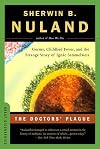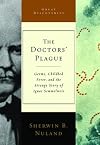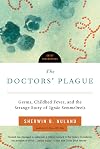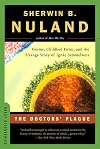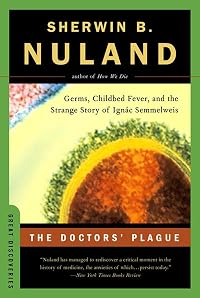
The Doctors' Plague: Germs, Childbed Fever, and the Strange Story of Ignac Semmelweis
by Sherwin B. Nuland
On This Page
Description
Surgeon, scholar, bestselling author, Sherwin B. Nuland tells the strange story of Ignác Semmelweis with urgency and the insight gained from his own studies and clinical experience. Ignác Semmelweis is remembered for the now-commonplace notion that doctors must wash their hands before examining patients. In mid-nineteenth-century Vienna, however, this was a subversive idea. With deaths from childbed fever exploding, Semmelweis discovered that doctors themselves were spreading the disease. show more While his simple reforms worked immediately-childbed fever in Vienna all but disappeared-they brought down upon Semmelweis the wrath of the establishment, and led to his tragic end. show lessTags
Recommendations



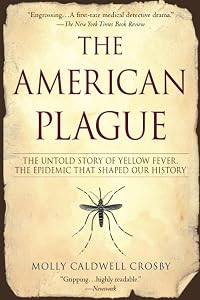


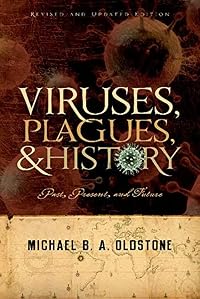





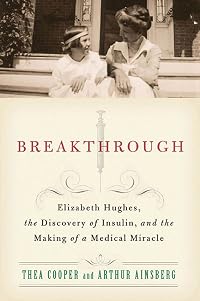
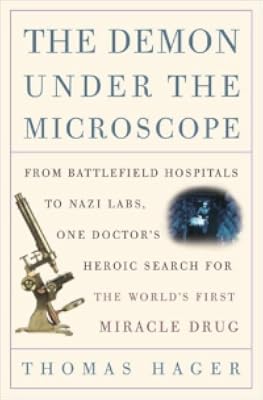


















Member Recommendations

Imprinted A moving novel based on the life and career of the Hungarian physician Ignaz Semmelweis (1818-1865), who introduced the practice of hygiene to medicine.
Member Reviews
I'm not saying that only formally-trained historians can write history books, but I am saying that this book is a solid example of the kind of bad history that a non-historian can produce when writing about a topic that they're in many ways quite knowledgeable about.
Sherwin Nuland was a physician, and so knows what he's talking about when it comes to puerperal fever—a possibly fatal form of infection or sepsis that can be contracted by post-partum people—and the technical processes by which the Hungarian-born Ignać Semmelweis discovered the disease's causation in the mid-nineteenth century.
He's on much shakier ground, however, when it comes to understanding the history of medicine, claiming that physicians didn't really understand show more that their ideas needed to be based on evidence until the nineteenth century and demonstrating little familiarity with the scholarship on pregnancy and childbirth during the Middle Ages and in early modern Europe.
And then there's the weird, fictional intro where Nuland imagines a virginal upper-class Viennese teenager who gets pregnant and is kicked out of the house by her "Papa", so is taken in by her former maidservant and ultimately dies shortly after giving birth from puerperal feveral. It's weird and creepy, and also unnecessary given how many real life women actually died an agonizing death from it—but then again, throughout Nuland seems not particularly interested in writing a history which centres women overly much. show less
Sherwin Nuland was a physician, and so knows what he's talking about when it comes to puerperal fever—a possibly fatal form of infection or sepsis that can be contracted by post-partum people—and the technical processes by which the Hungarian-born Ignać Semmelweis discovered the disease's causation in the mid-nineteenth century.
He's on much shakier ground, however, when it comes to understanding the history of medicine, claiming that physicians didn't really understand show more that their ideas needed to be based on evidence until the nineteenth century and demonstrating little familiarity with the scholarship on pregnancy and childbirth during the Middle Ages and in early modern Europe.
And then there's the weird, fictional intro where Nuland imagines a virginal upper-class Viennese teenager who gets pregnant and is kicked out of the house by her "Papa", so is taken in by her former maidservant and ultimately dies shortly after giving birth from puerperal feveral. It's weird and creepy, and also unnecessary given how many real life women actually died an agonizing death from it—but then again, throughout Nuland seems not particularly interested in writing a history which centres women overly much. show less
I have had an interest in the life of Ignaz Semmelweis ever since I read an essay by Kurt Vonnegut in 1979. Reprinted numerous times in magazines, the essay was originally a commencement address to Southhampton College.
Nuland's book gives a scholarly and well-researched account of Semmelweis' life and work. This comes under the category of "warts and all" as Nuland does not share Vonnegut's hero worship for the 19th century doctor who, although he figured out modern hospital sanitary practices, refused to deal with the scientific community's demand for verifiable experimental data. The author also debunks some myths about Dr. Semmelweis, several of which figure prominently into Vonnegut's laudatory speech. Most importantly, Nuland does show more not seek out villians - you will find no one entirely good or entirely bad. The decades long delay in implementing the now routine hospital sanitation and disinfection practices resulted from numerous people's ordinary human failings.
Highly recommended for anyone interested in the history of science and/or social aspects of scientific discovery. show less
Nuland's book gives a scholarly and well-researched account of Semmelweis' life and work. This comes under the category of "warts and all" as Nuland does not share Vonnegut's hero worship for the 19th century doctor who, although he figured out modern hospital sanitary practices, refused to deal with the scientific community's demand for verifiable experimental data. The author also debunks some myths about Dr. Semmelweis, several of which figure prominently into Vonnegut's laudatory speech. Most importantly, Nuland does show more not seek out villians - you will find no one entirely good or entirely bad. The decades long delay in implementing the now routine hospital sanitation and disinfection practices resulted from numerous people's ordinary human failings.
Highly recommended for anyone interested in the history of science and/or social aspects of scientific discovery. show less
I found this rare foray into the nonfiction realm quite rewarding. The Doctors’ Plague is the story of a man who very nearly stumbled on to the germ theory of medicine. Semmelweis made the connection between autopsies and puerperal fever by accident, when a friend died after cutting himself during an autopsy, and the autopsy of his body resembled those performed on women dead of puerperal fever. Lacking any concept of germs, Semmelweis nevertheless concluded that invisible particles were being carried from cadavers—or from infected wounds—to mothers in labor, causing their deaths. Then working as an assistant to the chief of obstetrics at a Vienna hospital, he began to insist that everyone wash their hands with chloride of lime show more solution—the same solution used to remove the smell of autopsies—before examining patients. Immediately, the rate of puerperal fever fell drastically. But Semmelweis hated writing and did not use the laboratory or the microscope. Colleagues who took on the burden of publicizing his work gave the erroneous impression that he thought only cadavers caused puerperal fever, leading many doctors to reject his theory. Stymied by the forces of the status quo in uncertain political times—the 1840s and 1850s—Semmelweis grew progressively more bitter. When he was refused a second term as assistant, he fled to his home city of Pest, alienating his Vienna supporters. When he finally agreed to publish his work, he wrote incomprehensibly and named his opponents as murderers. Ultimately, he became insane; two weeks after his wife had him committed, he died, probably as the result of having been severely beaten. The author concludes that Semmelweis’s organic brain syndrome was the result, not of syphilis as was often previously claimed by his biographers, but of early-onset Alzheimer’s. An engagingly written book about a fascinating medical discovery. show less
Good if very brief account of an interesting and in some ways tragic figure in the history of medicine. It appears that the author has been researching this case for some years; this book is a simplified popular account of his findings which he previously published in more detailed academic publications.
Nuland eplains the development of germ theory and how the acceptance of this concept opened the door to hygeinic measures in hospitals thereby reducing infection and death. He describes conditions that would be deplorable and shocking in any medical facility these day, yet were normal in the late nineteenth century. Simple acts such as washing one's hands and avoiding performing autopsies just prior to delivering babies - especially if the hands are not washed in between - proved to effect staggering changes in the mortality rates in Central European hospitals.
Ratings
Members
- Recently Added By
Lists

Best Medical Nonfiction
79 works; 29 members

My Wishlist
40 works; 1 member

al.vick-wishlist-science and nature
83 works; 1 member
Author Information

32+ Works 4,968 Members
Dr. Sherwin B. Nuland was born Shepsel Ber Nudelman on December 8, 1930 in the Bronx, New York. He received a bachelor's degree from New York University in 1951 and a medical degree from Yale University in 1955. He decided to specialize in surgery and in 1958, became the chief surgical resident at Yale-New Haven Hospital. From 1962 to 1991, he was show more a clinical professor of surgery at Yale University, where he also taught bioethics and medical history. Before retiring to write full-time, he was a surgeon at Yale-New Haven Hospital from 1962 to 1992. His books include Doctors: The Biography of Medicine, The Wisdom of the Body, The Doctors' Plague, The Uncertain Art, and the memoir Lost in America. His book, How We Die, won the National Book Award for nonfiction in 1994. He was also a contributing editor to The American Scholar and The New Republic. He died of prostate cancer on March 3, 2014 at the age of 83. (Bowker Author Biography) show less
Awards and Honors
Awards
Series
Belongs to Publisher Series
Common Knowledge
- Canonical title
- The Doctors' Plague: Germs, Childbed Fever, and the Strange Story of Ignac Semmelweis
- Original publication date
- 2003
- People/Characters
- Ignaz Semmelweis; Louis Pasteur; Joseph Lister
Classifications
- Genres
- Nonfiction, Science & Nature, General Nonfiction, History, Biography & Memoir
- DDC/MDS
- 618.740092 — Applied science & technology Medicine & health Gynecology, obstetrics, pediatrics, geriatrics Post-natal depression
- LCC
- RG811 .N85 — Medicine Gynecology and Obstetrics Gynecology and obstetrics Obstetrics Puerperal state
- BISAC
Statistics
- Members
- 284
- Popularity
- 113,390
- Reviews
- 6
- Rating
- (3.75)
- Languages
- 6 — Czech, English, German, Italian, Portuguese, Swedish
- Media
- Paper, Audiobook, Ebook
- ISBNs
- 11
- ASINs
- 4