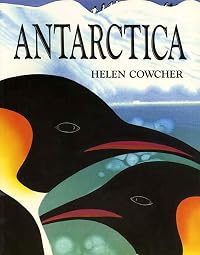
Antarctica
by Helen Cowcher
On This Page
Description
Describes the daily activities and dangers shared by the penguins and other animal inhabitants of Antarctica.Tags
Recommendations




Member Reviews
This simple book about the inhabitants of Antarctica and disruptive nature of the human interference is simple and well told. I enjoyed this book, though it left me wanting more at the end. A good addition to a section on Antarctica for primary and early intermediate readers.
This book does in interesting good at engaging readers from the beginning about the life of the animals that live in Antarctica. She immediately introduces the main animals that live there. She then transitions into each specific animals lifestyle there. Using many details she grasp her audience from an academic stand, while at the same time telling the information in a way children can relate to. The beautiful imagery gives children the imagination to actually visualize what Antarctica really looked like. However, not only was the author able to capture the good effectively, but the bad as well. For every positive their was a negative. For example when the author was talking about the penguins in the beginning, "Meanwhile, his mate is show more feeding at sea, where danger lurks." She concludes with the unknown mystery of whether all these animals will ever get along there. This book was very insightful, teaching a lot in a discrete way which is why the author set the story up this way. show less
Cowcher describes the life of Emperor Penguins, Adelie penguins, and Weddell seals in Antarctica. However the book is a little too complicated for the age group that it is intended for. Three year olds have difficulty distinguishing between the Weddell seals, who we are supposed to be sympathetic to, and the Leopard seal that almost eats one of the Emperor Penguins. The book ends with a helicopter scaring all the Adalie penguins away from their eggs, which are then eaten by Hua birds, Weddell seals being scared by explosions and ship hulls, and all the animals wondering whether the new arrivals (humans) will be able to share their environment or if they will destroy it. While I approve of the environmentalist message, Cowcher is trying show more to do too much with the book. If she had chosen only one antarctic species (I think she does the Emperor Penguins best) and gave more information on what the humans are doing there it would have been a stronger book and the children listening to it would be more likely to understand her message. show less
The book first takes you through the life cycle of a penguin, also showing you the dangers they face of keeping their young safe. But it also describes Adelie penguins who lose their babies, so can be sad for younger children. It then talks more about how humans are destroying the habitats that exist in the Antarctic.
A very touching story that is better for children 2-5 in my opinion. The text is very simple but I can see where my second graders might be thinking a bit when the birds eat the penguins eggs and when the helicopters make the penguins leave their nests altogether. But, we can't always shield our children from the problems they will continue to face as our Earth becomes more of a wasteland to certain habitats.
A very touching story that is better for children 2-5 in my opinion. The text is very simple but I can see where my second graders might be thinking a bit when the birds eat the penguins eggs and when the helicopters make the penguins leave their nests altogether. But, we can't always shield our children from the problems they will continue to face as our Earth becomes more of a wasteland to certain habitats.
I would use this book in a science class. It is about animals and their habitats in Antarctica. It also explains how humans and other creatures are a danger to them. Recommended for first-third grade.
In this book we follow a family of penguins who are trying to survive in the wilds of Antarctica. We face many different dangers, and learn how penguins perfect their own from the cold and other creatures.
This book seems fictional at first, but it has no fiction. All the struggles this family faces and decisions they make are true to the nature of penguins. They explain why the father, mother leave to get food, and why one stays back to protect their cub.
This book seems fictional at first, but it has no fiction. All the struggles this family faces and decisions they make are true to the nature of penguins. They explain why the father, mother leave to get food, and why one stays back to protect their cub.
This book was about penguins that lived in south, cold, Antarctica. In Antarctica, it is both night and day during the long winter season. When spring finally arrives, the penguins have to decide on a way to raise their young penguins. I like learning more about penguins after I read this book. This was a cute book to read, and the group of kids I read it to really enjoyed it, and asked questions about penguins and surviving out in the cold. I would use this book as a Science lesson over penguins, but it could also be used as a Social Studies lesson over the continent of Antarctica.
Members
- Recently Added By
Author Information

8+ Works 2,889 Members
Awards and Honors
Common Knowledge
- Canonical title
- Antarctica
- Original title
- Antarctica
- Original publication date
- 1990
- Important places
- Antarctica
- First words
- In the cold far south, in Antarctica, live emperor penguins, Weddell seals, and Adélie penguins.
- Last words
- (Click to show. Warning: May contain spoilers.)The seals and penguins cannot tell yet whether they will share or destroy their beautiful Antarctica. . .
Classifications
Statistics
- Members
- 1,177
- Popularity
- 21,193
- Reviews
- 13
- Rating
- (3.53)
- Languages
- English, Multiple languages, Spanish, Turkish
- Media
- Paper
- ISBNs
- 28
- ASINs
- 6