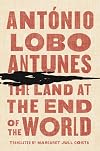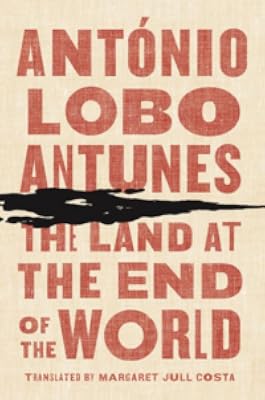
The Land at the End of the World
by António Lobo Antunes
On This Page
Description
A Portuguese medic, returning to Lisbon after a tour of duty in Angola, is haunted by the memories of war and feels completely detached from the ordered world of his privileged youth.Tags
Recommendations
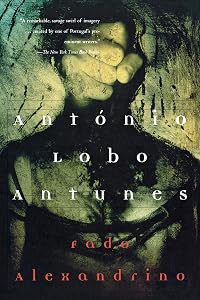





















Member Recommendations

Member Reviews
THE LAND AT THE END OF THE WORLD is a book that kept turning up in discussions of war lit, which is a specialized genre that always arouses my interest so I decided to give it a look. Considered the masterpiece of prolific Portuguese writer Antonio Lobo Antunes, the English title is a cleaned up version of something more like "The A**hole of the World." Any soldier who has ever been posted to a remote or primitive site with few of the amenities of civilized life will understand.
Told in a first person, circular, colorful narrative of seemingly endless runon sentences depicting nightmarish scenes of hideous combat injuries and disfigurements, interspersed with erotic sexual couplings, the aged narrator is looking back at his time as a show more new doctor conscripted into the Portuguese army and posted to the interior of Angola where a shadowy war continues to sputter and spark between stultifying boredom and explosions of bloody violence. (How's THAT for a runon?) Haunted by specific visions - his male nurse sitting stunned in the dust holding his bloody intestines in his hands following an attack, or the dead young soldier he wrapped gently in a sheet and put him in his own room, telling himself he was only asleep, or the camp dogs licking the operating room blood from his clothing, arms and hands - the narrator, in endless interior monologues to various sexual partners past and present, attempts to lose himself in drink and eroticism.
There are numerous flashbacks to his childhood and youth in Benfica and Lisbon, often skilfully contrasted with the awful circumstances of his two years of boredom, whoring, drinking and misery in Angola. I was often reminded of Yossarian and his "Snowdens of yesteryear." Think CATCH-22, but without the humor. There are also passing references to Fitzgerald, and maybe also to e.e. cummings' war novel, THE ENORMOUS ROOM, along with numerous allusions to Portuguese, Brazilian and other European writers, artists, politicians and more.
I can understand now why this book has earned a place in the canon of war literature. The writing is sinuous and graceful - although it's difficult to know how much the translator (Margaret Jull Costa) figures in. The endless, convoluted sentences were sometimes problematic, although you do get used to it after while. But war lit, yeah. It definitely belongs. I'm glad I read it, and will recommend it highly to fellow war lit buffs.
- Tim Bazzett, author of the Cold War memoir, SOLDIER BOY: AT PLAY IN THE ASA show less
Told in a first person, circular, colorful narrative of seemingly endless runon sentences depicting nightmarish scenes of hideous combat injuries and disfigurements, interspersed with erotic sexual couplings, the aged narrator is looking back at his time as a show more new doctor conscripted into the Portuguese army and posted to the interior of Angola where a shadowy war continues to sputter and spark between stultifying boredom and explosions of bloody violence. (How's THAT for a runon?) Haunted by specific visions - his male nurse sitting stunned in the dust holding his bloody intestines in his hands following an attack, or the dead young soldier he wrapped gently in a sheet and put him in his own room, telling himself he was only asleep, or the camp dogs licking the operating room blood from his clothing, arms and hands - the narrator, in endless interior monologues to various sexual partners past and present, attempts to lose himself in drink and eroticism.
There are numerous flashbacks to his childhood and youth in Benfica and Lisbon, often skilfully contrasted with the awful circumstances of his two years of boredom, whoring, drinking and misery in Angola. I was often reminded of Yossarian and his "Snowdens of yesteryear." Think CATCH-22, but without the humor. There are also passing references to Fitzgerald, and maybe also to e.e. cummings' war novel, THE ENORMOUS ROOM, along with numerous allusions to Portuguese, Brazilian and other European writers, artists, politicians and more.
I can understand now why this book has earned a place in the canon of war literature. The writing is sinuous and graceful - although it's difficult to know how much the translator (Margaret Jull Costa) figures in. The endless, convoluted sentences were sometimes problematic, although you do get used to it after while. But war lit, yeah. It definitely belongs. I'm glad I read it, and will recommend it highly to fellow war lit buffs.
- Tim Bazzett, author of the Cold War memoir, SOLDIER BOY: AT PLAY IN THE ASA show less
Lobo's tangled, sweaty prose with its overwrought similes works well when it's describing the infernal experience of the war in Angola; it's less suited to the Lisbon-set frame story in which the PTSD'd narrator has a grimy one-night stand. The sex-writing (in both narratives) in particular is of its time, repugnant even on the few occasions it isn't trying to be. But as a document of colonial brutality and futility, a memoir of the Portuguese dictatorship, and a concentrated catalogue of horrors, Os Cus de Judas (it's been translated under two different titles) packs one heck of a wallop.
Jackson Pollock once said, 'Every good artist paints what he is', which is something I was reminded of and felt was particularly pertinent to 'The Land at the End of the World' by Antonio Lobo Antunes. Antunes trained as a psychiatrist but, through national service, spent 27 months as an army medic during Portugal's doomed colonial war in Angola. His alienating experiences in the African country serve as the subject matter for this strongly autobiographical novel. So too, his childhood memories of family pressures surrounding his conscription and the later opposition to the government who sent him there. The protagonist, an army doctor sent to Angola, lives the life of Antunes, expatiating his experiences to his reader in an amalgam of show more digression and visceral diatribe.
Antunes is a god of simile and metaphor. At first, they were all I noticed and I perhaps felt there to be too many, but as the novel progressed, they were the engine to his evocative and macabre prose, filling my mind with powerful imagery as I vicariously experienced the grim and futile labours in ‘the armpit of the world’. In conjunction with this, a mention must go to the translator Margaret Jill Costa (who I understand has won many awards) who has done a magnificent job in translating his exemplary prose. Earlier this year, I waxed lyrical about the writing of David Foster-Wallace, believing that he was a class part in his manipulation of language, but I have seen in only a few months that other writers with equal genius exist, Antunes being the first I’ve to encounter since making the bold claim.
An example:
Gradually, the wear and tear of war, the never-changing landscape of sand and sparse woods, the long, sad months of mist that turned the sky and the night the sepia brown of faded daguerreotypes, had transformed us into a species of apathetic insect, machines made to withstand a day-to-day existence filled with hopeless hope, afternoons spent sitting on barrel-stave chairs or on the steps of the former administration post, staring at the excessively lethargic calendars on which the months lingered with maddening slowness, while endless leap days, full of hours, swelled up around us like great bloated, putrefying bellies that kept us imprisoned with no hope of salvation. We were fish, you see, in aquariums of cloth and metal, dumb fish, simultaneously fierce and tame, trained to die without protest, to lie down without protest in those army coffins, where we would be welded in, covered with the national flag, and sent back to Europe in the hold of a ship, our dog tags over our mouths to quash even the desire to utter a rebellious scream.
I look forward to the many other offerings from this writer, a genius who may be lost in Saramago's shadow yet who very much deserves to share the light. 5/5 show less
Antunes is a god of simile and metaphor. At first, they were all I noticed and I perhaps felt there to be too many, but as the novel progressed, they were the engine to his evocative and macabre prose, filling my mind with powerful imagery as I vicariously experienced the grim and futile labours in ‘the armpit of the world’. In conjunction with this, a mention must go to the translator Margaret Jill Costa (who I understand has won many awards) who has done a magnificent job in translating his exemplary prose. Earlier this year, I waxed lyrical about the writing of David Foster-Wallace, believing that he was a class part in his manipulation of language, but I have seen in only a few months that other writers with equal genius exist, Antunes being the first I’ve to encounter since making the bold claim.
An example:
Gradually, the wear and tear of war, the never-changing landscape of sand and sparse woods, the long, sad months of mist that turned the sky and the night the sepia brown of faded daguerreotypes, had transformed us into a species of apathetic insect, machines made to withstand a day-to-day existence filled with hopeless hope, afternoons spent sitting on barrel-stave chairs or on the steps of the former administration post, staring at the excessively lethargic calendars on which the months lingered with maddening slowness, while endless leap days, full of hours, swelled up around us like great bloated, putrefying bellies that kept us imprisoned with no hope of salvation. We were fish, you see, in aquariums of cloth and metal, dumb fish, simultaneously fierce and tame, trained to die without protest, to lie down without protest in those army coffins, where we would be welded in, covered with the national flag, and sent back to Europe in the hold of a ship, our dog tags over our mouths to quash even the desire to utter a rebellious scream.
I look forward to the many other offerings from this writer, a genius who may be lost in Saramago's shadow yet who very much deserves to share the light. 5/5 show less
While António Lobo Antunes' writing was not yet fully formed from the beginning of career, he already had developed his own, distinctive style - anyone who has read Elephant’s Memory will immediately recognise The Land at the End of the World (Os Cus de Judas in the Portugese original, also published in English as South of Nowhere or in German – the version I have read – as Der Judaskuss) as the work of the same author – it has the same fluidity, the constant shifting of place and time and even between first and third person, the same unrelentingly bitter and angered gaze on Portugal and human existence in general, and above all, it has the same language, the same long periods that sprawl in all directions while heaping show more metaphors upon metaphors. building towards a precarious but extremely fascinating novel-construct.
Like its predecessor, this second novel of António Lobo Antunes is at least partially autobiographical, and like before, there is some kind of framing narrative (this time the narrator telling his story to a woman in a bar which he then takes home and sleeps with – personally, I’d like to think that this is the same woman the narrator of Elephant’s Memory meets towards the end of that novel, so that the later work would be nested inside of the earlier one, but there is not really any indication for that), a framing narrative that surrounds and somewhat anchors the narrator reminiscing about his life in no particular order and jumping between times and places apparently at random.
As noticeable as the similarities are, there are a number of differences as well: The Land at the End of the World has a closer focus both in its framing (just an evening instead of a whole day, and involving only two people) and its central narrative, which concerns itself exclusively with the colonial war in Angola in which Antunes served as a medical officer. Apparently, it was to a great degree this subject matter – the Angolan war being something one did not really talk about in Portugal back in 1979 when the novel was first published – which made the release of this novel a scandal and Antunes a popular author in his home country. As was to be expected from his first novel, Antunes does not pull any punches in his depiction of the war, he is relentlessly grim whether writing about the Portuguese colonialists or the Angolan rebels, whether he describes the atrocities of the war, the thoughtless cruelty of the Portuguese towards the natives or the squalor and misery the Angolans are forced to exist in. The Land at the End of the World may not be fuelled by the hot fury that propels Elephant’s Memory, the narrator’s gaze is much colder in this book, his attitude more detached, even clinical at times, but this only serves to make it all the bleaker.
In sharp contrast to the misery man seems to spread everywhere he goes (and while Antunes’ apparent subject is very specifically Portugal, I don’t doubt that, in this as in all his other novels, it is at the same time the conditio humana in general that he describes, his regionalism being a means to represent the universal – one of the reasons, I presume, why he is so often compared to William Faulkner), and in fact the only relief from it, are the occasional, rare glimpses of untouched nature which Antunes describes with great, almost aching intensity. Not that the rest of his writing was any less intense; in fact, in the end it is the prose far more than the subject matter of The Land at the End of World which makes this an outstanding and enduring novel, the first of Lobo Antunes' masterworks. While the author still piles metaphors upon metaphors, the imagery in his second novel is much more under control than it was in the first - there is an actual purpose to the images, and a structure that even with all the twists and turns the narrator takes makes him return to the same places, the same images. Scenes and events are visited several times, explored from different angles and under different illuminations, and it becomes clear that the narrator will never be done with them, that his experiences in Angola have marked him for life. And there are recurring images, indeed many of them related to visibility - a particular prominent one is that of rays of light illuminating something at an angle: An image, I think, of Antunes' poetical method, the way his prose creates a kind of chiaroscuro, illuminates by obscuring, reveals by clothing in metaphor. If Elephant's Memory was the promise of a great writer, then The Land at the End of the World is the fulfillment of that promise - and only the first of many to come. show less
Like its predecessor, this second novel of António Lobo Antunes is at least partially autobiographical, and like before, there is some kind of framing narrative (this time the narrator telling his story to a woman in a bar which he then takes home and sleeps with – personally, I’d like to think that this is the same woman the narrator of Elephant’s Memory meets towards the end of that novel, so that the later work would be nested inside of the earlier one, but there is not really any indication for that), a framing narrative that surrounds and somewhat anchors the narrator reminiscing about his life in no particular order and jumping between times and places apparently at random.
As noticeable as the similarities are, there are a number of differences as well: The Land at the End of the World has a closer focus both in its framing (just an evening instead of a whole day, and involving only two people) and its central narrative, which concerns itself exclusively with the colonial war in Angola in which Antunes served as a medical officer. Apparently, it was to a great degree this subject matter – the Angolan war being something one did not really talk about in Portugal back in 1979 when the novel was first published – which made the release of this novel a scandal and Antunes a popular author in his home country. As was to be expected from his first novel, Antunes does not pull any punches in his depiction of the war, he is relentlessly grim whether writing about the Portuguese colonialists or the Angolan rebels, whether he describes the atrocities of the war, the thoughtless cruelty of the Portuguese towards the natives or the squalor and misery the Angolans are forced to exist in. The Land at the End of the World may not be fuelled by the hot fury that propels Elephant’s Memory, the narrator’s gaze is much colder in this book, his attitude more detached, even clinical at times, but this only serves to make it all the bleaker.
In sharp contrast to the misery man seems to spread everywhere he goes (and while Antunes’ apparent subject is very specifically Portugal, I don’t doubt that, in this as in all his other novels, it is at the same time the conditio humana in general that he describes, his regionalism being a means to represent the universal – one of the reasons, I presume, why he is so often compared to William Faulkner), and in fact the only relief from it, are the occasional, rare glimpses of untouched nature which Antunes describes with great, almost aching intensity. Not that the rest of his writing was any less intense; in fact, in the end it is the prose far more than the subject matter of The Land at the End of World which makes this an outstanding and enduring novel, the first of Lobo Antunes' masterworks. While the author still piles metaphors upon metaphors, the imagery in his second novel is much more under control than it was in the first - there is an actual purpose to the images, and a structure that even with all the twists and turns the narrator takes makes him return to the same places, the same images. Scenes and events are visited several times, explored from different angles and under different illuminations, and it becomes clear that the narrator will never be done with them, that his experiences in Angola have marked him for life. And there are recurring images, indeed many of them related to visibility - a particular prominent one is that of rays of light illuminating something at an angle: An image, I think, of Antunes' poetical method, the way his prose creates a kind of chiaroscuro, illuminates by obscuring, reveals by clothing in metaphor. If Elephant's Memory was the promise of a great writer, then The Land at the End of the World is the fulfillment of that promise - and only the first of many to come. show less
Antunes tunes into vivid illusions. Had I known of his work, I wouldn't have bothered reading László Krasznahorkai. Mr. Lobo's work has the same breathless fluidity, but the imagery is stronger, the dramatic pulse is quicker, and it appears far more inclusive, as opposed to the Hungarian's stark Beckett-like isolationism.
This great Portuguese war surgeon turned writer utilizes warlike tangles of symbolism to tango with heartache and human futility. Within nested imagery and dense, coupling metaphors, he explores multilayered settings with floral sentences, replete with luscious detail, free associating between dreamlike war reminiscences and enigmatic conquests. His haunting, serpentine, grisly prose, is both harrowing and alluring show more to behold. His seamless narration passes from atmospheric locales like a disembodied spirit of defiance, blending poetry and terror in a grueling alphabet soup of evanescent verbal eruptions. Since this is an anguished monologue, it dehumanizes with its existential horror and paints rich pastiches of a war-torn Angola from the desperate exile of Lisbon.
Baring his soul, the narrator conjures famous artists: Rembrandt, Dali, Bosch - overlaying their immortal scenes with his own shattered memory - "Cézanne's card players" appear before his beleaguered eyes, and so do "El Greco's greyhounds" and Magritte's skies. There are many integrated literary references and a tone reminiscent of Malcolm Lowry's Under the Volcano, about men forgotten in far corners of the world, struggling to undo the incomprehensible atrocities of well-fed, demonic leaders. An uncomfortably profound read. A lucid nightmare of knotted analogies. And some of the most enlightening rants I've ever encountered. show less
This great Portuguese war surgeon turned writer utilizes warlike tangles of symbolism to tango with heartache and human futility. Within nested imagery and dense, coupling metaphors, he explores multilayered settings with floral sentences, replete with luscious detail, free associating between dreamlike war reminiscences and enigmatic conquests. His haunting, serpentine, grisly prose, is both harrowing and alluring show more to behold. His seamless narration passes from atmospheric locales like a disembodied spirit of defiance, blending poetry and terror in a grueling alphabet soup of evanescent verbal eruptions. Since this is an anguished monologue, it dehumanizes with its existential horror and paints rich pastiches of a war-torn Angola from the desperate exile of Lisbon.
Baring his soul, the narrator conjures famous artists: Rembrandt, Dali, Bosch - overlaying their immortal scenes with his own shattered memory - "Cézanne's card players" appear before his beleaguered eyes, and so do "El Greco's greyhounds" and Magritte's skies. There are many integrated literary references and a tone reminiscent of Malcolm Lowry's Under the Volcano, about men forgotten in far corners of the world, struggling to undo the incomprehensible atrocities of well-fed, demonic leaders. An uncomfortably profound read. A lucid nightmare of knotted analogies. And some of the most enlightening rants I've ever encountered. show less
The Land at the End of The World by Antonio Lobo Antunes
The narrator, a middle-class Portuguese medical student is encouraged by his family to join the Army and go to Angola to fight the war that the Dictator Salazar was fighting to save Portugal’s false glory and his own grip on power. Sadly…
“True to the family prophesy, I had become a man: a kind of sad, cynical greed made up of lascivious despair, egotism, and an eagerness to hide from myself had replaced forever the fragile pleasure of childish joy, of open, unreserved laughter, embalmed in purity, and which at night, when I’m walking home down a deserted street, I seem to hear, echoing at my back like a mocking cascade.”
Antunes, a psychiatrist, who himself served as a show more doctor in Angola in the 1970s tells this tale of a medic whose experience in the war changes him forever.
Through an ample dose of magical metaphors and poetic phrasing Antunes’ creative imagination can, at times, dazzle and overwhelm the effects of this war on both the African populace and the soldiers who are held in check by Salazar’s secret police.
The narrator is doomed, witnessing what he does, he becomes a sad, depressed and disillusioned man, cut off from family he drinks, loses sleep and the ability to love another person. Back in Lisbon he tells his tale to an unnamed lover as he relates how the war changed him.
“deep down of course, it is our own death that we fear when we imagine someone else’s – and that is what makes cowards of us all”.
There is a fair amount of sexual description which relates how he was loved well by an Angolan native recounting their lovemaking like, “making love to one another, as furiously as rhinoceroses with toothaches”. Yet his sexuality fades as do most of his other desires.
In the end this is a daunting, poetic indictment of dictatorships, war and imperialism. Antunes in his writing is as persuasive as Clarence Darrow and creative as both Pablo Neruda and Gabriel Garcia Marquez.
A classic literary work, a cautionary tale, considered one of the great books of modern day Portuguese literature. show less
The narrator, a middle-class Portuguese medical student is encouraged by his family to join the Army and go to Angola to fight the war that the Dictator Salazar was fighting to save Portugal’s false glory and his own grip on power. Sadly…
“True to the family prophesy, I had become a man: a kind of sad, cynical greed made up of lascivious despair, egotism, and an eagerness to hide from myself had replaced forever the fragile pleasure of childish joy, of open, unreserved laughter, embalmed in purity, and which at night, when I’m walking home down a deserted street, I seem to hear, echoing at my back like a mocking cascade.”
Antunes, a psychiatrist, who himself served as a show more doctor in Angola in the 1970s tells this tale of a medic whose experience in the war changes him forever.
Through an ample dose of magical metaphors and poetic phrasing Antunes’ creative imagination can, at times, dazzle and overwhelm the effects of this war on both the African populace and the soldiers who are held in check by Salazar’s secret police.
The narrator is doomed, witnessing what he does, he becomes a sad, depressed and disillusioned man, cut off from family he drinks, loses sleep and the ability to love another person. Back in Lisbon he tells his tale to an unnamed lover as he relates how the war changed him.
“deep down of course, it is our own death that we fear when we imagine someone else’s – and that is what makes cowards of us all”.
There is a fair amount of sexual description which relates how he was loved well by an Angolan native recounting their lovemaking like, “making love to one another, as furiously as rhinoceroses with toothaches”. Yet his sexuality fades as do most of his other desires.
In the end this is a daunting, poetic indictment of dictatorships, war and imperialism. Antunes in his writing is as persuasive as Clarence Darrow and creative as both Pablo Neruda and Gabriel Garcia Marquez.
A classic literary work, a cautionary tale, considered one of the great books of modern day Portuguese literature. show less
How can I even start to review this book? It is so incredibly filled with storyline and references, past and present, war and peace, guilt, loneliness, deep thoughts, superficial conversation. I don't think I have ever read anything like this before and I loved it.
The narrator of the story is a veteran, who is haunted by the horrors of the Portuguese colonial war in Angola in the beginning of the 1970's. In the course of one night he just talks and talks, to a woman he meets in a bar, and later on takes home, and through her to us, the readers. He talks about his youth and family, about his divorce and his green eyed daughter, about his present life at the edge of society, about alcohol, about sex, but most, most of all, about the war show more in Angola. About the boredom, about the heat, about the dogs and the hungry local children hanging around the military bases, about the injured and dying men he had to treat, being the doctor. About the senselessness of it all. About the young man who couldn't stand it any longer and shot himself in the face. About the loneliness, even if there were all these other men around. About the search for comfort in the arms of prostitutes. About the crimes committed by the Portuguese army. About torture and rape. And most of all, about not doing anything to stop it all. Seeing, and not acting. And the incredible guilt of not having acted.
This is heavy stuff, not only because of its subject, but also because of its style. The sentences just go on and on, and can start in Angola and end along the shore of Portugal. In between you have possibly read a reference to a work of art, or a literary masterpiece, or a historic event. It is definitely no easy reading and I am quite sure I have missed about half of the cross-references. It seems to be the kind of book that you would start to appreciate more as you get older, and know more about art and history and literature. It took me awhile to get used to the style, and it was no relaxing read at all, but it was so beautifully written and so intimate in a way. The details make you feel as if you are there in Angola, and feel the utter despair of a person who has come to despise himself. show less
The narrator of the story is a veteran, who is haunted by the horrors of the Portuguese colonial war in Angola in the beginning of the 1970's. In the course of one night he just talks and talks, to a woman he meets in a bar, and later on takes home, and through her to us, the readers. He talks about his youth and family, about his divorce and his green eyed daughter, about his present life at the edge of society, about alcohol, about sex, but most, most of all, about the war show more in Angola. About the boredom, about the heat, about the dogs and the hungry local children hanging around the military bases, about the injured and dying men he had to treat, being the doctor. About the senselessness of it all. About the young man who couldn't stand it any longer and shot himself in the face. About the loneliness, even if there were all these other men around. About the search for comfort in the arms of prostitutes. About the crimes committed by the Portuguese army. About torture and rape. And most of all, about not doing anything to stop it all. Seeing, and not acting. And the incredible guilt of not having acted.
This is heavy stuff, not only because of its subject, but also because of its style. The sentences just go on and on, and can start in Angola and end along the shore of Portugal. In between you have possibly read a reference to a work of art, or a literary masterpiece, or a historic event. It is definitely no easy reading and I am quite sure I have missed about half of the cross-references. It seems to be the kind of book that you would start to appreciate more as you get older, and know more about art and history and literature. It took me awhile to get used to the style, and it was no relaxing read at all, but it was so beautifully written and so intimate in a way. The details make you feel as if you are there in Angola, and feel the utter despair of a person who has come to despise himself. show less
Members
- Recently Added By
Published Reviews
ThingScore 100
“The Land at the End of the World,” newly translated by Margaret Jull Costa, was originally published in 1979, four years after Portugal’s withdrawal from Africa and the final collapse of America’s intervention in Vietnam. At that time it was interpreted as a comment on the inherent futility of those recent Western adventures in the third world. But read at more than 30 years’ remove show more from those events much of this account of what Mr. Lobo Antunes’s narrator calls a “painful apprenticeship in dying” would no doubt make sense to survivors of the Iraq and Afghanistan wars. show less
added by kidzdoc
Lists

Best Literature in Portuguese
15 works; 2 members

The 10 greatest novels ever in portuguese language
10 works; 1 member
Author Information

76+ Works 4,817 Members
Lobo Antunes, a psychiatrist and a soldier in the Portuguese colonial wars in Angola, was born in Lisbon. "South of Nowhere", his second novel, published in 1980, became the center of controversy both because of its daring content and its novel structure. The action is very brief: it lasts only one night. The author tells a silent woman companion show more his frank impressions about his experience as a medical doctor in the war of liberation against Portuguese colonialism. In some passages, the novel makes allusion to The Lusiads and its allegorical intentions. It denounces with lucid sarcasm the failure of Portuguese colonization in Africa. (Bowker Author Biography) show less
Some Editions
Awards and Honors
Series
Belongs to Publisher Series
Common Knowledge
- Canonical title
- The Land at the End of the World
- Original title
- Os Cus de Judas
- Alternate titles
- South of Nowhere
- Original publication date
- 1983
- Important places
- Lisbon, Portugal; Ninda, Angola; Chiume, Angola; Marimba, Angola
- Important events
- Portuguese colonial war
- Dedication*
- Para o Daniel Sampaio
- meu Amigo. - First words*
- Wat ik vroeger altijd het mooiste vond in de dierentuin was de rolschaatsbaan onder de bomen, met de zwarte leraar die kaarsrecht, zonder een spier te bewegen, langzaam achterstevoren rondjes trok over het cement, omringd doo... (show all)r meisjes in korte rokjes en witte laarsjes die, als ze iets hadden gezegd, ongetwijfeld van die verbandgaasstemmen zouden hebben gehad waarmee in luchthavens het vertrek van de vliegtuigen wordt omgeroepen, watten lettergrepen die in je oren smelten zoals het laatste restje van een snoepje op de schelp van de tong.
- Original language*
- Portugees
*Some information comes from Common Knowledge in other languages. Click "Edit" for more information.
Classifications
- Genres
- Fiction and Literature, General Fiction, Romance
- DDC/MDS
- 869.3 — Literature & rhetoric Spanish Literature Literatures of Portuguese and Galician languages Portuguese fiction
- LCC
- PQ9263 .N77 .C813 — Language and Literature French, Italian, Spanish and Portuguese literatures Portuguese literature Individual authors, 1961-2000
- BISAC
Statistics
- Members
- 520
- Popularity
- 57,861
- Reviews
- 13
- Rating
- (3.91)
- Languages
- 14 — Bulgarian, Czech, Danish, Dutch, English, Finnish, French, German, Italian, Norwegian (Bokmål), Portuguese (Portugal), Spanish, Swedish, Turkish
- Media
- Paper, Ebook
- ISBNs
- 42
- ASINs
- 6