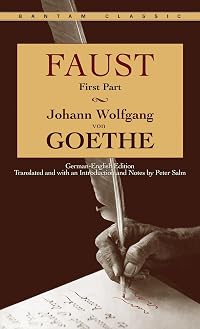
Faust, Part One
by Johann Wolfgang von Goethe
On This Page
Description
"Goethe is the most famous German author, and the poetic drama Faust, Part I (1808) is his best-known work, one that stands in the company of other leading canonical works of European literature such as Dante's Inferno and Shakespeare's Hamlet. This is the first new translation into English since David Constantine's 2005 version. Why another translation when there are several currently in print? To invoke Goethe's own authority when speaking of his favorite author, Shakespeare, Goethe show more asserts that so much has already been said about the poet-dramatist "that it would seem there's nothing left to say," but adds, "yet it is the peculiar attribute of the spirit that it constantly motivates the spirit." Goethe's great dramatic poem continues to speak to us in new ways as we and our world continually change, and thus a new or updated translation is always necessary to bring to light Faust's almost inexhaustible, mysterious, and enchanting poetic and cultural power. Eugene Stelzig's new translation renders the text of the play in clear and crisp English for a contemporary undergraduate audience while at the same time maintaining its leading poetic features, including the use of rhyme."-- show lessTags
Recommendations








































Member Reviews
I loooove that in contrast to Marlowe's Faust, where he's actually just about power and self-assertion, and Mann's, where he really was about deep knowledge and piercing the physical mysteries and developing an inhuman logic, etc., this Faust is more like a disaffected humanist--learning, and swimming in ideas and art, is what's put a spring in his step and given him a reason, and that's worn thin, and he doesn't want to know it all or pound armies into dust, he just wants to fill with easy joy again. So what he's really missing is youth--and so it's kind of no wonder this is really a love story, not a cautionary tale (or a cautionary tale about love, not about the devil): Faust and Margaret could have been the boon companions of each show more other's age, but marinating in great books and the like he'd never bothered to develop his concept of love beyond adolescent infatuation--he tries to make her Helen of Troy. And to maintain that kind of fantasy of limitlessness, to fight against the human life arc because it was all too beautiful, summer evenings at lectures, boozy under oak trees, is a kind of rebellion against God, I suppose. And so in contrast to the other two Fausts, where a very simple version of the caution on offer might be "Be content," here it is "Grow and change." No one would argue with that, on paper, but change means watching your old self die, and many of us (cf., in literature, obviously, Dorian Gray) have turned to different kinds of devils to keep alive the old selves we'd loved being when it was time to let them go. When what we really wanted to preserve was there for us if only the devils'd quit flitting and let us take a good look and have a think on't.
I wasn't too impressed with this translation--clunky in the attempt to simulate the German metre closely--but the illustrations from Harry Clarke were something really special (http://www.openculture.com/2015/09/harry-clarkes-1926-illustrations-of-goethes-faust-art-that-inspired-the-psychedelic-60s.html). I can feel an echo of the power of the German, I think--I'd read it in the original next time, but I also think for translations there might be others better. show less
I wasn't too impressed with this translation--clunky in the attempt to simulate the German metre closely--but the illustrations from Harry Clarke were something really special (http://www.openculture.com/2015/09/harry-clarkes-1926-illustrations-of-goethes-faust-art-that-inspired-the-psychedelic-60s.html). I can feel an echo of the power of the German, I think--I'd read it in the original next time, but I also think for translations there might be others better. show less
It's a strange notion, "reviewing" a text that is one of the pillars of German national identity and has had untold hectolitres of ink spilled over it by critics in the last couple of centuries. Maybe the most appropriate question to ask in a place like this is "What does Faust I have to offer the casual modern reader?"
Two main things, I think: amazing language and a cracking good yarn.
Like Hamlet or the KJV in English, reading Faust through is a bit like joining the dots between dozens of quotations you already know. The language has a very direct appeal to the reader: you don't have to be an expert in 19th century German verse to make sense of it (though I'm sure you would get more out of it if you were). After a few pages you show more entirely forget what a strange notion it is to be reading a verse drama, and just enjoy the sound of the words.
The story isn't as "big" and "epic" as you might imagine. The core story of Gretchen's seduction and fall is told in a very intimate, naturalistic way, and even the big Walpurgisnacht scene is essentially a series of little cameos rather than a big spectacular. show less
Two main things, I think: amazing language and a cracking good yarn.
Like Hamlet or the KJV in English, reading Faust through is a bit like joining the dots between dozens of quotations you already know. The language has a very direct appeal to the reader: you don't have to be an expert in 19th century German verse to make sense of it (though I'm sure you would get more out of it if you were). After a few pages you show more entirely forget what a strange notion it is to be reading a verse drama, and just enjoy the sound of the words.
The story isn't as "big" and "epic" as you might imagine. The core story of Gretchen's seduction and fall is told in a very intimate, naturalistic way, and even the big Walpurgisnacht scene is essentially a series of little cameos rather than a big spectacular. show less
The first of Goethe's two Faust plays is a surprisingly disordered, lewd, and at times hopelessly obscure play. The title character makes a deal with the devil--shenanigans and tragedies ensue. It introduced me to a new piece of folklore--the Brocken witches--to enchant my life or whatever. It gave me Proktophantasmist, which my Oxford edition kindly explained. So what if the scene order doesn't always make narrative sense?
Part One of Faust was one of the few books in my life that forced me to put on a pot of coffee and give up a night's sleep to finish it. The young Goethe simply nailed it. When I then got a hold of Part Two (written by the much older Goethe) and sat down with it, I was stunned. His style had completely changed; I never would have guessed it was by the same author. I'm not judging Goethe or the work as a whole, that would be arrogant and ridiculous given his stature as a writer, but simply noting that the experience of reading those two parts of Faust raised serious questions about critical editorial / literary analysis research which makes claims about authorship. It also convinced me that as a writer I should finish what I start. The show more idea of a long work being as organic and unified as a grapefruit--as John Gardner puts it--instinctively appeals to me. show less
`My name is Ozymandias, King of Kings:In Faust, the name of the game is passion. Passion for learning, passion for love, passion for life in all its forms and facets. The deprivation of passion by the slow grind of facts and figures and hypocrisy, the boons of inheritance providing shortcuts without granting the necessary experience of true effort, and excess. When the world is at one's feet, what is there left for passion to strive for?
Look on my works, ye mighty, and despair!'
-Percy Bysshe Shelley, 'Ozymandias'
Wer immer strebend sich bemüht,
Den können wir erlösen.
("Who ever strives with all his power,
We are allowed to save.")
-Johann Wolfgang von Goethe, Faust
But until then, what will you do to achieve that world?
It's an almost show more impossible balance, especially when the rest of the world is thrown in at full tilt. The passion becomes split, and when one track is spent the next is sought, and the next, and the next, by any means to any measure. One may wish at the beginning to be good, but when the so-called custodians of morality sell it by the yard for a varying price, and all the esteem generated by the straight and narrow pales in comparison to the smallest glimpse of moonlit wraith, well. One must consider the odds when the devil comes a calling.
On the one hand, your wish at the immortal's command. On the other, all the ramifications of those wishes, bound as they are in a reality of finite glory, finite justice, finite truth. To go forth enraptured in the potential, and in the end consigning everything outside of that potential to the flames.
Now, who among you would proclaim yourselves worthy of judging just how far one can go?
---
Now, as this is Faust we're talking about, I know this first reading was nowhere near good enough to exempt me from future rereadings. Also, the German language is one that I am intent on mastering, and what better piece to work towards than one of, if not the, pillars of German literature? So, until we meet again, Mephisto, preferably on a span of stage that does full honors to your Walpurgisnacht. I'm very much looking forward to it. show less
What does Faust mean? Tough to find too many books more open to interpretation since Columbus landed on American soil. Obvious comparisons with Adam and Eve and the serpent: except the sinner/first one to bite the apple/knowledge-seeker here is a man (yup, feminists have jumped all over that one). interpretations still up for grab: is the sinner a rebel? overly ambitious? is wanting knowledge a deadly sin (ie. pride) -- should Faust be punished? ; or maybe the socialist interpretations are right and Mephistoles symbolizes dissidence -- truth seekers may just be rejecting oppression...down with the elites, closed minds and limited worldviews! Is Mephistopheles the tempter, trying to destroy Faust or is he freeing him? This book was also show more the center of a cultural war of interpretation in Germany between the Nazis and the spirit of the Weimar....we all know who won that battle... What Goethe was really trying to say, you'll have to decide for yourself...
The cultural war (or class war?) is far from over...so read it! show less
The cultural war (or class war?) is far from over...so read it! show less
A man, perhaps what we would today call a scientist, but then was an alchemist, becomes disillusioned with life. As in the book of Job, God allows Satan (Mephistopheles), to have a crack at him. Sadly, this being the First part only, I'm not sure of the outcome of this experiment.
Having heard of Faust referred to through the years, I thought it was high time I read the original source. I did not expect to be as drawn into the story as I was. For one thing, it was written in German, which I do not read. The translator, Peter Salm, did a fine job of making the tale readable while still keeping a sense of the poetry. The extensive footnotes at the end of the book were very helpful in understanding the historic words, places and peoples. I show more would have to be a scholar of the times to understand every bit of satire and humor within the tale. As it was, I had a glimmer of understanding, which was enough to help me enjoy it. show less
Having heard of Faust referred to through the years, I thought it was high time I read the original source. I did not expect to be as drawn into the story as I was. For one thing, it was written in German, which I do not read. The translator, Peter Salm, did a fine job of making the tale readable while still keeping a sense of the poetry. The extensive footnotes at the end of the book were very helpful in understanding the historic words, places and peoples. I show more would have to be a scholar of the times to understand every bit of satire and humor within the tale. As it was, I had a glimmer of understanding, which was enough to help me enjoy it. show less
Members
- Recently Added By
Lists

Favourite Books
1,819 works; 316 members

Favourite 19th century fiction
257 works; 62 members

Books You Read During High School (For School)
301 works; 53 members

German Literature
518 works; 56 members

Classics you know you should have read but probably haven't
421 works; 408 members

Faust legend
30 works; 3 members

Théâtre
10 works; 1 member

Best Antiheroes and Antiheroines
119 works; 7 members

100 Most Recommended Works
100 works; 11 members

Best Books Involving Satan
63 works; 26 members

Read in school
24 works; 1 member

A Reading List
100 works; 3 members
School Made Us Read It
380 works; 196 members

bound
100 works; 1 member
Author Information

Johann Wolfgang von Goethe, 1749-1832 Johann Wolfgang von Goethe was born in Frankfurt am Main. He was greatly influenced by his mother, who encouraged his literary aspirations. After troubles at school, he was taught at home and gained an exceptionally wide education. At the age of 16, Goethe began to study law at Leipzig University from 1765 to show more 1768, and he also studied drawing with Adam Oeser. After a period of illness, he resumed his studies in Strasbourg from 1770 to 1771. Goethe practiced law in Frankfurt for two years and in Wetzlar for a year. He contributed to the Frankfurter Gelehrte Anzeigen from 1772 to 1773, and in 1774 he published his first novel, self-revelatory Die Leiden des Jungen Werthers. In 1775 he was welcomed by Duke Karl August into the small court of Weimar, where he worked in several governmental offices. He was a council member and member of the war commission, director of roads and services, and managed the financial affairs of the court. Goethe was released from day-to-day governmental duties to concentrate on writing, although he was still general supervisor for arts and sciences, and director of the court theatres. In the 1790s Goethe contributed to Friedrich von Schiller´s journal Die Horen, published Wilhelm Meister's Apprenticeship, and continued his writings on the ideals of arts and literature in his own journal, Propyläen. The first part of his masterwork, Faust, appeared in 1808, and the second part in 1832. Goethe had worked for most of his life on this drama, and was based on Christopher Marlowe's Faust. From 1791 to 1817, Goethe was the director of the court theatres. He advised Duke Carl August on mining and Jena University, which for a short time attracted the most prominent figures in German philosophy. He edited Kunst and Altertum and Zur Naturwissenschaft. Goethe died in Weimar on March 22, 1832. He and Duke Schiller are buried together, in a mausoleum in the ducal cemetery. (Bowker Author Biography) show less
Some Editions
Awards and Honors
Awards
Series
Belongs to Publisher Series
Work Relationships
Is contained in
Sorrows of Young Werther: WITH Elective Affinities, Faust and Italian Journey (Everyman's Library classics) by Johann Wolfgang von Goethe (indirect)
Goethes Sämmtliche Werke : vollständige Ausgabe in zehn Bänden. Bd. 3 by Johann Wolfgang von Goethe (indirect)
Die Leiden des jungen Werther / Iphigenie auf Tauris / Faust I & II by Johann Wolfgang von Goethe (indirect)
Johann Wolfgang von Goethe - Ausgewählte Werke in zwei Bänden - Band Eins (Weltbild Sammler-Edition) by Johann Wolfgang von Goethe (indirect)
A Treasury of the Theatre; an Anthology of Great Plays From Aeschylus to Hebbel by Philo M. Jr. Buck
Reclam XL : Text und Kontext : Johann Wolfgang Goethe : Faust : Der Tragödie Erster Teil [2021] by Wolf Dieter Hellberg
Reclam XL : Text und Kontext : Johann Wolfgang Goethe : Faust : Der Tragödie Erster Teil [2014] by Wolf Dieter Hellberg
Klett : Editionen mit Materialien : Johann Wolfgang von Goethe : Faust : Der Tragödie erster Teil : mit Materialien by Bernd Mahl
EinFach Deutsch : Textausgaben : Johann Wolfgang von Goethe : Faust der Tragödie erster Teil [3rd edition] by Franz Waldherr
Hamburger Lesehefte plus Königs Materialien : Johann Wolfgang von Goethe : Faust I by Rüdiger Bernhardt
Is retold in
Has the adaptation
Is parodied in
Has as a supplement
Has as a commentary on the text
Has as a student's study guide
Reclam Erläuterungen und Dokumente : Johann Wolfgang Goethe : Faust : Der Tragödie Erster Teil by Ulrich Gaier
Reclam XL : Text und Kontext : Johann Wolfgang Goethe : Faust : Der Tragödie Erster Teil [2021] by Wolf Dieter Hellberg
Reclam XL : Text und Kontext : Johann Wolfgang Goethe : Faust : Der Tragödie Erster Teil [2014] by Wolf Dieter Hellberg
Klett : Editionen mit Materialien : Johann Wolfgang von Goethe : Faust : Der Tragödie erster Teil : mit Materialien by Bernd Mahl
EinFach Deutsch : Textausgaben : Johann Wolfgang von Goethe : Faust der Tragödie erster Teil [2nd edition] by Franz Waldherr
EinFach Deutsch : Textausgaben : Johann Wolfgang von Goethe : Faust der Tragödie erster Teil [3rd edition] by Franz Waldherr
Hamburger Lesehefte plus Königs Materialien : Johann Wolfgang von Goethe : Faust I by Rüdiger Bernhardt
Common Knowledge
- Canonical title
- Faust, Part One
- Original title
- Faust I; Faust : Der Tragödie erster Teil
- Alternate titles*
- Goethes Faust; Faust
- Original publication date
- 1808; 1832; 1808 (1e édition allemande de la 1ere version dans les oeuvres complètes de Goethe) (1e é | dition allemande de la 1ere version dans les oeuvres complè | tes de Goethe)
- People/Characters
- Faust; Mephistopheles; Christoph Wagner; Gretchen; Mephostophiles; Marthe (show all 9); Beelzebub; Wagner; Valentine
- Important places
- Leipzig, Saxony, Germany; Weimar, Thuringia, Germany; Auerbachs Keller, Leipzig, Saxony, Germany; Wittenberg, Saxony-Anhalt, Germany; Holy Roman Empire; Saxony, Germany (show all 7); The Brocken, Saxony-Anhalt, Germany
- Related movies
- Faust - Eine deutsche Volkssage (1926 | IMDb); Faust (1994, tt0109781)
- First words
- Ye draw near again wavering forms,
The early once shown the gloomy view. - Last words
- (Click to show. Warning: May contain spoilers.)[Voice from within, dying.]
Henry! Henry! - Original language
- German
- Disambiguation notice
- Contains only Part 1. Please don't combine with either the complete Faust or with Part 2.
0140449019 2005 softcover English Penguin Classics
0192835955 1998 softcover English Oxford World's Classic
0553213482 198... (show all)8 softcover bilingual Bantam Classics
3458317503 1974 softcover German insel taschenbuch 50
3150000017 Reclam UB 000001-4
*Some information comes from Common Knowledge in other languages. Click "Edit" for more information.
Classifications
- Genres
- Fiction and Literature, Poetry
- DDC/MDS
- 832.6 — Literature & rhetoric German & related literatures German drama 1750–1832 : 18th century; classical period; romantic period
- LCC
- PT2026 .F2 — Language and Literature German, Dutch and Scandinavian literatures German literature Individual authors or works 1700-ca. 1860/70 Goethe Translations
- BISAC
Statistics
- Members
- 5,821
- Popularity
- 2,242
- Reviews
- 44
- Rating
- (3.90)
- Languages
- 30 — Czech, Danish, Dutch, English, Esperanto, Estonian, Finnish, French, German, Greek, Hungarian, Indonesian, Italian, Korean, Lithuanian, Norwegian (Nynorsk), Norwegian (Bokmål), Norwegian, Farsi/Persian, Polish, Portuguese, Russian, Serbian, Croatian, Slovenian, Spanish, Swedish, Turkish, Vietnamese, Welsh
- Media
- Paper, Audiobook, Ebook
- ISBNs
- 218
- UPCs
- 5
- ASINs
- 118