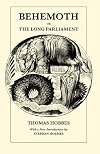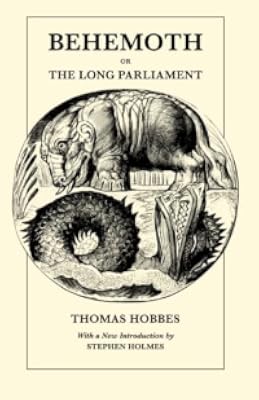
Behemoth ; or The Long Parliament
by Thomas Hobbes
On This Page
Description
'Behemoth' is a history of the English Civil Wars and Interregnum (1640-60) written by one of England's most famous philosophers, Thomas Hobbes. It covers the events which were the background to his major philosophical writings, especially 'Leviathan', and is the only work in which where he discusses them directly.Tags
Recommendations







Member Reviews
For supporters of Charles I and his son, the middle of the 17th Century was a hard time and in the aftermath of the Restoration was a time to show they were right. Behemoth is Thomas Hobbes’ history of the lead up to the English Civil War and the resulting Interregnum.
Covering roughly two decades of political, military, cultural, and religious upheaval within the frame of a dialogue, Thomas Hobbes uses the political framework written in Leviathan to analyze the breakdown of political order and how it was restored. The first and second section of the book concerns how Charles I strong political position was undermined by seven factions acting independently of one another and how the King’s attempts to combat one faction were used by show more other factions to represent tyranny against their own party eventually leading to a rupture and war between King and Parliament. The third section covered the civil war itself with neither side getting an advantage until the rise of Oliver Cromwell turned the tide for Parliament that eventually lead to the capture of the King and after political machinations from both sides, Charles is put on trial then executed. The last section highlights how Parliament had no idea how to replace the King and went from one solution to another all the while Cromwell continued to accumulate power until taking over the place of Charles in all but the title of King. However, after Cromwell’s death and weakness of his son’s leadership, General Monck uses his army to takeover the political situation and invite Charles II to take the throne.
While Hobbes uses the ideas in Leviathan to frame this history, it is essentially a Royalist view of the history of the 1640s and 1650s. Throughout the book the prime factor that Hobbes saw as being the instigator of Parliament’s position against the King wasn’t taxes, but religion more specifically Presbyterian minister preaching from the pulpit against the King so they could achieve leadership of the nation like John Calvin had done in Geneva. Though Hobbes did mention several other factors, his obsession on the religious aspect overawed everything else in this history which at times became too much.
Behemoth is ultimately a royalist history of events in the mid-17th Century. Thomas Hobbes shows the breakdown of political order when the sovereign’s position is challenged and usurped by those that have no right to it and the chaos that follows, but through his partisan lens. show less
Covering roughly two decades of political, military, cultural, and religious upheaval within the frame of a dialogue, Thomas Hobbes uses the political framework written in Leviathan to analyze the breakdown of political order and how it was restored. The first and second section of the book concerns how Charles I strong political position was undermined by seven factions acting independently of one another and how the King’s attempts to combat one faction were used by show more other factions to represent tyranny against their own party eventually leading to a rupture and war between King and Parliament. The third section covered the civil war itself with neither side getting an advantage until the rise of Oliver Cromwell turned the tide for Parliament that eventually lead to the capture of the King and after political machinations from both sides, Charles is put on trial then executed. The last section highlights how Parliament had no idea how to replace the King and went from one solution to another all the while Cromwell continued to accumulate power until taking over the place of Charles in all but the title of King. However, after Cromwell’s death and weakness of his son’s leadership, General Monck uses his army to takeover the political situation and invite Charles II to take the throne.
While Hobbes uses the ideas in Leviathan to frame this history, it is essentially a Royalist view of the history of the 1640s and 1650s. Throughout the book the prime factor that Hobbes saw as being the instigator of Parliament’s position against the King wasn’t taxes, but religion more specifically Presbyterian minister preaching from the pulpit against the King so they could achieve leadership of the nation like John Calvin had done in Geneva. Though Hobbes did mention several other factors, his obsession on the religious aspect overawed everything else in this history which at times became too much.
Behemoth is ultimately a royalist history of events in the mid-17th Century. Thomas Hobbes shows the breakdown of political order when the sovereign’s position is challenged and usurped by those that have no right to it and the chaos that follows, but through his partisan lens. show less
Ratings
Members
- Recently Added By
Lists

Early Modern (Shakesperean)
64 works; 2 members
Author Information

116+ Works 11,971 Members
Thomas Hobbes was born in Malmesbury, the son of a wayward country vicar. He was educated at Magdalen Hall, Oxford, and was supported during his long life by the wealthy Cavendish family, the Earls of Devonshire. Traveling widely, he met many of the leading intellectuals of the day, including Francis Bacon, Galileo Galilei, and Rene Descartes. As show more a philosopher and political theorist, Hobbes established---along with, but independently of, Descartes---early modern modes of thought in reaction to the scholasticism that characterized the seventeenth century. Because of his ideas, he was constantly in dispute with scientists and theologians, and many of his works were banned. His writings on psychology raised the possibility (later realized) that psychology could become a natural science, but his theory of politics is his most enduring achievement. In brief, his theory states that the problem of establishing order in society requires a sovereign to whom people owe loyalty and who in turn has duties toward his or her subjects. His prose masterpiece Leviathan (1651) is regarded as a major contribution to the theory of the state. (Bowker Author Biography) show less
Some Editions
Common Knowledge
- Canonical title
- Behemoth ; or The Long Parliament
Classifications
- Genres
- Nonfiction, History, Philosophy, General Nonfiction, Politics and Government
- DDC/MDS
- 941.06 — History & geography History of Europe British Isles Historical periods of British Isles 1603-1714, House of Stuart and Commonwealth periods
- LCC
- DA400 .H6 — History of Europe, Asia, Africa and Oceania Great Britain History of Great Britain England History By period Modern, 1485- Civil War and Commonwealth, 1642-1660
- BISAC
Statistics
- Members
- 144
- Popularity
- 227,850
- Reviews
- 1
- Rating
- (3.57)
- Languages
- 6 — English, French, German, Italian, Portuguese, Spanish
- Media
- Paper, Ebook
- ISBNs
- 20
- ASINs
- 2